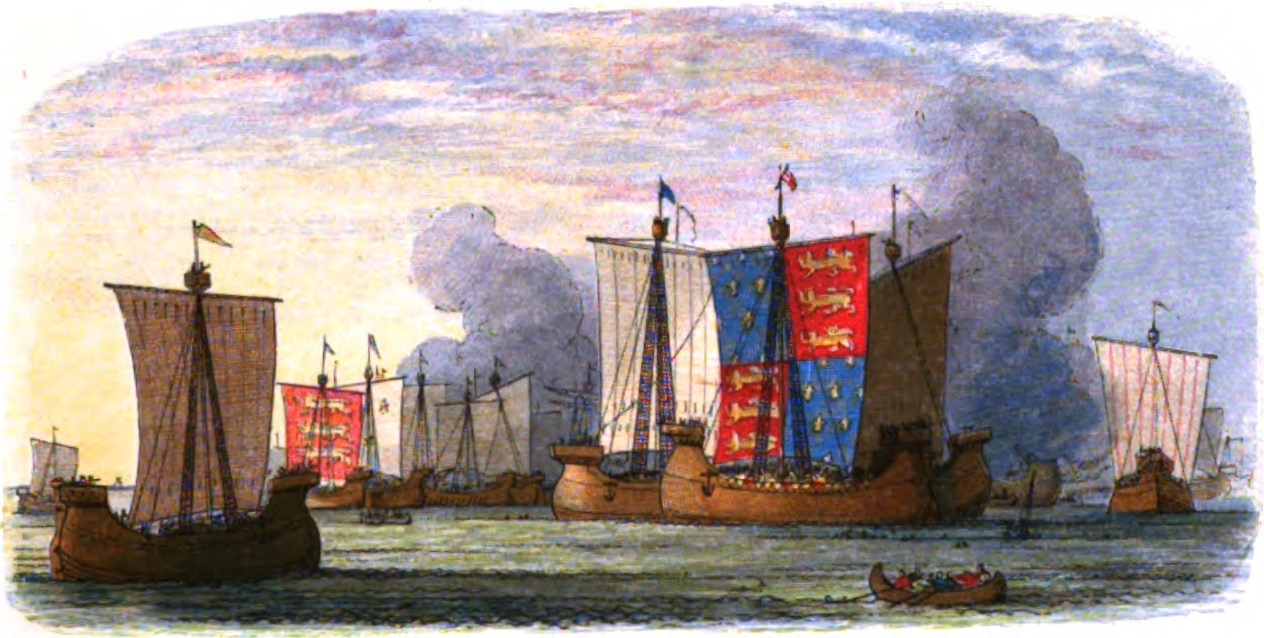
Battle of Sluys
On June 24, 1340, the water ran red. Nearly 20,000 French sailors and soldiers died in a single afternoon in the narrow waters of the Zwin estuary, their bodies washing ashore for days afterward. The English joked grimly that if the fish in Sluys harbour could speak, they would speak French. This was the Battle of Sluys, the opening naval catastrophe of the Hundred Years' War, fought in waters that no longer exist. The inlet has long since silted up, and modern Sluis sits kilometers from the sea, but in 1340 this was the gateway to Flanders and the stage for one of history's bloodiest naval engagements.
The Fatal Decision
The French commanders made a choice that sealed their fate. Admiral Hugues Quieret and Constable Nicolas Behuchet ordered their 230 ships chained together in three defensive lines across the estuary, creating floating fighting platforms. Pietro Barbavera, the Genoese corsair commanding the French galleys, protested furiously. He understood naval warfare; the French nobles did not. Barbavera urged them to put to sea, gain the weather advantage, and attack the English while they disembarked. But Behuchet, who outranked the commoner Barbavera, dismissed his advice. He wanted no chance of the English slipping past. The chains went on. The ships became a floating trap.
Arrows Like Winter Hail
King Edward III of England approached with patience, waiting until wind, tide, and sun favored his 120-150 ships. His fleet attacked in coordinated units of three: two ships of archers flanking one filled with men-at-arms. The English longbowmen could loose ten arrows per minute, two to three times faster than French crossbowmen, with significantly greater range. A London longbowman later described the volleys as 'like hail in winter.' The chained French ships could not maneuver, could not retreat, could not separate. The English picked them apart one by one, overwhelming isolated ships while the rest of the French fleet watched helplessly, bound in place by their own chains.
Vengeance on the Victors
The battle lasted from three in the afternoon until late into the night. Apart from Barbavera's galleys, which he had wisely refused to chain, only seventeen French ships escaped. The English captured 166 vessels. The rest sank or burned. Both French commanders were taken alive, but mercy was not forthcoming. Behuchet was hanged from the mast of his own ship; Quieret was beheaded. This was payback for French atrocities at the Battle of Arnemuiden two years earlier and their devastating raids on Portsmouth, Southampton, and Hastings. French survivors who managed to swim ashore were clubbed to death by Flemish civilians watching from the banks. Edward himself took a crossbow bolt to the thigh but survived.
Victory Without Consequence
The historian Jonathan Sumption called it 'a naval catastrophe on a scale unequalled until modern times.' Yet strategically, the battle changed little. Philip VI of France had greater resources than Edward and rapidly rebuilt his fleet. Within a month, a new French squadron captured thirty English merchantmen and threw their crews overboard. French raids continued on English coastal towns. The tactical brilliance at Sluys could not overcome the fundamental reality: England was the smaller, poorer kingdom. But for the English, one thing had been proven beyond doubt. Their longbowmen, the common men of England, could defeat French nobility. The lesson of Sluys would be repeated at Crecy and Agincourt.
Ghosts Beneath the Farmland
Today, the battleground has vanished. The Zwin estuary silted up over the centuries, transforming what was once a navigable inlet into flat Belgian farmland. Modern Sluis is a quiet Dutch town several kilometers from the sea, its streets lined with the cafes and shops of a peaceful border community. Nothing marks where 20,000 men drowned. The channel where chained ships burned and longbow arrows darkened the sky is now under soil, under grass, under the everyday life of farmers and tourists. Only the name remains, and the memory of that midsummer day when the water turned the color of wine.
From the Air
Located at 51.35N, 3.375E near modern-day Sluis, Netherlands. The battlefield no longer exists as water - the Zwin estuary silted up centuries ago, transforming the site into farmland. Best approached from the coast at 2,000-3,000 feet to appreciate how the landscape has changed. Nearby airports include Ostend-Bruges (EBOS) to the southwest and Rotterdam The Hague (EHRD) to the northeast. The Belgian-Dutch border runs through the area.