Battle of St. Charles
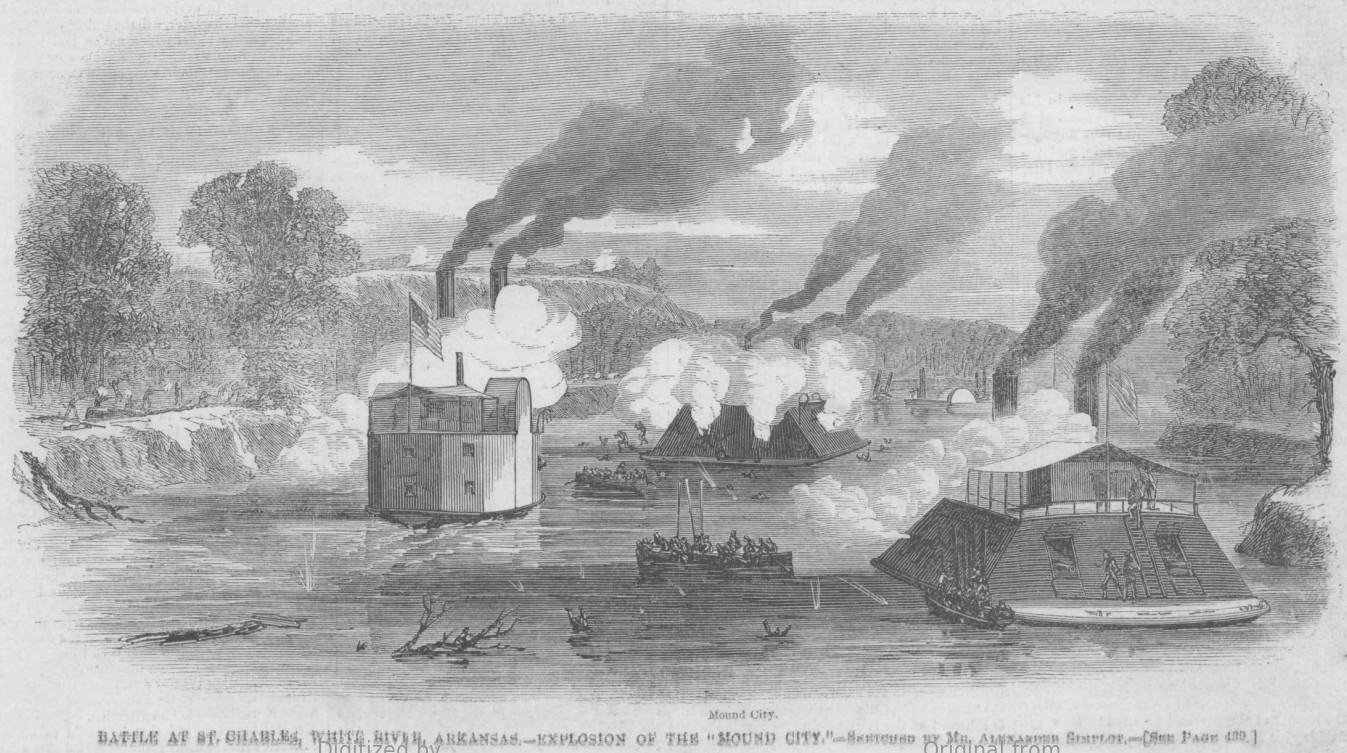
One shot changed everything. On June 17, 1862, a Confederate solid shot struck the ironclad USS Mound City as it bombarded batteries along the White River near St. Charles, Arkansas. The ball punctured one of the ship's steam drums, and scalding steam erupted through the vessel's interior. Within moments, roughly 150 of the 175 men aboard were killed or wounded -- many boiled alive in the confined spaces below deck, with only those near escape hatches managing to survive. Military historians would come to call it the deadliest single shot of the entire Civil War, a grim reminder that the era's new ironclad technology could shield sailors from cannonballs but not from the lethal pressures building inside their own engines.
A Supply Line Through the Swamps
The battle at St. Charles grew from a supply crisis deeper in Arkansas. Union Major General Samuel Curtis had pushed his army south from Missouri after winning the Battle of Pea Ridge in March 1862, reaching Batesville by early May with designs on the state capital at Little Rock. But his supply line stretched thin through difficult terrain, and after Confederate cavalry ambushed a foraging party near Searcy -- murdering wounded Union soldiers attempting to surrender -- Curtis concluded he could not advance without resupply. He sent word to St. Louis that he would have to retreat unless reinforcements arrived. The Union leadership responded by directing a naval flotilla up the White River from Memphis to deliver supplies to Curtis at Jacksonport. The mission was urgent: if the flotilla failed, Curtis's entire Arkansas campaign would collapse.
Guns on the Bluffs
Confederate Major General Thomas Hindman, newly appointed to command in Arkansas, anticipated exactly such a Union naval movement. He had taken over a state stripped of military resources by Earl Van Dorn, who had moved Confederate troops east of the Mississippi after the disaster at Pea Ridge. Working with what he had, Hindman declared martial law, authorized guerrilla warfare, and sent a surveying party to find chokepoints on the White River. Near St. Charles, they found an ideal position: high bluffs overlooking a bend in the river. Logs were driven into the riverbed as obstructions, three ships including CSS Maurepas were scuttled to block the channel, and heavy guns salvaged from CSS Pontchartrain were positioned on the commanding heights. Two three-inch Parrott rifles from Little Rock completed the battery. The trap was set.
Steam and Slaughter
Commander Augustus Kilty led the Union flotilla upstream on June 13, with ironclads Mound City and St. Louis, the timberclad Lexington, and supporting vessels. Colonel Graham Fitch's 46th Indiana Infantry Regiment, nearly 1,000 strong, provided ground forces aboard the transport New National. On the morning of June 17, Fitch sent his infantry ashore to assault the fortifications from landward while the warships attacked from the river. The ironclads pushed toward the batteries, their guns blazing. Then the fatal shot struck Mound City. Steam filled every compartment. Men who could not reach open air within seconds were scalded beyond saving. Crewmen who leaped into the river to escape the steam were fired upon by Confederate soldiers and sharpshooters on the banks. The carnage aboard was almost total. Yet on land, the 46th Indiana pressed their attack, overrunning the Confederate earthworks and capturing the position. The batteries fell, but the supply mission still failed -- low water levels on the White River prevented the flotilla from reaching Curtis.
A Monument for Both Sides
Curtis, unable to be resupplied, made a bold decision: he cut loose from his supply line entirely and marched his army cross-country to Helena on the Mississippi River, arriving in July 1862. The Battle of St. Charles, while tactically a Union victory on land, had failed in its primary objective. Its lasting legacy is the terrible fate of Mound City's crew, a catastrophe that exposed the vulnerability of steam-powered warships to a single well-placed shot. A portion of the battlefield is listed on the National Register of Historic Places. In 1919, a commemorative monument was placed at St. Charles -- unusual for a monument in the South because it honors soldiers from both sides of the conflict, a quiet acknowledgment that the men who fought and died along those muddy bluffs shared more in common than the causes that divided them.
From the Air
Located at 34.378°N, 91.126°W along the White River in Arkansas County, Arkansas. The terrain is flat Mississippi Delta lowland with the White River winding through dense bottomland forest. Nearest airport is Stuttgart Municipal (KDWU) about 25 nm southwest. The battlefield and monument are near the small community of St. Charles on the river bluffs. Best viewed at 2,000-4,000 feet AGL to appreciate the river bends and bluff positions that shaped the battle. The White River's course through the alluvial plain is clearly visible from altitude.