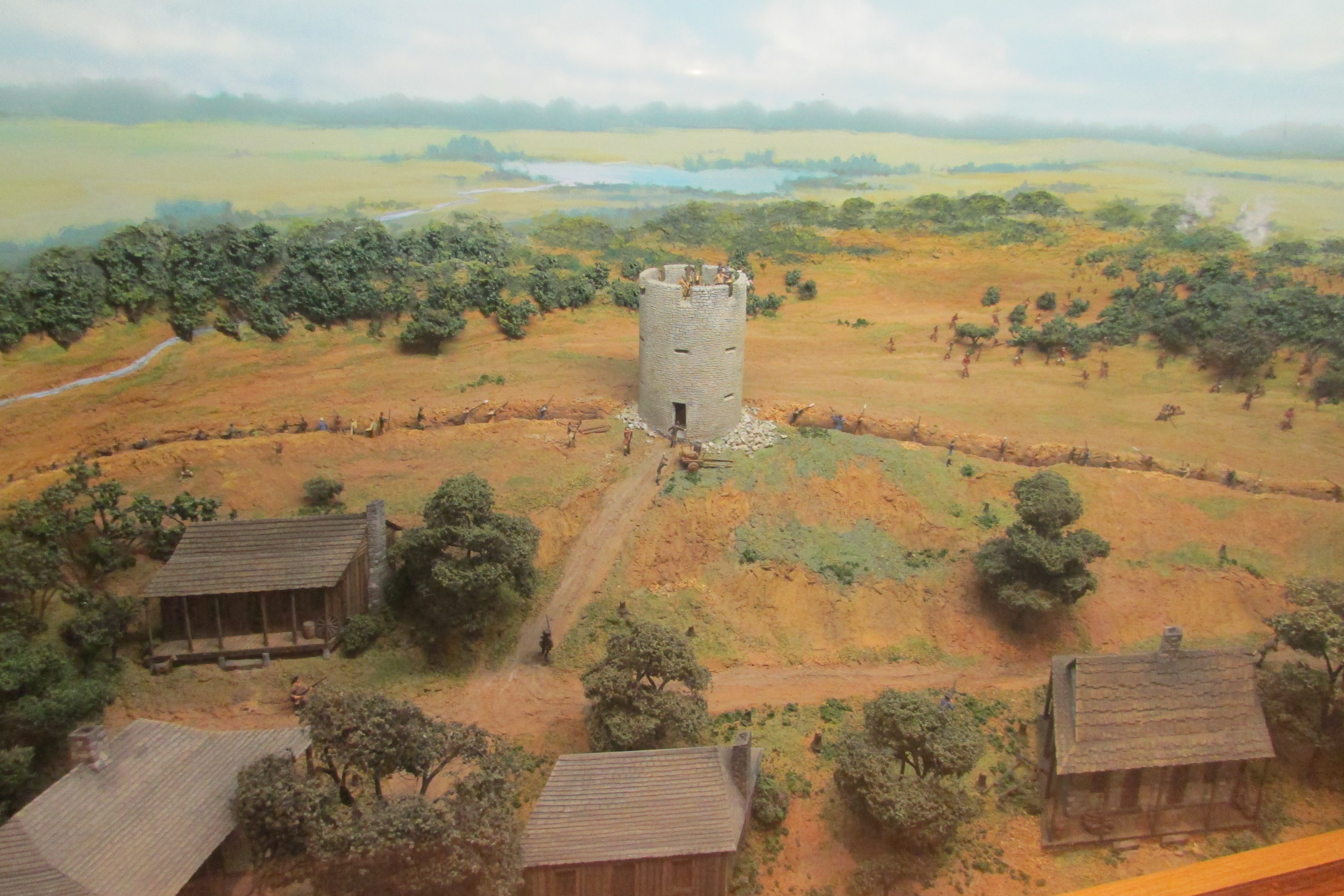
Battle of St. Louis
The American Revolution came to the Mississippi River on a spring afternoon in 1780. The village of St. Louis -- a Franco-Spanish trading post of 700 souls on the west bank, governed by a Spanish captain named Fernando de Leyba -- was not an obvious military target. But British strategists in London had their eyes on the river corridor, and on May 26, a force of roughly two dozen Loyalist fur traders and an estimated 750 to 1,000 Indigenous warriors from the Sioux, Ojibwe, Menominee, Ho-Chunk, and other nations descended on the little settlement. What they found was not the easy prize they expected. Leyba had built a tower, dug trenches, and mounted cannons. The Battle of St. Louis, also known as the Battle of Fort San Carlos, would effectively end British ambitions to control the upper Mississippi during the Revolutionary War.
A Desperate Fortification
Leyba had been warned. In late March 1780, a fur trader brought word that the British were recruiting Indigenous nations for an expedition against St. Louis and the nearby American post at Cahokia, Illinois. The lieutenant governor of Upper Louisiana had an inexperienced militia of 168 men and virtually no funds. His grand plan called for four stone towers, but without money from New Orleans and with time running short, he asked the villagers to contribute funds and labor. He paid for some of the construction from his own pocket. By mid-May, a single round tower had been completed -- Fort San Carlos -- roughly 30 to 40 feet tall, commanding a view of the surrounding countryside. Trenches connected the tower to the riverbank north and south of the village. Three four-pound and two six-pound cannons from the older Fort Don Carlos, 15 miles to the north, were mounted in the tower, with additional guns at each end of the trench line.
The Defender from Sainte Genevieve
With only 197 defenders against a force potentially five times their number, the odds looked grim. Leyba appealed to Francois Valle, a 64-year-old former captain of the French militia living 60 miles south at Sainte Genevieve. Valle responded by sending his two sons and 60 well-trained, well-equipped French militiamen north. He also supplied the defenders with a critical tactical advantage: genuine lead from his mines for musket balls and cannonballs, replacing the pebbles and stones that might otherwise have been their only ammunition. Valle's contribution tipped the scale. For his service, King Carlos III of Spain conferred upon him the rank of lieutenant in the regular Spanish army by royal decree on April 1, 1782. Valle became known as the 'Defender of St. Louis' -- a Frenchman honored by a Spanish king for helping protect a village that would eventually become one of America's great cities.
Cannons and Treachery
The British-allied force gathered at Prairie du Chien under the command of Emanuel Hesse, a former militia captain turned fur trader. Two hundred Sioux warriors led by Wapasha I formed the largest contingent, with additional companies of Ojibwe, Menominee, and Ho-Chunk. The diversity of the expedition bred tension: the Ojibwe and Sioux had a history of conflict with each other, though Wapasha and the Ojibwe leader Matchekewis promoted unity during the march south. On May 23, Leyba's scouts reported that the force had landed canoes nearby and was approaching overland. Hesse split his command, sending Jean-Marie Ducharme with 300 warriors across the river to attack Cahokia, while the main body arrived near St. Louis around 1:00 p.m. on May 26. A warning shot rang from the tower. The Sioux and Ho-Chunk led the advance, but when Leyba opened fire with his cannons and muskets, most of the Sauk and Meskwaki fell back, apparently unwilling to fight. The remaining attackers accused them of treachery.
The Aftermath on the River
Wapasha and the Sioux pressed the attack for several hours, attempting to draw the defenders out of their fortifications. They went so far as to kill captives they had taken in the surrounding fields in full view of the townspeople, but Leyba held firm, refusing to authorize a sortie that might expose his men. The attackers eventually withdrew northward, destroying crops, livestock, and buildings as they retreated. The simultaneous attack on Cahokia was also repulsed. Between 50 and 100 of the village's inhabitants were killed, wounded, or captured, virtually all of them civilians caught outside the defended perimeter. Leyba died the following month, never having received local recognition for his defense. In an irony of imperial communication, King Charles III, unaware of his death, promoted him to lieutenant colonel for his valor. Today, the corner of Fourth and Walnut Street in downtown St. Louis marks where Fort San Carlos once stood. A commemoration committee annually reads the names of the 21 people confirmed killed in the battle, a small ritual of remembrance for one of the Revolution's most forgotten engagements.
From the Air
Located at 38.62°N, 90.19°W in downtown St. Louis, at the approximate corner of Fourth and Walnut Streets. The site of Fort San Carlos is now part of the urban grid near the Gateway Arch and the Mississippi River waterfront. The battle took place along the west bank of the Mississippi, with the simultaneous attack on Cahokia occurring on the east bank in present-day Illinois. Lambert-St. Louis International Airport (KSTL) is approximately 12 nm northwest. St. Louis Downtown Airport (KCPS) is about 3 nm east across the river. The terrain is flat riverfront at approximately 450 feet MSL. The Gateway Arch serves as the primary visual landmark for locating the battle site from the air, which lies immediately to the west.