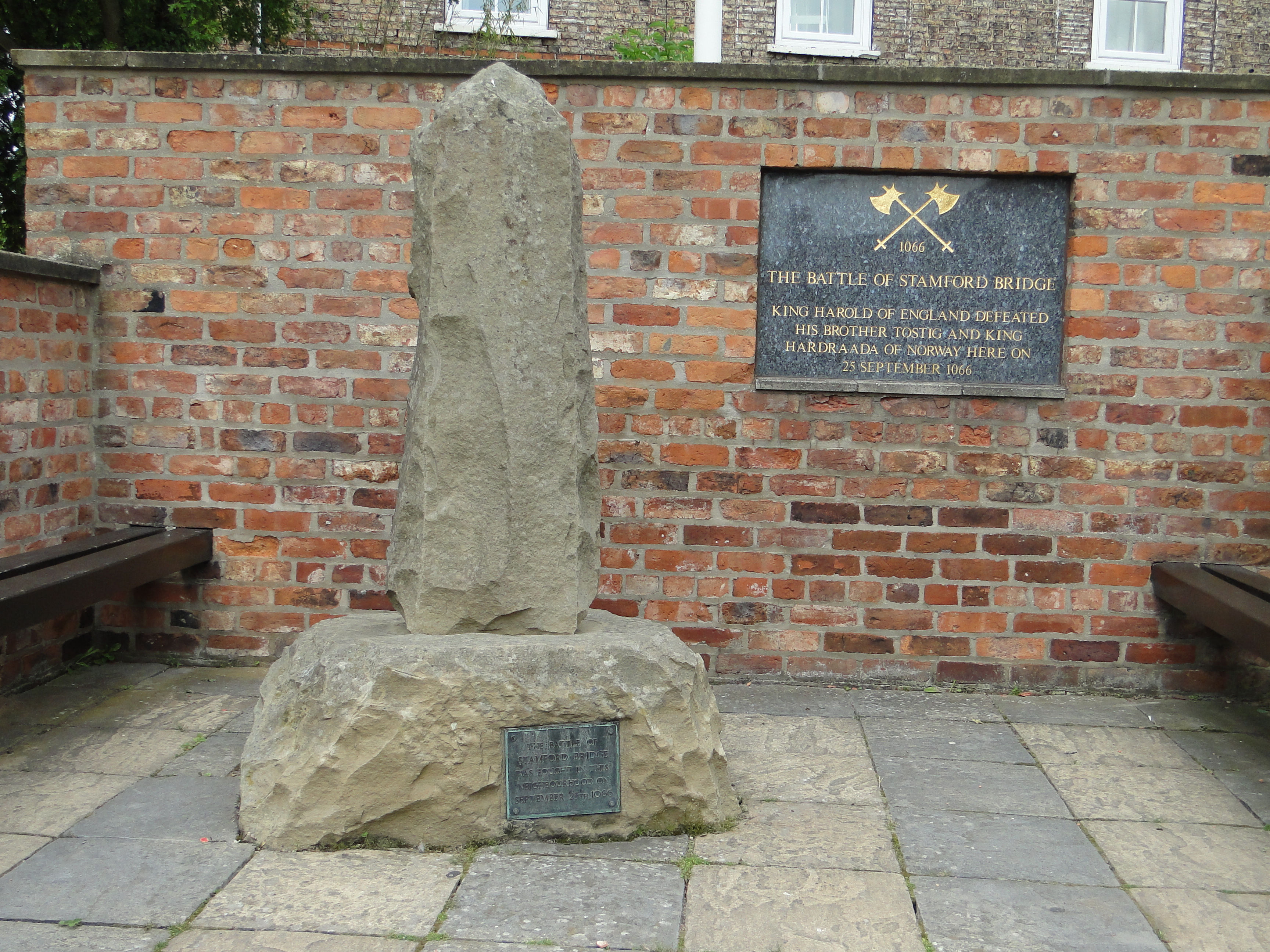
Battle of Stamford Bridge
When Tostig asked what King Harold of England would offer King Harald Hardrada in return for peace, the unnamed rider on horseback answered without hesitation: seven feet of English ground, or as much more as he needs, as he is taller than most men. The rider was Harold Godwinson himself. Within hours, on 25 September 1066, he would make good on the offer.
Three Kings and One Throne
Edward the Confessor died childless in January 1066, and the English throne became the most dangerous prize in Europe. Harold Godwinson, the most powerful English earl, was elected king by the Witenagemot. But two other men believed the crown was theirs. William, Duke of Normandy, claimed Edward had promised it to him. Harald Hardrada, King of Norway and the most feared warrior in Scandinavia, asserted an older Norwegian claim. Hardrada sailed with a fleet of over two hundred warships, picking up reinforcements in Orkney until his army numbered between seven and nine thousand men. He was joined by Harold's own brother, Tostig Godwinson, who had been exiled from his earldom of Northumbria the previous year and burned for revenge. In September, they sailed up the Ouse and advanced on York. On 20 September, they crushed a northern English army at the Battle of Fulford. York surrendered. The Norwegians, confident, arranged to collect hostages and supplies at a crossing point on the River Derwent: Stamford Bridge.
One Hundred and Eighty-Five Miles in Four Days
Harold Godwinson was in southern England, watching the Channel for William's invasion fleet, when news arrived of the Norwegian landing. What he did next remains one of the most remarkable forced marches in military history. He gathered his housecarls and every thegn he could find and drove north at extraordinary speed, covering roughly 185 miles from London to Yorkshire in four days. He passed through York without stopping. The Norwegians at Stamford Bridge had no idea an army was anywhere near them. Many had left their armor behind at the ships, moored at Riccall some sixteen miles to the south. They were waiting for hostages, not war.
The Axeman on the Bridge
The English army appeared suddenly, and the Norwegians scrambled to form a defense. According to the Anglo-Saxon Chronicle, a single Norwegian warrior armed with a great axe positioned himself on the narrow wooden bridge and held up the entire English army. He cut down more than forty men before an English soldier floated beneath the bridge in a barrel or small boat and thrust a spear upward through the planks and under the axeman's mail shirt. It was an ignoble end to a legendary stand. The delay, however, gave the main Norwegian force time to form a shield wall on the far bank. Harold's army poured across the bridge and the battle became a grinding slaughter. The Norwegians fought without much of their armor, and the disadvantage was fatal. Hardrada fell with an arrow through his windpipe. Tostig was cut down shortly after. The Norwegian army disintegrated. In the battle's final act, reinforcements led by Eystein Orre arrived from the ships at Riccall, having run sixteen miles in full armor. Some collapsed dead from exhaustion on reaching the field. Their counter-attack, remembered as Orre's Storm, briefly checked the English advance before it too was overwhelmed. So many Norwegians died in so small an area that the field was said to have been whitened with bleached bones fifty years later.
Twenty-Four Ships
Harold accepted a truce with the survivors, including Hardrada's son Olaf. He allowed them to leave after pledging never to attack England again. The losses were staggering: of the fleet of more than three hundred ships that had carried the invasion force, only twenty-four were needed to carry the survivors home. The Viking Age, which had shaped the British Isles for nearly three centuries, effectively ended on that September afternoon in Yorkshire. But Harold's triumph lasted exactly three days. On 28 September, William of Normandy landed at Pevensey on the south coast. Harold force-marched his exhausted army 250 miles south. On 14 October, at Hastings, he was killed and his army destroyed. The king who had offered Hardrada seven feet of English ground received no better. Today, two monuments stand in the village of Stamford Bridge, one inscribed in both English and Norwegian. The wooden bridge is long gone. The River Derwent flows quietly through a landscape that gives no hint of what happened here, on the day that ended one era and, within three weeks, began another.
From the Air
Located at 53.99N, 0.91W at the village of Stamford Bridge in the East Riding of Yorkshire, on the River Derwent approximately 7 miles east of York. The village is visible along the A166 road. The flat terrain of the Vale of York provides good visibility. The exact battlefield location is uncertain but the village and river crossing are identifiable. Nearest airports: EGNM (Leeds Bradford) approximately 25 miles west; EGCN (Doncaster Sheffield) approximately 35 miles south.