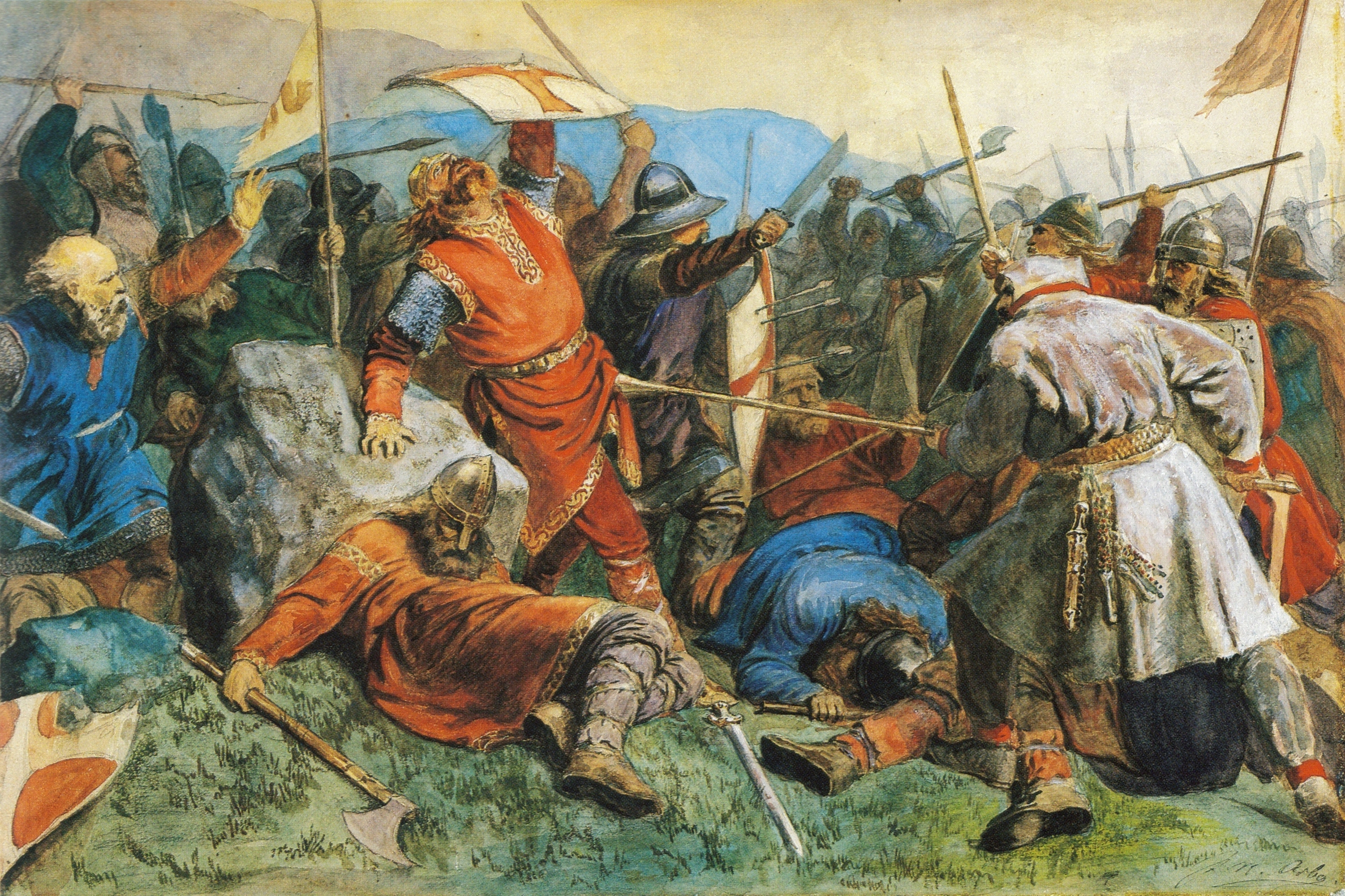
Battle of Stiklestad
On July 29, 1030, a deposed king led a ragged army down through the Verdalen valley toward a field that would become the most sacred ground in Norwegian history. Olaf Haraldsson had returned from exile in Kievan Rus to reclaim his throne, gathering along the way whatever fighters he could find -- loyal retainers, Swedish mercenaries, even local outlaws. Waiting for him at Stiklestad were the farmers and lesser nobles of Trondelag, men who had chafed under his forced conversions and aligned themselves with the Danish king Cnut the Great. What followed was not a grand clash of mighty armies but a brief, brutal encounter whose consequences would reshape Scandinavia for centuries.
A King Without a Kingdom
Olaf Haraldsson had seized the Norwegian throne in 1015, fresh from years of raiding across Europe. He won the decisive Battle of Nesjar in 1016 against the jarls of Lade, and for a dozen years he ruled -- consolidating power, building churches, and converting his subjects to Christianity with a zeal that bordered on cruelty. He blinded, maimed, and killed those who refused baptism. The Trondelag chieftains, accustomed to their independence and their old gods, simmered with resentment. When Cnut the Great offered an alternative in 1028, they accepted readily enough. Olaf fled east to the court of Yaroslav the Wise in Kievan Rus, where his young half-brother Harald -- later known as Harald Hardrada -- accompanied him into exile. The throne Olaf had built through force now belonged to Cnut's regents.
Down Through the Valley
Why Olaf chose to march through hostile Trondelag rather than rally allies in eastern Norway remains one of the great puzzles of the saga age. Perhaps he was gambling on a quick strike at Nidaros, the spiritual and political heart of the region. His army, by any honest reckoning, was small -- the grand numbers in Snorri Sturluson's Heimskringla likely reflect literary ambition more than military reality. Recruitment through the sparsely populated Swedish borderlands and mountain valleys would have yielded hundreds, not thousands. The opposition, too, assembled hastily. When word reached the local chieftains that Olaf was descending the valley, they scrambled to gather their forces, meeting him surprisingly far upstream. Both sides arrived at Stiklestad tired and undermanned, though the farmers held the numerical advantage.
The Battle and the Stone
According to saga tradition, Olaf received three fatal wounds: an axe blow to the knee, a spear thrust into his belly, and a final axe strike to the neck. He died leaning against a large rock -- the Olavssteinen -- which, tradition holds, still rests inside the altar of Stiklestad Church, built on the spot where he fell. His fifteen-year-old half-brother Harald was wounded but survived, beginning a journey that would take him to Constantinople's Varangian Guard and eventually back to Norway as its king. A solar eclipse visible across Scandinavia on August 31, 1030, fed the growing legend that something miraculous had happened at Stiklestad. Whether the eclipse could have been observed during the battle itself is debated, but its timing was enough to seed the myth.
The Saint Who Won in Death
Olaf lost the battle. He lost his life. But within a year, miracles were being reported at his grave. His body, exhumed and found reportedly uncorrupted, was enshrined at what would become Nidaros Cathedral in Trondheim. The Roman Catholic Church formally canonized him in 1164 during the pontificate of Pope Alexander III. In a twist that his enemies could not have anticipated, the king whose heavy-handed Christianity had driven them to rebellion became, in death, the very symbol of Christian Norway. His cult spread across Scandinavia and into England, and his sainthood provided the spiritual foundation for a unified Norwegian kingdom. The farmers who killed him at Stiklestad had, paradoxically, created the nation's most powerful unifying figure.
Stiklestad Lives On
Every July, thousands gather at Stiklestad for the Saint Olav Drama -- the largest outdoor theater in Scandinavia -- to watch the story of the battle performed on the very field where it happened. The play, written by Olav Gullvag, has been staged annually since 1954. Nearby stands Olavsstotta, a monument erected in 1807 that ranks among Norway's oldest preserved public memorials. The Stiklestad National Cultural Center, established by parliamentary resolution in 1995, anchors a broader cultural landscape that includes the medieval church, the battlefield, and the farm where centuries of memory have been kept alive. The poet Per Sivle captured Stiklestad's enduring meaning in 1901 with a single line about Olaf's standard-bearer Tord Foleson: 'The symbol stands, even when the man falls.' That inscription appears not only at the memorial in Stalheim but also, movingly, at the Bergen-Belsen concentration camp memorial -- proof that Stiklestad's resonance reaches far beyond Viking history.
From the Air
Located at 63.80N, 11.57E in the Verdalen valley of Trondelag, central Norway. The battlefield and cultural center sit in open farmland visible from moderate altitude. Nearest major airport is Trondheim Airport, Varnes (ENVA), approximately 80 km to the southwest. The valley runs roughly northeast-southwest, with the Trondheimsfjord visible to the west. Best viewed at 2,000-4,000 feet AGL for landscape context. The church and cultural center complex are identifiable as a cluster of buildings amid green fields.