Battle of Sualkuchi (1636)
For twenty-one years, the Ahom kingdom and the Mughal Empire had avoided direct confrontation in the Brahmaputra Valley. The peace was not born of goodwill. Ahom rulers quietly funded rebellions in Mughal-controlled Kamarupa, sheltering dissidents, bankrolling chieftains, and arming hill tribes, all while maintaining a veneer of neutrality. When that veneer finally cracked in 1636, it cracked violently. King Pratap Singha assembled ten thousand soldiers, sixty warships, and a fleet of five hundred smaller vessels and sent them downriver to break Mughal control over the Brahmaputra's strategic crossings. The Battle of Sualkuchi was the centerpiece of a campaign that would reclaim an entire region.
A Cold War on the River
The roots of the 1636 conflict ran deep. After the Mughals seized Koch Hajo and its territory of Kamarupa in 1613, they established a string of garrisons and administrative posts along both banks of the Brahmaputra. The Ahoms, whose kingdom lay upriver to the east, watched this encroachment with alarm. Rather than risk open war, Pratap Singha waged a shadow campaign. He gave asylum to Mughal defectors, including Harikesh, a former revenue officer whose handover the Mughals demanded and the Ahoms refused. He backed frontier leaders from Dimarua, Hojai, and Barduar in raids on Mughal outposts. When Mughal forces killed Ahom subjects in what the Ahoms considered their territory, the pretense of peace collapsed. Pratap Singha launched his forces westward, attacking the fortified town of Hajo and seizing 360 cannons and firearms in the opening engagements.
The Night Assault at Srighat
The Mughals responded with reinforcements from Dhaka: one thousand cavalry, one thousand musketeers, and 210 war sloops under the command of Abdus Salam, the governor of Hajo. These fresh troops pushed the Ahom forces back at Pandu and Srighat, forcing a temporary withdrawal. But the setback was brief. The Ahoms regrouped and launched a nighttime assault on the Mughal fleet at Srighat with five hundred vessels. The attack caught the Mughal navy entirely off guard. In the chaos of a river battle fought in darkness, the Mughals lost their officer Muhammad Salih, and the capture of Majlis Bayazid further gutted their command structure. The Ahoms seized seven ghrabs, thirty bachharis, and enough war supplies to fuel the next phase of their campaign. What remained of the Mughal river force retreated upriver to Sualkuchi, their last major stronghold on the Brahmaputra.
Ten Thousand at the Walls
Pratap Singha recognized the moment. With the Mughal fleet crippled and their leadership in disarray, he concentrated his forces for a decisive blow. Ten thousand Ahom soldiers, trained in archery and matchlock firearms, advanced on Sualkuchi supported by sixty large warships. The Mughals, still reeling from Srighat, mounted a defense but could not hold. The battle was a rout. The Ahoms captured three hundred ships, 160 swords, two hundred hand grenades, various firearms, and a substantial haul of gold and silver. The Mughal garrison at Sualkuchi was effectively destroyed as a fighting force. In a single engagement, the Ahoms had broken Mughal naval dominance on the upper Brahmaputra and opened the path westward to Hajo, the administrative heart of Mughal Kamarupa.
The Brahmaputra Reclaimed
The fall of Sualkuchi triggered a cascade of Mughal retreats. Ahom forces, now led by the Barphukan and reinforced by Koch King Bali Narayan, besieged Hajo itself. Abdus Salam, governor of Bengal, was compelled to surrender. The spoils from Hajo alone included two hundred firearms, nearly five thousand swords, seven hundred horses, and arrays of pearls and ornaments. Bali Narayan, with three hundred Koch and Assamese troops, then captured Barnagar, a Mughal-aligned vassal state, and swept through Mughal outposts in northwestern Kamarupa. Between March and December 1636, the Ahom-Koch alliance overran every significant Mughal position along both banks of the Brahmaputra, including Hajo, Pandu, and Srighat. The coordination between the Ahom kingdom and their Koch allies proved decisive. By year's end, the Mughals had been pushed back from the Brahmaputra Valley, and Ahom sovereignty over Kamarupa was restored.
From the Air
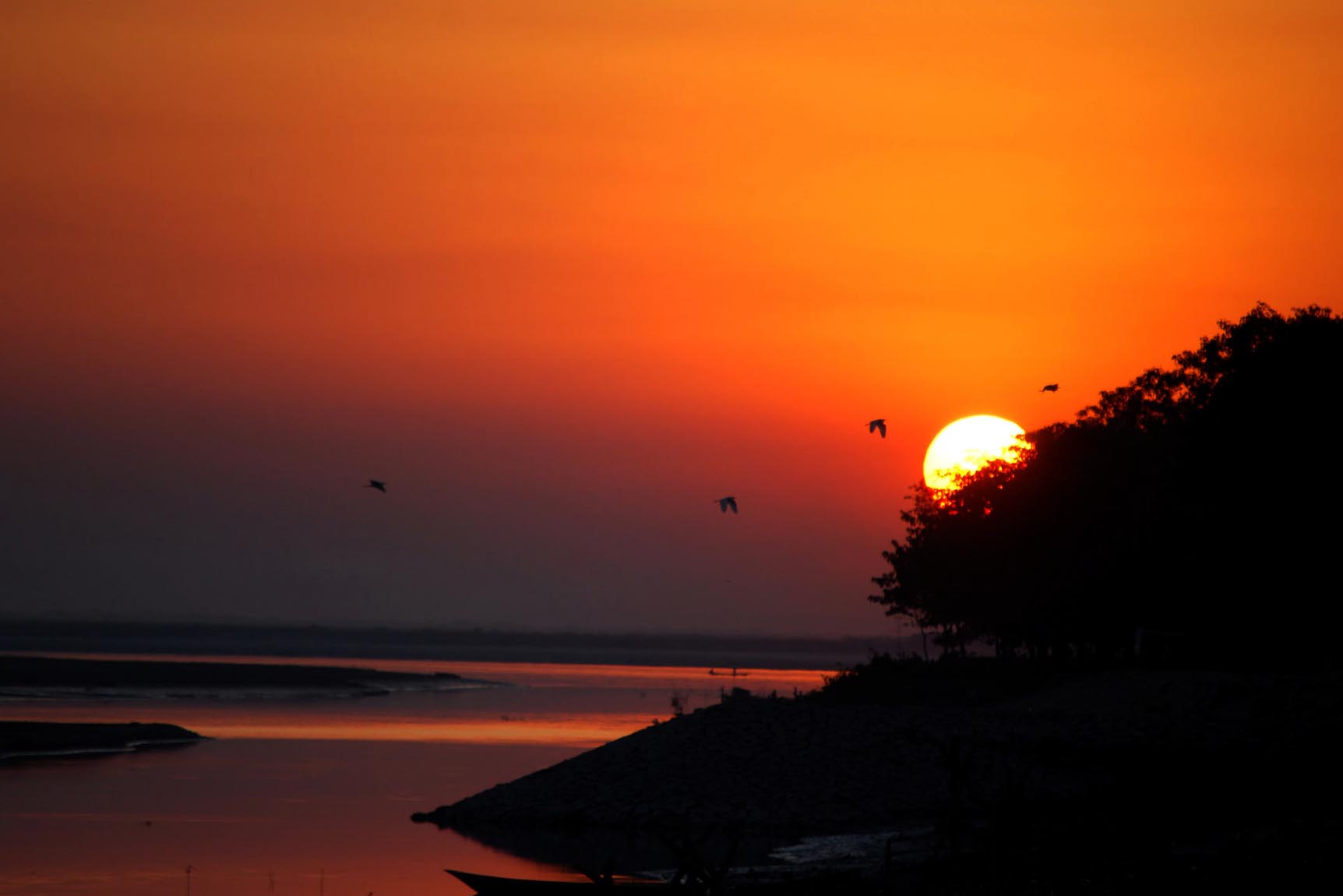
Located at 26.17N, 91.57E on the north bank of the Brahmaputra River in present-day Assam, India. Sualkuchi sits approximately 30 km west of Guwahati. The Brahmaputra is the dominant landscape feature, a massive braided river visible from any altitude. Nearest major airport is Lokpriya Gopinath Bordoloi International Airport (VEGT) in Guwahati. Best viewed at 10,000-15,000 feet to appreciate the river's strategic geography and the positions of the key battle sites along its banks.