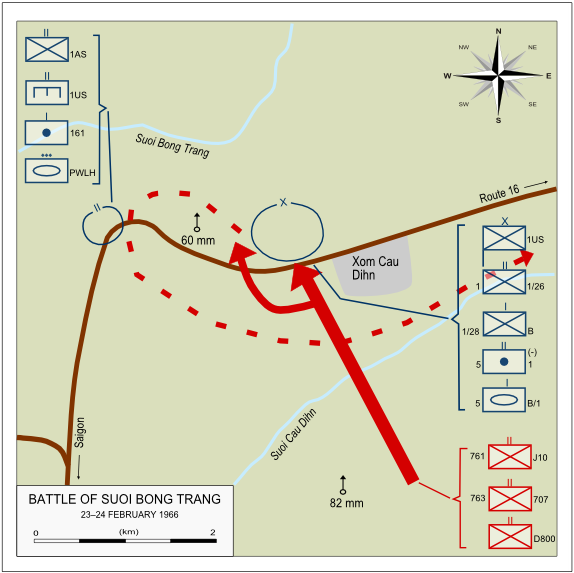
Battle of Suoi Bong Trang
The lights appeared just after ten o'clock. Soldiers from B Company, 1st Battalion Royal Australian Regiment, peering into the darkness from the western edge of their perimeter near the Suoi Bong Trang creek, watched small flickering points moving through the tree line 250 meters away. It was the night of 23 February 1966, and outside the wire, an entire Viet Cong regiment was preparing to attack. The Australians and Americans inside the perimeter had spent the day guarding engineers building a road designed to cut communist supply routes through central Binh Duong Province, 30 kilometers northwest of Bien Hoa airbase. The road was an act of defiance -- slicing through territory the Viet Cong considered their own. The response was coming.
A Road Through Enemy Country
In February 1966, the US 1st Engineer Battalion was carving an all-weather road between Route 13 and Route 15 through the northern edge of the Iron Triangle, one of the most dangerous Viet Cong strongholds near Saigon. The road was strategic: it would sever communist supply lines running between War Zone C, the Mekong Delta, and War Zone D, while linking two forward brigades of the US 1st Infantry Division between Phuoc Vinh and Lai Khe. The Viet Cong understood its significance immediately and began harassing the sappers with daily sniping, mines, and sabotage. The US 1st Brigade launched Operation Rolling Stone on 11 February to protect the engineers, rotating battalions between guard duty and probing enemy positions. The Australians of 1 RAR were brought in at the specific request of Major General William DePuy, who wanted their reputation for dispersed, aggressive patrolling.
Waiting for the Storm
By late afternoon on 23 February, 1 RAR had settled into an all-round defensive position near the creek, with the American engineers sheltering inside the Australian perimeter. Alerted by the Australians' aggressive patrols -- which had been finding signs of large enemy concentrations throughout the week -- a platoon of M48 Patton tanks and a second 105mm howitzer battery had been moved in to bolster the US 1st Brigade headquarters nearby. Additional ammunition was stockpiled in anticipation. When the lights appeared after dark, B Company's commander requested artillery fire on the position but was turned down. A small Australian standing patrol under Private Walter Brunalli held its ground forward of the main line, watching the lights creep closer. By midnight, American listening posts were reporting sounds of movement on all sides. Two Viet Cong were killed approaching the wire. Colonel Edgar Glotzbach, commanding the US 1st Brigade, sensed the main blow had not yet fallen. He held his firepower in reserve and waited.
The Assault Breaks
At 01:45 the jungle exploded. Viet Cong mortar and small arms fire raked the perimeter, and over the next hour the intensity built steadily until, at 03:00, the communists shifted their fire to the northwest side of the American position and added recoilless rifles to the barrage. Glotzbach expected a full-scale ground assault, but the weight of American firepower -- eight field batteries including 8-inch and 175mm howitzers firing from Phuoc Vinh, the defenders' own artillery firing over open sights with tubes lowered to engage directly -- shattered the Viet Cong formations before they could close. Brunalli's standing patrol, trapped between the Viet Cong and the American positions, was caught in a terrifying crossfire; Brunalli was wounded in the arm but held his position. When aircraft arrived overhead to illuminate the battlefield, the Australians joined the fight, firing into masses of disoriented Viet Cong who had lost their pathfinder guides to earlier Australian ambushes and were now milling in the open under devastating fire.
Silence at Dawn
By morning, the battlefield told the story. The Viet Cong had thrown what intelligence later estimated to be at least a regiment at the combined position and been broken against its defenses. American and Australian patrols sweeping outward found the enemy had withdrawn, leaving behind weapons and equipment scattered through cratered jungle. The Australians had suffered light casualties thanks to their prepared positions. For the next two days, 1 RAR continued to guard the road work before flying out on 26 February. The Viet Cong, stung by the defeat, resorted to harassing mortar and sniper fire but could not stop the road. It was completed by 2 March. The Americans launched a civic action program in the area -- repairing damaged houses, distributing food, providing health care -- though their commanders were realistic about how long the gains would last without permanent South Vietnamese Army protection.
Prelude to a Larger Commitment
Suoi Bong Trang was an early test of Australia's growing military role in Vietnam. In March 1966, just weeks after the battle, the Australian government announced the deployment of a two-battalion brigade -- the 1st Australian Task Force -- with armor, aviation, engineer, and artillery support totaling 4,500 troops. It was a significant escalation from the single battalion that had fought at the creek. The battle demonstrated what DePuy had sensed when he requested the Australians: their skill at dispersed patrolling and night defense made them a formidable complement to American firepower. But it also foreshadowed the dilemmas ahead. The road was built, the battle was won, yet within days of the engineers' departure the Viet Cong would begin filtering back. The pattern -- fight, build, leave, repeat -- would define much of the war to come. The soldiers who held their ground that February night beside the Suoi Bong Trang could not have known they were rehearsing for years of the same.
From the Air
Located at 11.18°N, 106.68°E in Bình Dương Province, approximately 30 km northwest of Bien Hoa Air Base (VVBH). The battlefield sits in flat terrain near the northern apex of the former Iron Triangle, between Route 13 and the Saigon River. Tan Son Nhat International Airport (VVTS) is approximately 40 km to the south. Best viewed from 2,000-4,000 feet AGL. The area is now largely developed with industrial parks and residential areas north of Ho Chi Minh City.