Battle of Suoi Chau Pha
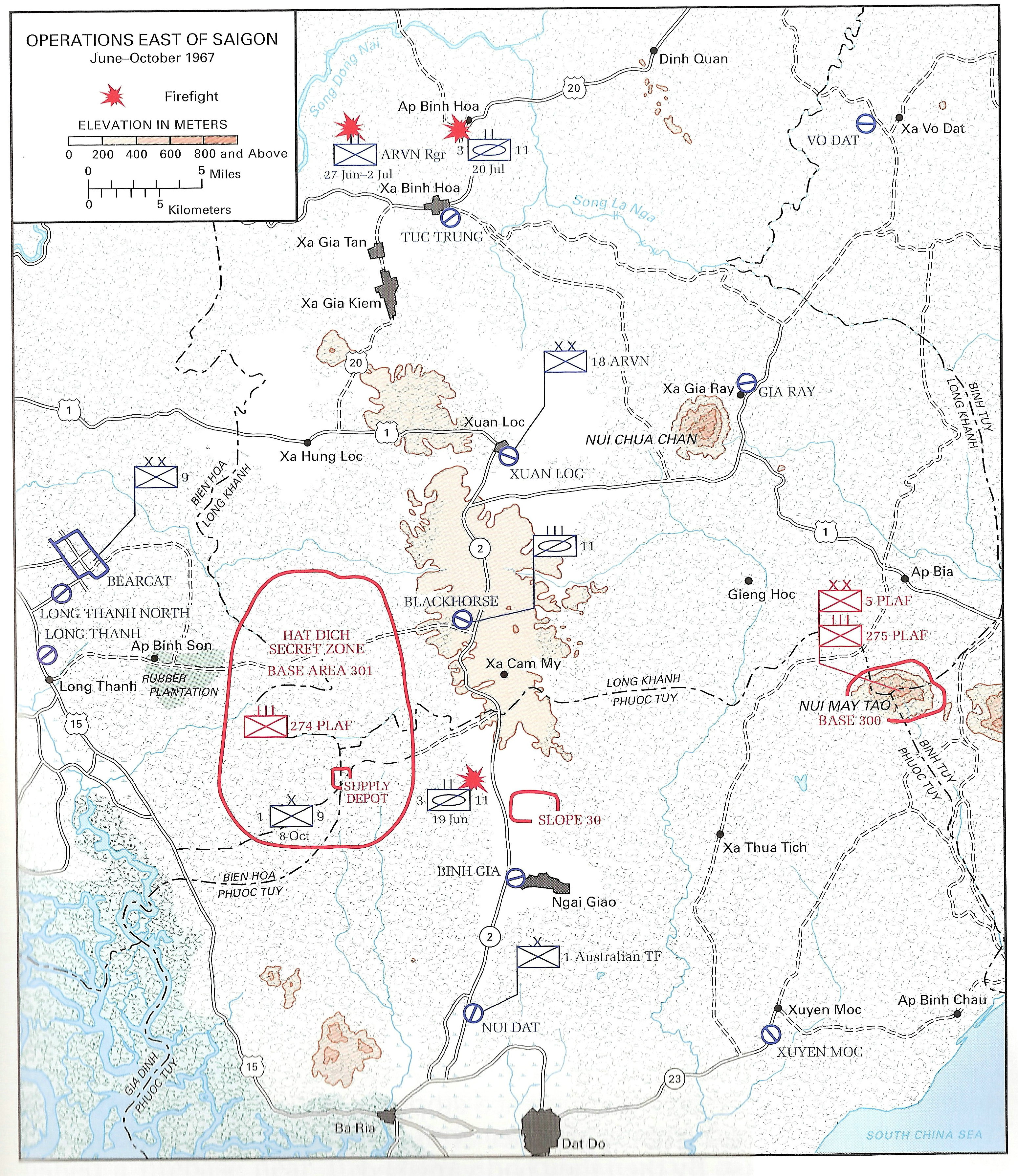
The monsoon rain was falling so hard that the soldiers could barely hear each other shout. On 6 August 1967, in the dense jungle of the Hat Dich area northwest of Nui Dat, A Company of the 7th Battalion, Royal Australian Regiment, walked straight into a reinforced company from the Viet Cong 274th Regiment. Neither side knew the other was there until the shooting started. What followed was a textbook encounter battle, two forces of roughly equal size colliding in terrain that reduced the fight to something almost medieval in its intimacy. The jungle was so thick and the rain so heavy that the engagement was decided at ranges measured in meters, not hundreds of meters. It lasted several hours.
A Province That Seemed Pacified
By mid-1967, the Australians in Phuoc Tuy Province had convinced themselves they were winning. The Battle of Long Tan and Operation Bribie had bloodied the Viet Cong, and Brigadier Stuart Graham, commanding the 1st Australian Task Force, speculated that the enemy may have fled the province entirely. A barrier minefield at Dat Do and steady patrolling had, in Graham's assessment, eliminated any sizable threat to the populated areas. The Australians pursued their own counter-insurgency approach, emphasizing deliberate patrols and population security over the large-scale search-and-destroy operations favored by the Americans. This philosophical divide had produced friction with General William Westmoreland, who complained to the Australian commander about what he saw as limited results. The Australians politely ignored him. But the VC had not fled. They were consolidating, absorbing replacements, and avoiding contact to preserve their strength for future offensives. The 274th Regiment, now believed to be under the command of Ut Thoi, remained in the Hat Dich, and the Australians did not know it.
The Covert Insertion
Operation Ballarat sent Australian companies into the eastern Hat Dich to hunt the Viet Cong's remaining infrastructure. A Company, 7 RAR, inserted covertly on 5 August, catching several VC sentries off guard as they moved into position. The element of surprise suggested the area was lightly defended, and the Australians pushed forward the next day, patrolling through jungle so dense that sections could lose sight of each other within a few paces. They had no idea that the 3rd Battalion of the 274th Regiment had established positions nearby, a main force unit equipped with automatic weapons, mortars, and rocket-propelled grenades. The two forces were moving toward each other through the same stretch of jungle, blind to the collision that was about to occur. Australian signals intelligence had tracked the 274th Regiment's transmitter during earlier movements, but the unit's precise location on 6 August remained unknown.
Collision in the Monsoon
When the lead elements of A Company met the Viet Cong, the fight erupted at close quarters with shocking violence. Both sides opened fire almost simultaneously, the crack of automatic weapons and the concussion of grenades amplified by the canopy overhead. In the heavy monsoon downpour, visibility collapsed to almost nothing. Wounded men lay where they fell because the fire was too intense to allow evacuation. Neither side could maneuver effectively in the tangle of jungle and rain, and for hours the engagement devolved into a grinding exchange where individual sections fought their own desperate actions within the larger battle. The Australians could not advance; the Viet Cong could not break through. It was the kind of fight that comes down to endurance, ammunition supply, and which side can bring outside force to bear first.
The Guns Decide
Australian artillery proved to be the difference. Fire support bases behind the Australian lines held 105mm howitzers with pre-registered coordinates across the Hat Dich, and when the call came, the shells began falling dangerously close to the Australian positions, walking through the jungle between the two locked forces. The 155mm M109 self-propelled guns of the US 2/35th Artillery Regiment added their weight, and heavier American 8-inch and 175mm pieces were available if needed. For the Viet Cong, who had no comparable fire support, the artillery transformed a stalemated battle into an untenable one. After several hours of fighting, the VC began their withdrawal, dragging as many of their dead from the battlefield as they could carry. Both sides had suffered heavily. The Australians counted their own casualties and found the jungle floor scattered with evidence of the damage the artillery had inflicted on the retreating enemy.
What the Rain Concealed
The Battle of Suoi Chau Pha was one of several sharp engagements that Australian forces fought in the Hat Dich during 1967 and 1968, part of a larger effort to disrupt the Viet Cong's network of bases, supply routes, and staging areas in the province's jungle interior. The encounter confirmed what intelligence analysts had underestimated: the 274th Regiment had not left Phuoc Tuy. It was intact, reinforced, and capable of fighting the Australians to a standstill in close terrain. The battle also underscored the critical importance of artillery in jungle warfare, where air support was often neutralized by canopy cover and poor visibility. For the soldiers who survived, the memory was defined by sensory details no report could capture: the weight of sodden uniforms, the impossibility of telling friend from enemy at ten meters in a downpour, the sound of a man hit nearby but invisible in the undergrowth. The province would not be quiet for long.
From the Air
Coordinates: 10.65°N, 107.15°E. The battle site lies in the Hat Dich area of former Phuoc Tuy Province, now part of Ba Ria-Vung Tau Province in southern Vietnam, northwest of the Australian base at Nui Dat. The terrain is dense tropical jungle with limited ground visibility. Nearby airports include Vung Tau Airport (VVVT) approximately 30 km south and Tan Son Nhat International Airport (VVTS) roughly 80 km northwest in Ho Chi Minh City. Best viewed from 5,000-8,000 feet AGL where the jungle canopy and river valleys become discernible.