Battle of Suoi Tre
The howitzers at Fire Support Base Gold were designed to lob shells in high arcs over distant targets. On the morning of March 21, 1967, their crews cranked the barrels down to nearly zero elevation and fired directly into the tree line at point-blank range. The ammunition they loaded was beehive rounds -- anti-personnel shells packed with 8,000 finned steel flechettes. When those ran out, they switched to high-explosive rounds, still at point-blank. This was not how artillery was supposed to work. But by 08:40 that morning, the eastern perimeter of the base had collapsed inward, Viet Cong soldiers were within five meters of the battalion aid station, and the textbook had become irrelevant.
Building a Base in Indian Country
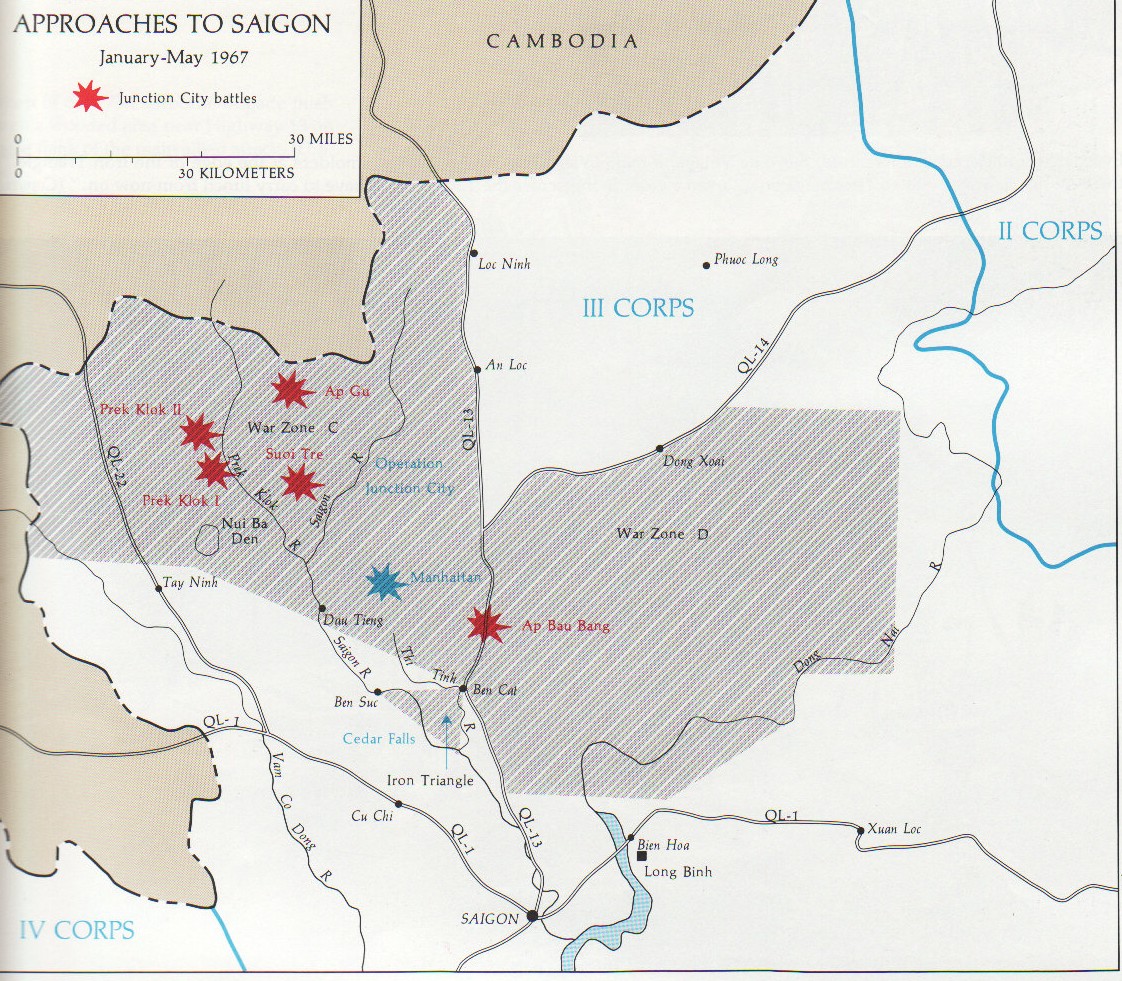
Two days before the battle, on March 19, American helicopters landed the 3rd Battalion, 22nd Infantry and the 2nd Battalion, 77th Artillery into an elliptical clearing near Suoi Tre in War Zone C, about 90 kilometers northwest of Saigon. Their mission was to establish Fire Support Base Gold as part of Operation Junction City. The artillery commander was Lieutenant Colonel John William Vessey Jr., who would later rise to become Chairman of the Joint Chiefs of Staff. The Americans did not expect serious resistance, but the clearing's history should have given pause: only three kilometers away, during Operation Attleboro a few months earlier, they had fought the VC's 272nd Regiment at the Battle of Ap Cha Do. That regiment had recovered. As the helicopters landed, five remote-controlled charges detonated in the clearing, destroying three aircraft and damaging six more. Fifteen soldiers died before the base was even begun. A claymore-type mine wounded five more infantrymen. The VC already knew they were there.
Six-Thirty in the Morning
At 04:30 on March 21, a night patrol from Company B reported movement near its ambush site outside the perimeter. Two hours of silence followed. At 06:30, as the patrol prepared to return to camp, the world exploded. Mortar rounds -- 60-millimeter and 82-millimeter -- began falling on the base at a rate that would eventually total an estimated 650 rounds. The night patrol was overrun within five minutes; every man was killed or wounded. Seconds after the first mortar round struck near a company command post, another detonated outside battalion headquarters. Then waves of VC infantry emerged from the jungle, firing recoilless rifles, RPG-2 rockets, and automatic weapons. The heaviest pressure hit the northeast and southeast. By 07:11, Company B's 1st Platoon on the southeastern perimeter had been overrun. The Forward Air Controller who arrived to direct airstrikes was shot down by automatic weapons fire. By 08:13, the northeastern section fell to another infantry charge.
Shrinking the Circle
The defenders contracted. By 08:40, the Americans on the eastern perimeter had withdrawn to a secondary line clustered around the artillery positions. The northern, western, and southern sectors held, but barely -- VC fighters pressed to within 15 meters of the defensive positions and within hand grenade range of the battalion command post. An M45 Quadmount machine gun on the northern perimeter was hit by RPG-2 rounds and overrun. As the VC tried to turn the weapon against its owners, a 105-millimeter howitzer crew 75 meters away put a round directly into it. With the perimeter shrinking and the eastern positions folded in, the howitzers had nothing left to do but fight like direct-fire weapons. Crews loaded beehive rounds, each carrying 8,000 steel flechettes, and fired into the VC at ranges that left scorch marks on the gun tubes. When the beehive supply was exhausted, they loaded high-explosive rounds and kept firing at the same impossible distance.
The Relief Column Breaks Through
Brigade headquarters had alerted all available units the moment the attack began. The 2nd Battalion, 12th Infantry moved from the northwest. The 2nd Battalion, 22nd Infantry (Mechanized) and the 2nd Battalion, 34th Armor advanced from the southwest, delayed by the search for a single feasible crossing of a stream in their path. At 09:00, the 2/12th Infantry broke through the VC encirclement and linked up with the battered Company B. Twelve minutes later, the armor and mechanized column crashed through the jungle from the southwest, 90-millimeter guns firing canister rounds and machine guns raking the VC positions. The effect was immediate and devastating. Caught between the reinforced perimeter and the armored column, the VC began to withdraw. Even then, some fought on -- American soldiers reported seeing wounded VC fighters, already bandaged from earlier in the same battle, being carried forward into new attacks by their comrades. By 09:30 the perimeter was restored. By 10:45, it was over.
What the Jungle Yielded
The aftermath revealed the scale of the fight. American sweeps counted 647 Viet Cong dead. Seven prisoners were taken. The weapons recovered -- 65 crew-served and 94 individual -- included fifty RPG-2 rocket launchers. American losses were 36 killed and 190 wounded. Captured documents showed that the 272nd Regiment of the VC 9th Division, supported by elements of U-80 Artillery, had planned the assault carefully. The 272nd was considered one of the best-equipped VC units and among the few willing to launch daylight attacks. Four American units received the Presidential Unit Citation for the action at Suoi Tre: the 2nd Battalion, 34th Armor; the 2nd and 3rd Battalions, 22nd Infantry; and the 2nd Battalion, 77th Field Artillery. Lieutenant Colonel Vessey received the Distinguished Service Cross. His artillerymen had fired their guns in a way no manual prescribed, at a range no doctrine anticipated, and it had saved the base.
From the Air
The battle site is at approximately 11.49N, 106.27E in the former War Zone C of Tay Ninh Province, now southern Vietnam. From 8,000-12,000 feet AGL, the terrain is flat tropical lowland with dense vegetation. The Suoi Tre stream runs through the area. Tan Son Nhat International Airport (VVTS) in Ho Chi Minh City lies roughly 90 km to the southeast. The former fire support base clearing may still be partially visible as a gap in the canopy. The Cambodian border is approximately 15 km to the northwest.