Battle of Tabora
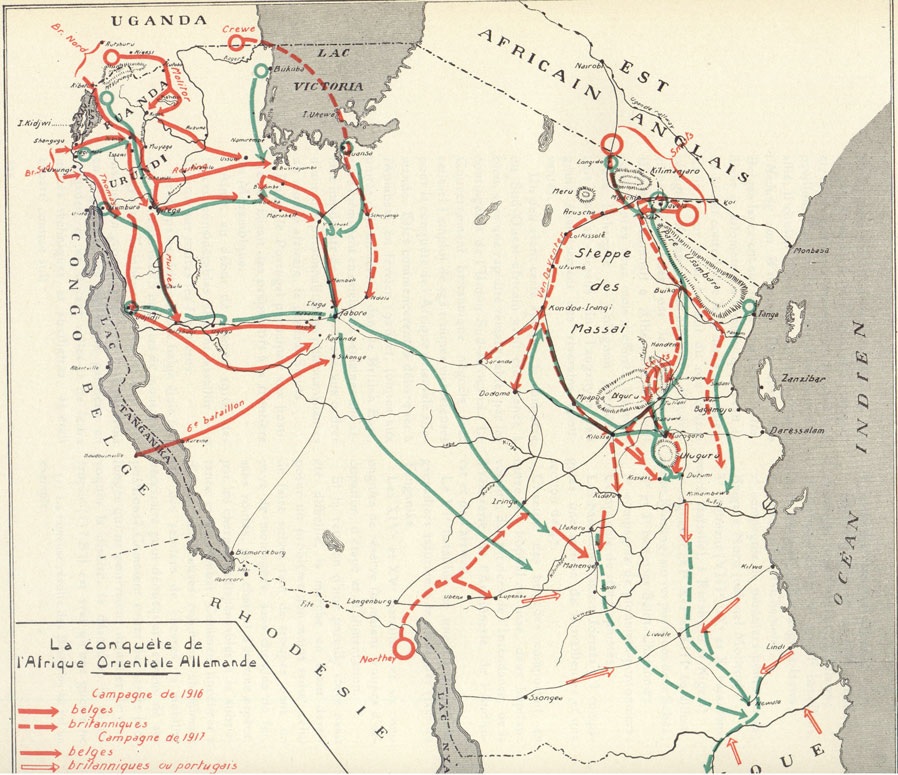
Most histories of World War I barely mention Africa at all, and when they do, they tend to focus on the legendary German commander Paul von Lettow-Vorbeck and his years-long guerrilla campaign in the east. But in September 1916, a different story played out on the open plains around Tabora, the largest town in the interior of German East Africa. A Belgian force -- the Force Publique, drawn from the Belgian Congo -- had crossed hundreds of kilometers of difficult terrain, captured the strategic port of Kigoma on Lake Tanganyika, and now converged on Tabora in a two-pronged advance that would determine who controlled the railways, the lakes, and the future borders of Central Africa. The battle lasted eleven days. Its consequences lasted a century.
An Empire's Provocation
The Belgian Congo had initially tried to stay out of the war. Bound by the Congo Act of 1885, which established the territory's neutrality, the Force Publique could only defend. Germany ended that restraint on August 15, 1914, when ships stationed on Lake Tanganyika bombed the port of Mokolobu south of Uvira, then struck the Lukuga post a week later. By September, German forces had occupied Kwijwi Island on Lake Kivu. Belgium's colonial army had its justification. Over the next two years, the Force Publique fought its way through Ruanda in May 1916 and Urundi in June, then organized two columns for the final push to Tabora. The northern column, Brigade Nord, reached Lake Victoria near Mwanza after heavy fighting in the Ussewi region. The southern column, Brigade Sud, advanced along Lake Tanganyika's eastern shore and captured the port of Kigoma on July 28 -- the western terminus of the strategic Tanganjikabahn railway connecting Dar es Salaam to the interior.
A Race Between Allies
The Belgians were not the only Allied force converging on Tabora. A smaller British formation called Lake Force, commanded by South African Brigadier-General Charles Crewe, was racing to get there first. The prize was not merely military but political: whoever took Tabora would strengthen their claim to the postwar division of German East Africa. Crewe's force struggled with heavy German resistance and severe supply problems, and fell behind. The Belgians, meanwhile, advanced along the railway that the retreating Germans methodically destroyed behind them. Colonel Frederik Valdemar Olsen's southern brigade reached the German railway station at Usoke on August 30. General Kurt Wahle, the German commander, threw everything he had at Usoke -- including a naval gun mounted on a railcar -- but the Force Publique held and pushed the Germans back after days of intense fighting.
Eleven Days on the Plains
Tabora sat on an open plain surrounded by hills, and Wahle had fortified those hills thoroughly. His forces included not only German Schutztruppen and their askari soldiers but also Indugaruga warriors loyal to the Kingdom of Rwanda. On September 8, the Belgians reached Wahle's defensive positions at Lulanguru. For four days the southern brigade pressed the attack from the west while the northern brigade, under Colonel Philippe Molitor, slammed into the entrenched German positions in the hills of Itaga to the north. The fighting at Itaga was some of the fiercest of the East African campaign, with the northern brigade suffering considerable casualties against determined resistance. By mid-September, Wahle's force had been whittled down to roughly 1,100 rifles, and his askari soldiers were deserting in growing numbers. On September 16, the Germans intercepted a letter from Crewe revealing that the main northern offensive was planned for the 19th. They chose to withdraw rather than be encircled. The civilian authorities of Tabora surrendered to the Force Publique on September 19.
The Cost That Maps Cannot Show
The Belgians liberated around 200 Allied prisoners of war and captured 228 German soldiers. The Force Publique itself lost 1,300 men. General Wahle retreated southeast toward Mahenge at a punishing pace, driving his remnant force through unexplored and waterless terrain where survival itself became the enemy. The British Lake Force was disbanded on October 3, its purpose overtaken by events. Belgium's victory at Tabora cemented its military occupation of the Ruanda-Urundi territory -- an occupation that would become a League of Nations mandate and shape the political geography of Rwanda and Burundi for the rest of the twentieth century. Of the Rwandan Indugaruga warriors who had fought alongside the Germans at Tabora, few ever returned home. Those who did found no gratitude waiting for them -- the Belgian colonial authorities subjected them to abuse. Their service, like so much of World War I's African chapter, was written out of the story by the people who claimed the victory.
From the Air
Located at 5.02S, 32.80E in the Tabora Region of central Tanzania. The town sits on a broad, relatively flat plain surrounded by low hills -- the same terrain that defined the 1916 battle's defensive positions. Best viewed from 5,000-8,000 feet AGL. The Central Line railway (formerly the Tanganjikabahn) is visible passing through the town. Nearest airport: Tabora Airport (HTTB). Kigoma Airport (HTKA), terminus of the rail line, is approximately 200 nm to the west on Lake Tanganyika.