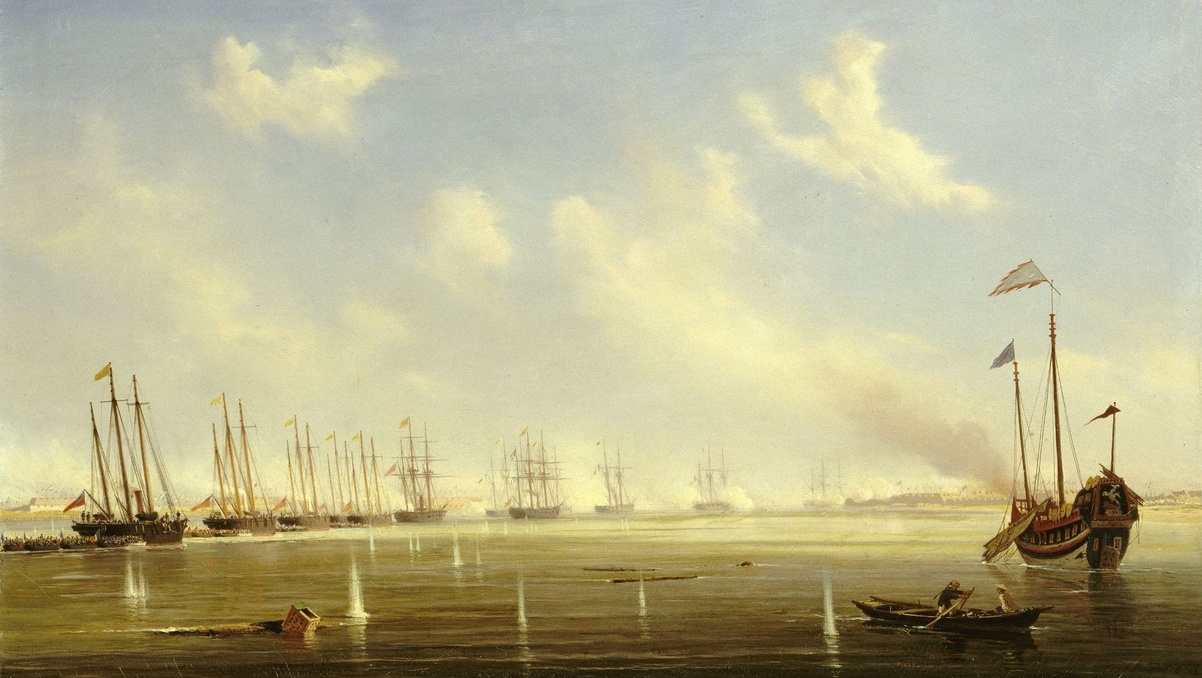
Battle of Taku Forts (1858)
On May 20, 1858, a squadron of British and French gunboats under Rear Admiral Michael Seymour steamed up the Hai River toward a line of fortifications guarding the approach to Tianjin. The Second Opium War had been grinding on since 1856, and the Anglo-French alliance, having already captured Canton the previous year, was turning its attention northward. The Taku Forts stood between the foreign powers and the road to Beijing. They would not stand for long.
The Road from Canton
The war had begun over a Chinese-owned ship called the Arrow. Registered in Hong Kong and flying a British flag, it had been boarded by Chinese soldiers suspicious of piracy and opium smuggling. Though the ship's flag registration had actually expired, Britain treated the incident as an insult to its sovereignty. France, nursing its own grievance over the execution of a French missionary in Guangxi, joined the British cause. Together they captured Canton in late 1857. When the Xianfeng Emperor learned on January 27, 1858, that his southern port had fallen, the strategic picture shifted. Seymour decided to press northward, toward the forts that controlled access to the Hai River and, beyond it, the capital.
Gunboats on the Hai River
The Taku Forts were the keystone of China's northern coastal defense, positioned at the mouth of the Hai River where it empties into the Bohai Sea. But in 1858, their defenses were not prepared for the firepower the Anglo-French flotilla brought to bear. The battle was brief and decisive. The allied gunboats overwhelmed the fortifications, and when the fighting ended, the British and French looted the forts, finding an array of weapons and cannons, both foreign-made and domestically cast. The fortresses fell, and with them, China's ability to keep the foreign powers at arm's length from its northern heartland.
The Treaties That Changed Tianjin
The fall of the forts forced China to the negotiating table. In June 1858, the Treaties of Tianjin were signed, opening Tianjin to foreign trade and granting Western nations new privileges on Chinese soil. British soldiers who participated in the assault received the Second China War Medal with the clasp 'Taku Forts 1858.' But the treaties also contained the seeds of future conflict. When the first phase of the war ended, the forts were returned to the Qing Army, and China's refusal to fully comply with the treaty terms would lead to a second battle at the Taku Forts in 1859 and a third in 1860, each escalation drawing the foreign powers deeper into Chinese territory.
The First of Many
The 1858 battle was the opening blow in a sequence of assaults that would, over the next two years, crack open Beijing itself. It established a pattern that would repeat through the rest of the century: Western naval technology overwhelming Chinese coastal defenses, followed by treaties that extracted concessions the Qing Court never intended to honor, followed by further military action to enforce compliance. For the people of Tianjin, this first battle marked the beginning of a transformation. Within a few years, the city would be carved into foreign concessions, its riverbanks lined with European-style buildings, its economy reshaped by international trade. The gunboats on the Hai River in May 1858 did not just breach a line of forts. They opened a gateway that would never fully close.
From the Air
The battle site is at the mouth of the Hai River near 38.97N, 117.71E, in the Binhai New Area approximately 60 km southeast of Tianjin's urban center. The flat coastal terrain and river estuary are visible from altitude. Tianjin Binhai International Airport (ZBTJ) is approximately 30 km to the northwest. The remnants of the Taku Forts are along both banks of the Hai River estuary.