Battle of Takur Ghar
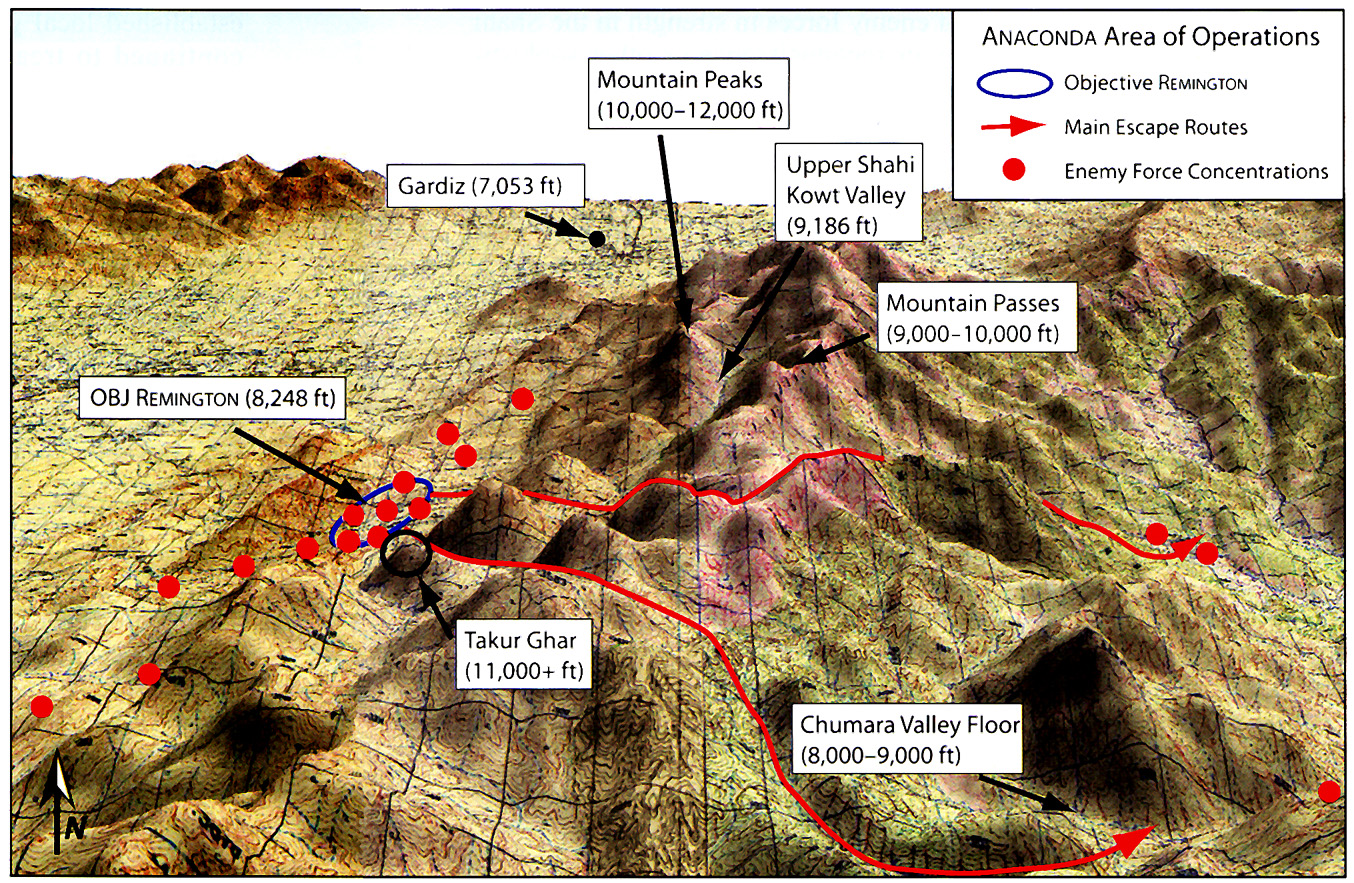
Navy SEAL Neil Roberts fell three meters into the snow and activated his infrared strobe. It was just after midnight on March 4, 2002, and the Chinook helicopter that had been carrying his team to the peak of Takur Ghar -- a 10,000-foot mountain commanding a view of the Shahi-Kot Valley in eastern Afghanistan -- had taken heavy fire and lurched away without him. What followed over the next eighteen hours would cost seven American lives, wound twelve more, and eventually produce one of the most contested and extraordinary Medal of Honor awards in military history.
A Series of Delays
The operation was troubled before it began. On the evening of March 3, two SEAL teams from DEVGRU -- MAKO 30 under Senior Chief Britt Slabinski and MAKO 21 under Lieutenant Commander Vic Hyder -- were slated for insertion into the Shahi-Kot Valley as part of Operation Anaconda, the largest U.S. ground offensive since the war's opening months. MAKO 30's mission was to establish an observation post on the peak of Takur Ghar. The plan called for a helicopter drop at a point 1,400 meters east of the summit, giving the team time to hike in under cover of darkness. But delays mounted. A B-52 sortie pushed back their departure. The first pair of MH-47 Chinooks from the 160th Special Operations Aviation Regiment developed engine trouble and had to be replaced. By the time new helicopters were ready, the window for the offset landing zone had closed. Daylight was approaching. The SEALs chose to land directly on the peak.
Contact on the Summit
The decision proved catastrophic. As the Chinook carrying MAKO 30 touched down on Takur Ghar's summit, a DShK heavy machine gun opened fire. Roberts, positioned near the rear ramp, was thrown from the aircraft. The damaged helicopter managed to set down again to offload the rest of the team, which split into two-man pairs and began bounding toward the peak in the pre-dawn darkness. They initially went undetected, but one pair stumbled onto a concealed al-Qaeda bunker, killing three fighters before a PKM machine gun pinned the team down. The firefight raged for twenty minutes. Air Force Combat Controller John Chapman and two SEALs were wounded. Slabinski ordered a retreat off the mountain. Chapman was believed to be dead. He was not.
Razor 01's Hot Landing
With MAKO 30 driven from the peak, a quick reaction force of nineteen Army Rangers from the 75th Ranger Regiment, a three-man Air Force special tactics team, and Tactical Air Control Party Staff Sergeant Kevin Vance was dispatched from Bagram aboard two Chinooks, Razor 01 and Razor 02. A cascade of communications failures made the situation worse. The AC-130 gunship providing overhead cover was forced to leave at dawn under standing Air Force rules. The Ranger commander aboard Razor 01 was told he was extracting a SEAL sniper team in contact -- inaccurate information that left his men unprepared for what awaited them. At approximately 6:10 AM, Razor 01 reached the landing zone. The helicopter immediately took RPG, heavy machine gun, and small arms fire. Sergeant Philip Svitak, manning the right-side minigun, was killed instantly. Both pilots were seriously wounded. An RPG destroyed the right engine, forcing a crash landing. As Rangers rushed down the ramp, Corporal Matthew Commons and Sergeant Bradley Crose were gunned down. Specialist Marc Anderson was killed inside the aircraft. The survivors scrambled behind a hillock and fought back.
The Last Fight of John Chapman
For years, the official story held that Master Sergeant John Chapman died during MAKO 30's initial assault on the peak. Slabinski reported crawling over Chapman's body during the retreat. But years later, analysis of Predator drone footage and GRIM-32 infrared imagery told a different story. The footage showed that after the SEALs withdrew, Chapman -- wounded twice in the torso -- regained consciousness alone on the mountaintop, surrounded by al-Qaeda fighters closing from three directions. He crawled into a bunker, killed an enemy combatant who charged him, and fought another in hand-to-hand combat. Then, as Razor 01 approached the peak, Chapman left the bunker's cover and stepped into the open, drawing enemy fire to give the incoming helicopter a chance to land. He was killed by a gunshot to the heart, having already been wounded sixteen times. In 2018, Chapman became the first airman since the Vietnam War to receive the Medal of Honor, awarded posthumously at a White House ceremony on August 22.
Seven Names on the Mountain
By the time the peak was secured, seven Americans were dead: Neil Roberts, John Chapman, Philip Svitak, Matthew Commons, Bradley Crose, Marc Anderson, and Senior Airman Jason Cunningham, a pararescueman who bled out while treating the wounded. Twelve others carried injuries ranging from RPG shrapnel to heavy machine gun rounds through their limbs. The battle exposed failures in inter-service communication, the risks of inserting directly onto an unsecured objective, and the limits of real-time intelligence when satellite links failed at the worst possible moments. It also revealed something else. Drone footage and infrared cameras captured acts of individual courage -- Chapman fighting alone on the summit, Rangers charging uphill into withering fire -- that the fog of war had initially obscured. Takur Ghar is remote, inhospitable, and difficult to reach by any means. The men who fought there did not choose the ground. They fought on it anyway.
From the Air
Located at 33.34°N, 69.21°E in eastern Afghanistan's Paktia Province, within the Arma Mountains southeast of the Shahi-Kot Valley. Takur Ghar rises to approximately 10,240 feet (3,121 meters). The terrain is extremely rugged high-altitude mountain terrain. Nearest major airfield is Bagram Air Base (OAIX), approximately 150 km to the northwest. Gardez airstrip is closer but limited. The peak is identifiable as a prominent summit overlooking the valley to the west. Best viewed from medium to high altitude; the mountaintop is snow-covered in winter months.