Battle of Tampa: The Yankee Outrage That Nobody Won
"We don't understand the meaning of the word surrender. There is no such letter in our book." Captain John William Pearson, Confederate States Army, delivered this defiant response from a rowboat in the middle of Tampa Bay on June 30, 1862, facing down a Union gunboat with twenty armed sailors. The USS Sagamore had steamed into the bay that morning, opened her gun ports, turned broadside toward the little village of Tampa, and sent a boat under flag of truce to demand unconditional surrender. Pearson met them with eighteen of his own men, refused to let the Federals set foot on shore, and told them to "pitch in" when they threatened to shell the town. His men gave three cheers for the Southern Confederacy. The Union boat crew, according to Pearson's report, said nothing.
A Port Worth Watching
Tampa in 1862 was barely a town. A scattering of buildings clustered near the old army post at Fort Brooke, at the mouth of the Hillsborough River where it emptied into the bay. But small as it was, Tampa's port mattered. Central Florida's cattle ranchers and cotton growers shipped through here, and blockade runners regularly slipped out past the Union naval cordon that stretched from the Atlantic coast around Florida's peninsula and up its Gulf shore. Washington knew that strangling Confederate commerce meant plugging every gap, and Tampa was one of those gaps. The Union had already captured New Orleans in April 1862 and was tightening its grip on the Mississippi. Every little port that still moved goods for the Confederacy was a target.
The First Warning Shot
The Sagamore was not Tampa's first uninvited guest. Back on April 13, a Union schooner had anchored behind an island two miles offshore, setting off alarm bells through town. Confederate pickets posted on every road feared the ship was a decoy while Federal troops marched overland to attack from behind. Robert Watson, a soldier in the colorfully named 'Key West Avengers,' recorded the tension in his diary. When the Federals launched a boat under a flag of truce and demanded surrender, Major Thomas refused. The Union officer gave twenty-four hours to evacuate women and children before the bombardment would begin. Watson noted that his comrades gave three cheers at the prospect of a fight, which "made the men in the Yankee boat look down in the mouth as they expected to see us all look frightened and ready to surrender." But the next day brought no attack. The schooner simply vanished.
An Evening of Sound and Fury
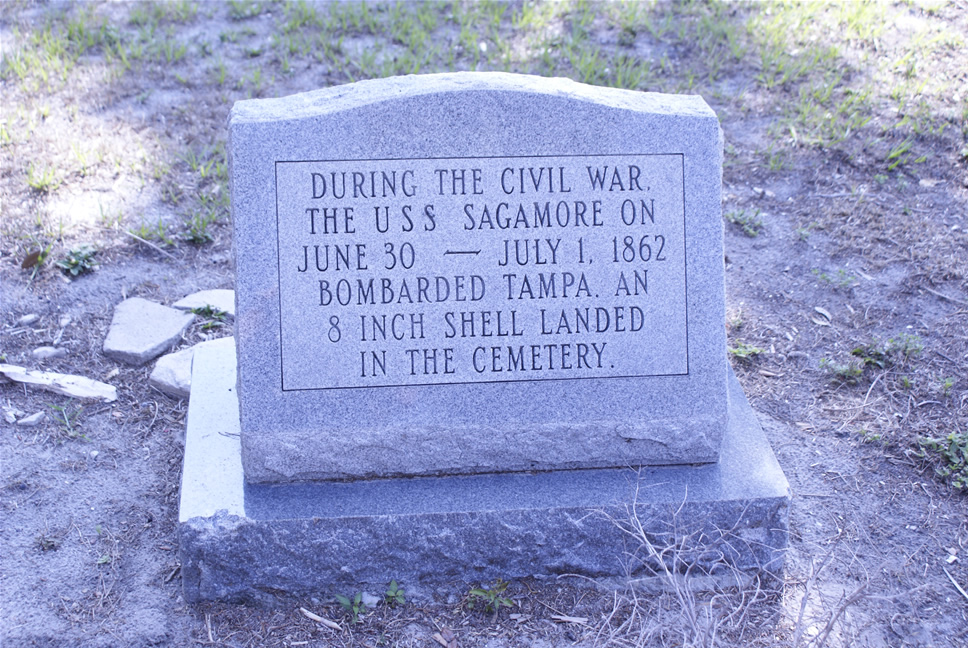
Two months later, on June 30, the Sagamore made good on the threat. At six o'clock that evening, exactly as promised, the gunboat opened fire with heavy shell and shot. Fort Brooke's defenders answered with their three 24-pounder cannons. For an hour, the two sides traded fire across Tampa Bay, the deep boom of naval guns rolling over the flat Florida landscape and the sharper crack of the fort's cannons echoing back. By seven o'clock, the Sagamore withdrew. Neither side had inflicted any real damage. No one was killed. No one was even wounded. The next morning, July 1, the gunboat returned and lobbed shells from beyond the range of the fort's guns for two hours. Then the crew broke for lunch. After the midday meal, the Sagamore fired two final rounds, weighed anchor, and sailed back to its blockade station near the mouth of Tampa Bay. The Battle of Tampa was over.
What Came After
The real consequences arrived later. In October 1863, the Battle of Fort Brooke proved more damaging: a Union gunboat bombarded the fort as a distraction while a raiding party slipped up the Hillsborough River and destroyed several Confederate blockade runners hidden along its banks. By May 1864, the Confederate war effort was crumbling, and Fort Brooke's defenders had been transferred to more critical fronts. Troops from the USS Adela landed in Tampa without opposition, destroyed whatever supplies remained in the abandoned fort, and left after two days. During that raid, two of Fort Brooke's cannons were dumped into the Hillsborough River. They were eventually recovered, restored, and placed on display in Plant Park on the University of Tampa campus, where they remain today - tangible reminders of the afternoon an entire battle produced zero casualties.
A Pennsylvanian's Confederate Battery
One detail from Captain Pearson's after-action report stands out: he singled out Captain James Gettis of Hillsborough County for decisive leadership of one of the Confederate batteries during the bombardment. Gettis was originally from Pennsylvania. The Civil War's tangled loyalties ran through every corner of the country, and Tampa was no exception. A Northern-born man commanding Southern guns against a Northern ship in a Southern bay, in a battle where nobody got hurt - the whole engagement reads like a parable of a conflict that was far messier and more human than the grand narratives suggest. The locals called it the 'Yankee Outrage at Tampa,' though outrage might be too strong a word for an exchange of cannon fire that left the town, the fort, and the gunboat all essentially intact.
From the Air
Located at 27.94°N, 82.46°W on the eastern shore of Tampa Bay, at the mouth of the Hillsborough River. The battle site is in present-day downtown Tampa near the Tampa Convention Center and the University of Tampa. Plant Park, where the recovered Civil War cannons are displayed, sits along the Hillsborough River on the UT campus. Nearby airports include Tampa International (KTPA) approximately 5 miles west and Peter O. Knight Airport (KTPF) on Davis Islands just south of the battle site. Best viewed at 2,000-3,000 feet AGL; the Hillsborough River winding through downtown Tampa and the broad expanse of Tampa Bay provide clear visual references for locating the former Fort Brooke site.