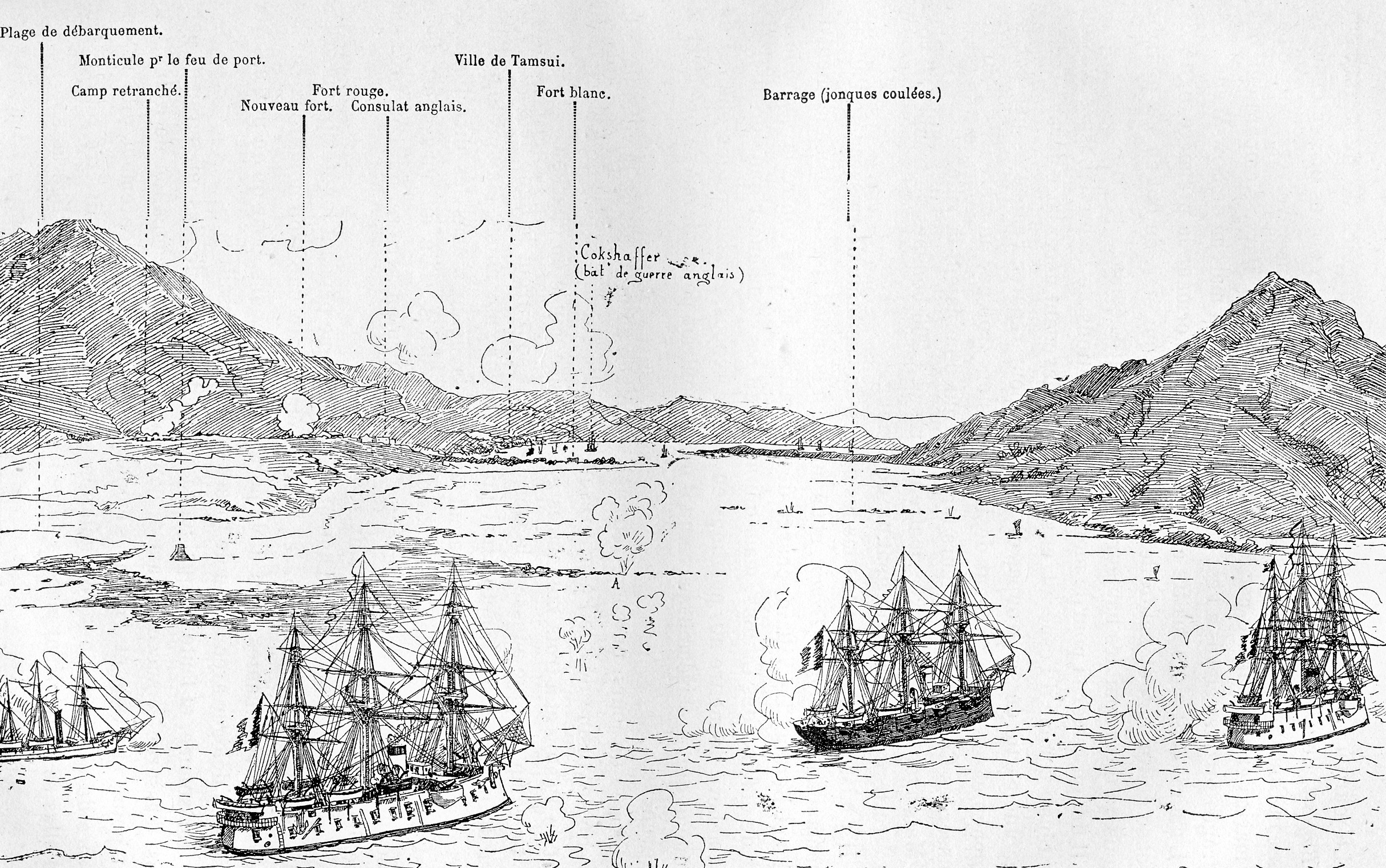
Battle of Tamsui
The European residents of Tamsui packed picnic baskets. On 8 October 1884, confident that the French navy would seize the town by nightfall, the foreign community climbed to vantage points on the surrounding hills to watch the spectacle unfold. They expected entertainment. What they got was one of the most embarrassing defeats in French colonial military history -- a battle in which 600 French sailors, armed with modern rifles, were stopped cold by roughly 1,000 Qing defenders fighting in terrain the French had never bothered to scout.
Gunboats at the River Mouth
The Battle of Tamsui was part of the Keelung Campaign during the Sino-French War of 1884-1885. France wanted to pressure China by seizing key ports in northern Formosa. On 1 October, while French marines landed at Keelung to the east, Rear Admiral Sebastien Lespes positioned his flotilla off Tamsui: the ironclads La Galissonniere and Triomphante, a cruiser, and the gunboat Vipere. His orders were to bombard the Chinese forts, destroy the barrage across the Tamsui River, and take the town. Tamsui had a population of about 6,000, including a small European colony whose British members hastily hung Union Jacks from their windows to signal neutrality.
Mines, Matchlocks, and Krupp Guns
Governor Liu Mingchuan had prepared. Nine torpedo mines lay in the river. Ballast boats filled with stone had been sunk across the entrance on 3 September, blocking passage. Matchlock-armed Hakka hill people reinforced the mainland Chinese battalion. Around the British Consulate and Customs House at Fort Santo Domingo -- the old Spanish "Red Fort" -- Shanghai Arsenal-manufactured Krupp guns formed an additional battery. On the morning of 2 October, the Chinese fired first, loosing three cannon from the partly finished "New Fort." The French replied with a bombardment lasting several hours, pouring more than 2,000 shells into both forts. Many shells failed to explode. Others missed entirely, damaging European residences across town. Canadian missionary George Mackay refused to shelter aboard the British gunboat HMS Cockchafer because he could not take his Formosan converts with him.
Into the Scrub
After days of failed attempts to clear the mines, Lespes assembled 600 sailors from seven ships into a makeshift landing battalion. At 10 a.m. on 8 October, they advanced over the sand dunes north of the river. What they expected to find was open terrain -- rice paddies, small clumps of trees. What they found was dense scrub: cultivated fields hemmed by tall hedges and spiny plants, ground broken by ditches, visibility measured in meters. Companies lost sight of each other immediately. The bugler was shot dead early in the action, cutting off the only reliable means of signaling. General Sun Kaihua had placed his Cho-Sheng Regiment in two lines: one entrenched before Fort Santo Domingo, the other hidden in the woods on the right flank, positioned to rake the French advance from the side.
Retreat Before Lunch
Separated by about 100 meters from their Chinese opponents, the French sailors fired individually into the bushes as fast as they could, burning through their ammunition on targets they could not see. Their commander, Boulineau, screamed cease-fire orders that most of his men could not hear. On the French left, General Zhang Gaoyuan's troops pushed back the flank guard, compressing the entire landing force into a single thin line with no reserves. By half past noon, the first boats were pulling back toward the ships. By 1:30 p.m., the withdrawal was complete, with the gunboat Vipere firing at increasingly long range to cover the retreat. French casualties were 17 dead and 49 wounded. Chinese losses were approximately 80 dead and 200 wounded.
Severed Heads and National Pride
The aftermath was brutal on both sides of decorum. The French were unable to recover the body of Lieutenant Fontaine of La Galissonniere, nor those of two sailors killed nearby. Chinese soldiers beheaded the three corpses and paraded the severed heads through Tamsui that evening. The British consul and the captain of HMS Cockchafer protested, and the heads were handed over for Christian burial. The Chinese victory, however, resonated far beyond Tamsui. Liu Mingchuan's account of the battle, published in the Peking Gazette in November 1884, greatly exaggerated French casualties, claiming 300 killed. The defeat at Tamsui had a greater effect on Chinese national morale than simultaneous French victories in Tonkin. At the local Fuyou Temple, a temple of the sea goddess Mazu, the victory was commemorated as evidence of divine protection.
From the Air
Located at 25.19N, 121.46E at the mouth of the Tamsui River in northern Taiwan. The battle site is visible where the river meets the Taiwan Strait, with Fort Santo Domingo and Hobe Fort both nearby on the hillsides of modern Tamsui District. Guanyin Mountain rises across the river. Taipei Songshan Airport (RCSS) is approximately 15 km to the southeast. Taiwan Taoyuan International Airport (RCTP) is about 25 km to the south. Best viewed at 2,000-4,000 feet to appreciate the river mouth terrain.