Battle of Tanga
The bees did not take sides. They attacked everyone -- British, Indian, German, Askari -- with the same indiscriminate fury after the fighting disturbed their hives in the coconut plantations south of Tanga. But in the chaos that followed, it was the British Indian Expeditionary Force that broke. On November 3-5, 1914, roughly 8,000 troops under Major-General Arthur Aitken attempted to seize this port city in German East Africa. They were repelled by about 1,000 defenders under Lieutenant Colonel Paul von Lettow-Vorbeck. The British Official History of the War later called it 'one of the most notable failures in British military history.' The bees just made it unforgettable.
A Warning Politely Delivered
Tanga sat only 80 kilometers from the border of British East Africa -- modern-day Kenya -- and served as the ocean terminal of the Usambara Railway, which ran inland to Neu Moshi at the foot of Mount Kilimanjaro. A pre-war agreement had guaranteed the port's neutrality, but the British decided to void it. On November 2, 1914, Captain Francis Wade Caulfeild of the protected cruiser HMS Fox sailed into Tanga harbor and went ashore to deliver an ultimatum: take down the German flag within one hour. The Germans did not comply. Three hours later, with the flag still flying, Fox departed to bring in a convoy of fourteen troop transports. The gesture was courteous and catastrophic. It gave Lettow-Vorbeck time to rush reinforcements to Tanga by rail from Neu Moshi. By the time the British landed, a garrison of a single Askari company had grown to about 1,000 men in six companies.
Into the Plantations
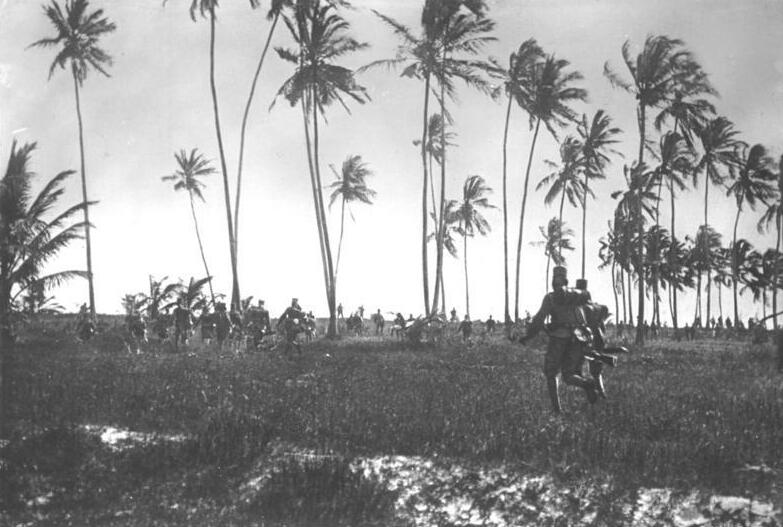
Aitken landed his troops in two groups -- one at the harbor, one on a beach three miles east of the city -- on November 3. The next day, he ordered them to advance. What followed was confusion layered on confusion. In the coconut and palm oil plantations south of town, well-concealed German defenders broke up the southern column almost immediately. The harbor force fared better initially: the Kashmir Rifles and the 2nd Loyal North Lancashire Regiment fought their way into town, captured the customs house and the Hotel Deutscher Kaiser, and raised the Union Jack. But support never arrived. Poorly trained Indian battalions of the 27th Bangalore Brigade scattered under fire. The 98th Infantry stumbled into beehives, and the swarming insects completed what the German bullets had started. British propaganda later claimed the Germans had rigged tripwires to agitate the hives -- a fanciful invention. The bees needed no encouragement.
Rout by Bugle Call
By late afternoon on November 4, Lettow-Vorbeck committed his last reserves. The 13th and 4th Askari field companies -- the 4th having just arrived by train -- launched bayonet charges along the entire front, accompanied by bugle calls and what accounts describe as piercing tribal war cries. At least three battalions of the Imperial Service Brigade fled. All semblance of order collapsed, and what had been a fighting retreat became a rout. The deepest irony came that night. Through a series of miscommunications, German buglers accidentally signaled a withdrawal, and several Askari companies pulled back from Tanga to a camp miles away. For most of the night before dawn on November 5, the town sat virtually undefended. Aitken, whose forces still outnumbered the Germans eight to one, never knew. He had already ordered a general evacuation.
What the Retreat Left Behind
The British withdrawal was so hasty that troops abandoned nearly all their equipment on the beaches and docks. Lettow-Vorbeck's men collected enough modern rifles to re-arm three Askari companies, along with 600,000 rounds of ammunition, sixteen machine guns, field telephones, and enough clothing to outfit the Schutztruppe for a year. These captured supplies sustained the German colonial force through years of guerrilla warfare that tied down far larger Allied armies across East Africa. On the morning of November 5, British intelligence officer Captain Richard Meinertzhagen entered Tanga under a white flag, bringing medical supplies and a letter from Aitken apologizing for having shelled the hospital. The streets were strewn with dead and wounded from both sides. German doctors and their African orderlies treated casualties without regard for uniform. For the soldiers who fought and died at Tanga -- British, Indian, German, and African -- the battle was no footnote. It was the opening disaster of a four-year East African campaign whose human costs remain underappreciated.
From the Air
Located at 5.07S, 39.10E on the coast of northeastern Tanzania. Tanga sits at the mouth of a natural harbor visible from altitude, with the town's grid spreading inland from the waterfront. The Usambara Railway once ran west from here toward Mount Kilimanjaro. The coconut and palm plantations south of town where much of the fighting occurred are still visible as cultivated areas. Nearest airport is Tanga Airport (HTTG). Kilimanjaro International Airport (HTKJ) is approximately 300 km to the northwest. The Kenya border lies roughly 80 km to the north along the coast. Pemba Island is visible offshore to the east.