Battle of Tehumardi
In the darkness of October 8, 1944, two columns of soldiers marched silently toward each other along a narrow Estonian road. One group was retreating. The other was advancing. Neither knew the other was there until flares split the night sky and revealed the terrible truth: they were close enough to touch. What followed was one of the most brutal engagements of the entire Moonsund campaign, a chaotic melee fought with bayonets and rifle butts in the pitch black, where friend and foe became indistinguishable and survival was measured in footsteps.
The Island Trap
Saaremaa, the largest island in the Estonian archipelago, was the last piece of contested ground in the Soviet Moonsund Landing Operation. The Soviets had swept through quickly since landing on September 29, 1944. The smaller islands of Muhu and Hiiumaa fell with little resistance. Now, five days after the main landing, German forces were conducting a fighting withdrawal toward the Sorve Peninsula, the narrow thumb of land at the island's southern tip where they planned to make their final stand. Two infantry battalions from the 67th Potsdam Grenadier Regiment, part of Kampfgruppe Eulenburg, found themselves cut off near the Nasva River west of Kuressaare. With about 750 men between them and no communication with their parent unit, they received orders toward midnight to retreat to Sorve. Unknown to them, Soviet forces had already slipped past their position and now straddled the main road ahead.
Strangers in the Dark
Major V. Miller commanded about 370 men of the 307th Anti-Tank Battalion from the Estonian 249th Rifle Division. They had taken up positions astride the road leading to the peninsula, joined later by Major G. Karaulnov's 300 men from the 1st Battalion of the 917th Regiment. Many soldiers on the Soviet side were themselves Estonians, forcibly conscripted into the Red Army. Without proper reconnaissance, neither side knew the other was approaching until they were nearly on top of each other. The Germans, fearful of being cut off, had ordered their men to move in silence. Their road had been cratered by other retreating German units, forcing them to slowly drag vehicles across with a recently captured American-made M3 Stuart light tank. The two German battalions split up: the 1st moved along the waterline, the 2nd along the main road.
Recognition by Flare Light
The 2nd Battalion's soldiers found themselves marching alongside a Soviet column in the darkness. In the confusion, the Soviets assumed the shadowy figures were fellow Red Army troops and gave way. Then someone fired a flare. In its harsh, swinging light, German and Soviet soldiers stared at each other from meters away. The battle exploded instantly. Major Karaulnov's 1st Battalion of the 917th was quickly overwhelmed, but the Germans then collided with Miller's anti-tank positions. The fighting degenerated into hand-to-hand combat, men grappling and stabbing in near-total darkness, unable to tell enemy from friend except by the sounds of their voices. The chaos was absolute. Meanwhile, the German 1st Battalion, moving along the shoreline, heard the carnage but encountered no resistance at all, emerging from the night without a single casualty.
The Butcher's Bill
When dawn broke, nearly 400 men lay dead on the fields around Tehumardi. The Germans lost almost 200 soldiers, the Soviets about the same, including Major Miller himself. Captured German soldiers were executed, a grim pattern that held throughout the fighting on Saaremaa. Most German vehicles were abandoned in the chaos, including the captured Stuart tank and a self-propelled anti-aircraft gun. At least one Soviet tank and several guns were also destroyed. The majority of the German force managed to break through to reinforce the Sorve Peninsula defenses, but the losses were devastating for units that could not afford to lose men or equipment at this late stage of the war. The fighting bought the Germans time to strengthen their positions, but it was time borrowed against an inevitable conclusion.
Stone Sword Over Tehumardi
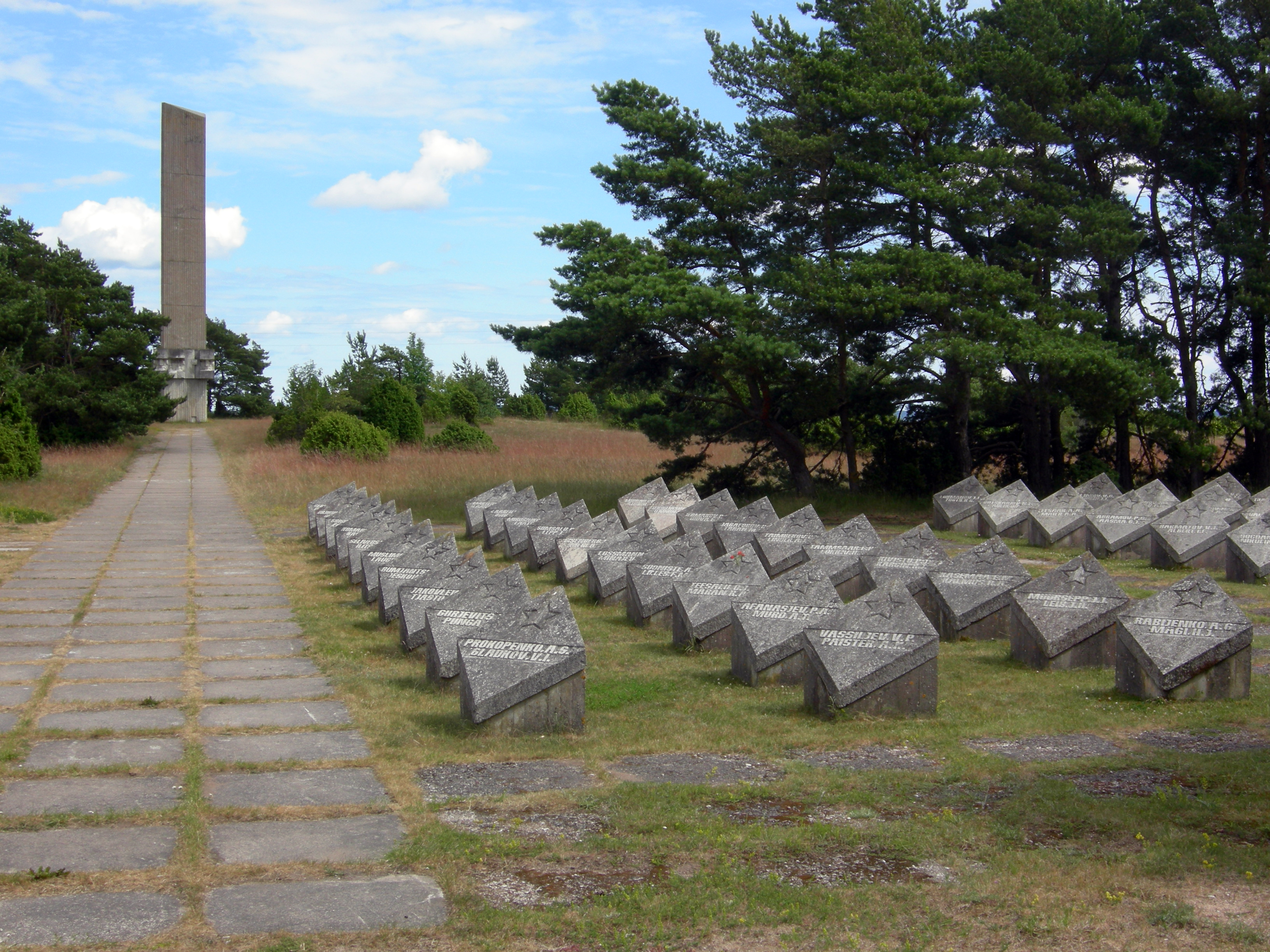
The Sorve Peninsula held for six more weeks of bitter combat before the Germans evacuated Saaremaa entirely on November 23-24, 1944. Today, the site of the night battle is marked by a massive Soviet-era monument, a gigantic sword of concrete and dolomite thrust into the Estonian earth. Nearby, concrete slabs bear the names of the fallen Soviet soldiers. The monument stands in silent testimony to a night when two armies collided in darkness on a narrow island road, when recognition came too late and mercy was absent. The Estonian island, whose shores have witnessed conflict from Viking raids to world wars, absorbed the blood of Germans, Russians, and Estonians alike into its sandy soil.
From the Air
The Battle of Tehumardi site is located at 58.176°N, 22.250°E on the island of Saaremaa, Estonia. The sword-shaped Soviet memorial is visible from low altitude. The site lies along the road leading to the Sorve Peninsula at the island's southern tip. Nearby airports include Kuressaare Airport (EEKA), approximately 15 km to the north, the only airport on Saaremaa. The island's flat terrain and coastal location make it excellent for low-level observation. The Sorve Peninsula extending to the south shows the narrow bottleneck geography that made it defensible. Hiiumaa island is visible to the north across the Soela Strait.