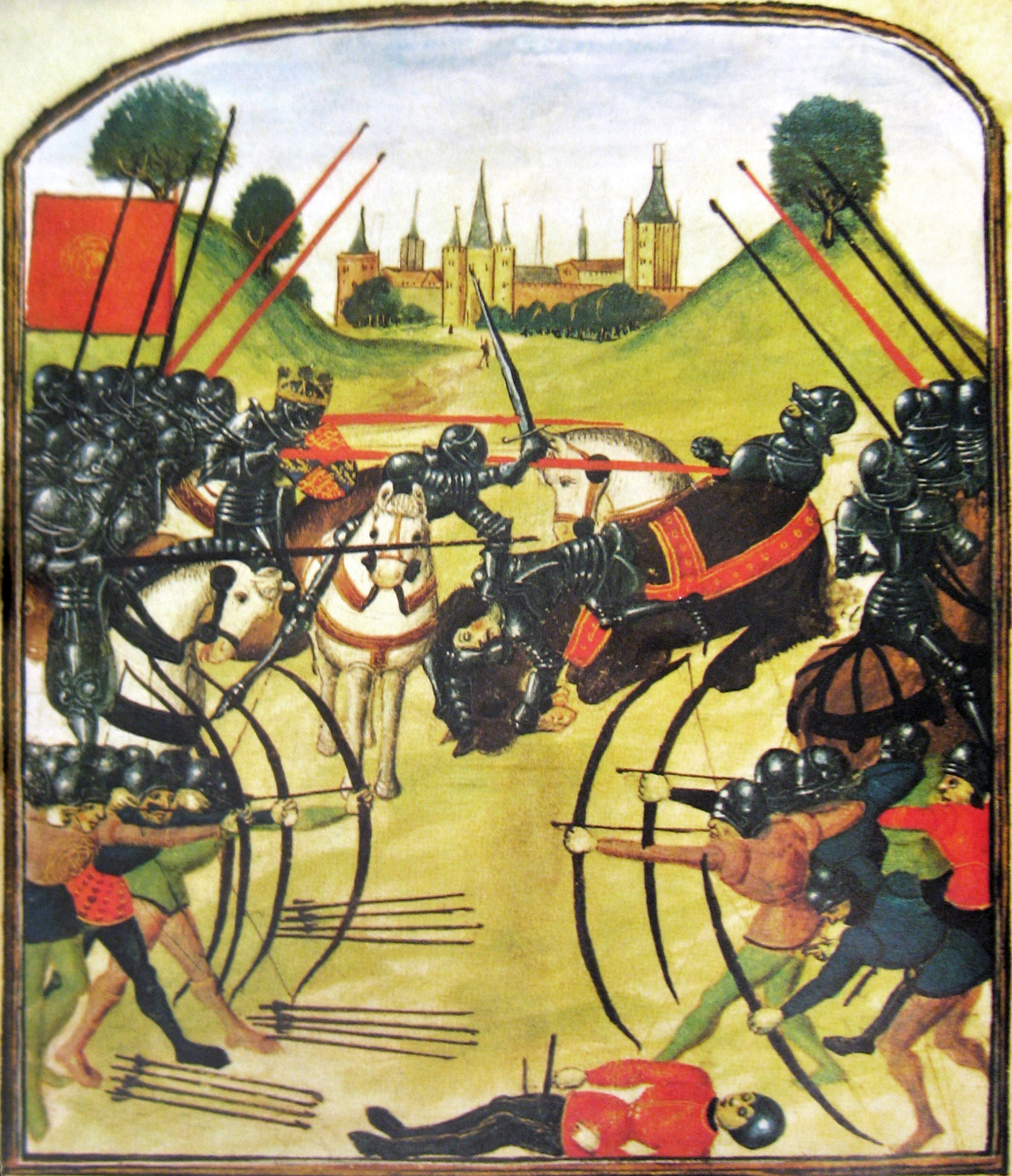
Battle of Tewkesbury
The field is still called the Bloody Meadow. South of Tewkesbury, where the flat ground beside the River Avon once grew thick with spring grass, the Lancastrian army made its last stand on 4 May 1471. By evening, the heir to the throne was dead, the Lancastrian nobility was shattered, and the Wars of the Roses had effectively been decided. It would be another fourteen years before Bosworth Field officially ended the conflict, but Tewkesbury broke the Lancastrian cause beyond repair.
The Long March from the West
Queen Margaret of Anjou and her seventeen-year-old son Edward, Prince of Wales, had landed at Weymouth on the very day the Earl of Warwick was killed at the Battle of Barnet. Any hope of reinforcement from the Kingmaker was already gone. Margaret gathered what Lancastrian support remained in the West Country and marched north, hoping to cross the Severn into Wales where Jasper Tudor could supply fresh troops. King Edward IV, the Yorkist monarch whose throne she meant to reclaim, pursued her with a battle-hardened army. The race to the Severn crossing became desperate. When the Lancastrians found the gates of Gloucester closed against them, they were forced further north to Tewkesbury. They arrived exhausted, having marched thirty-six miles in a single day.
The Fields South of the Abbey
The Lancastrian commander, Edmund Beaufort, Duke of Somerset, deployed his army on rising ground south of Tewkesbury Abbey, using hedgerows, ditches, and rough terrain to protect his flanks. Lord Wenlock commanded the centre, and the Earl of Devon held the left. Edward IV arranged his Yorkist forces in three divisions. His brother Richard, Duke of Gloucester -- the future Richard III -- commanded the vanguard. The battle opened with an exchange of arrows and artillery, after which Somerset launched an aggressive flanking attack against the Yorkist left. The manoeuvre initially succeeded, but a concealed force of two hundred Yorkist spearmen, placed in woods to guard exactly this approach, counter-attacked from the flank.
The Bloody Meadow
Somerset's attack collapsed, and as his troops fled back toward their lines, the rest of the Lancastrian army broke. What followed was a rout. Fleeing soldiers were cut down in the fields south of the abbey, in the area that acquired the name Bloody Meadow. Edward, Prince of Wales, was killed during or shortly after the battle -- the only Prince of Wales in English history ever to die in combat. He was seventeen years old. Some accounts say he was struck down in the fighting; others that he was captured and executed. His body was buried in the chancel of Tewkesbury Abbey, where a brass plate marks his grave to this day. Somerset was captured and beheaded two days later. Within three weeks, the captive Lancastrian king Henry VI was dead in the Tower of London, almost certainly murdered.
Sanctuary Denied
Some defeated Lancastrians fled into Tewkesbury Abbey seeking sanctuary, the medieval right of protection within a church. Edward IV's forces followed them inside. The resulting bloodshed was so extensive that the abbey had to be closed for a month, purified, and reconsecrated before services could resume. The violation of sanctuary shocked even the violent sensibilities of the age. Today the abbey contains memorials to both sides of the conflict. George, Duke of Clarence -- Edward IV's brother, later supposedly drowned in a butt of malmsey wine -- is buried behind the high altar with his wife Isabel, daughter of the Kingmaker. The Bloody Meadow, now quiet farmland, carries nothing more threatening than cattle. But the name persists, and locals know what happened there.
From the Air
Located at 51.983N, 2.161W in the fields south of Tewkesbury, Gloucestershire, where the rivers Severn and Avon converge. The battlefield is flat agricultural land identifiable from the air by the Bloody Meadow name on maps. Tewkesbury Abbey's massive Norman tower is a prominent landmark. Nearest airports: Gloucestershire Airport (EGBJ) approximately 8nm south, Coventry (EGBE) approximately 35nm northeast. Best viewed from 2,000-3,000ft.