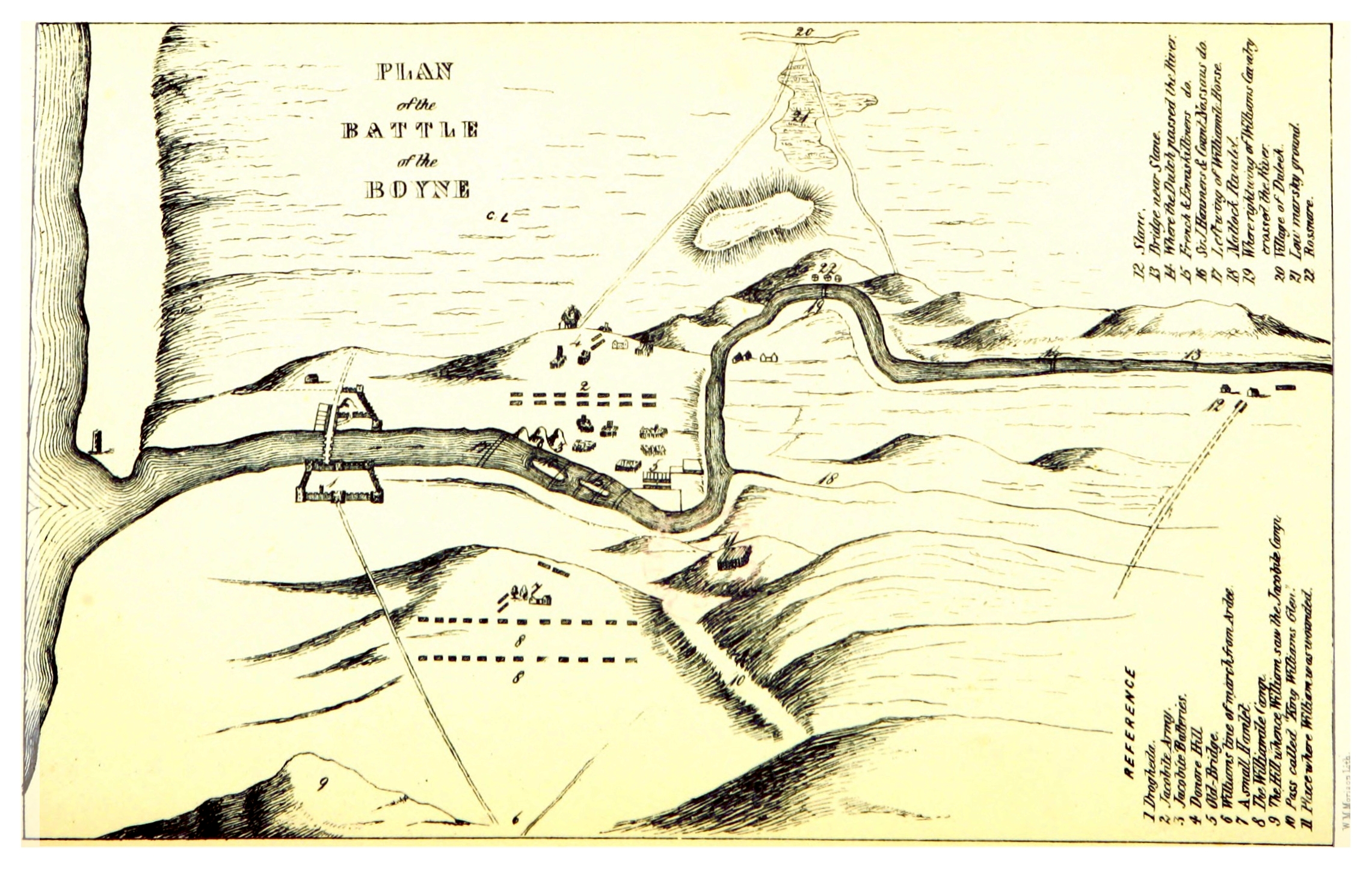
Battle of the Boyne
The Pope celebrated William of Orange's victory. That fact -- improbable, almost absurd -- captures the tangled politics of the Battle of the Boyne better than any single detail. On 1 July 1690, the Protestant King William III defeated the Catholic King James II at a ford on the River Boyne near Drogheda. But the Vatican backed William, because Pope Alexander VIII and the Papal States were part of the Grand Alliance opposing Louis XIV of France, who was Catholic but whose ambitions to dominate Europe threatened everyone. James was Louis's ally. So when news reached the continent, Catholic church bells rang for a Protestant king's victory over a Catholic one. The Boyne was never as simple as it seemed.
Two Kings at the River
The battle was the climax of James II's attempt to regain the thrones he had lost in the Glorious Revolution of 1688. William, who was both James's nephew and son-in-law, had been invited to take the English throne by seven Protestant peers. James fled to France, then sailed to Ireland in 1689 with 6,000 French troops provided by Louis XIV. By 1690, Jacobite forces controlled all of Ireland except Derry and Enniskillen. William crossed to Ireland with 16,000 additional troops to join the 20,000 already there under the Duke of Schomberg, a 74-year-old German-born professional soldier and former Marshal of France who had been forced out by the revocation of the Edict of Nantes. William's army of 36,000 was a multinational force: English, Dutch, Danish, Huguenot, and Ulster Protestant "Enniskilliners" -- many of them descendants of Anglo-Scottish border reivers.
The Ford at Oldbridge
William's plan hinged on a feint. He sent a quarter of his army, under Schomberg's son Meinhardt, through morning mist to cross the Boyne upstream at Roughgrange. James took the bait, dispatching his best French troops and most of his artillery to counter what he feared was a flanking movement. Neither side realized a deep, swampy ravine separated the forces at Roughgrange -- they spent the battle staring at each other across impassable ground. Meanwhile, at the main ford near Oldbridge, William's elite Dutch Blue Guards forced their way across the river. The Jacobite cavalry, commanded by James's illegitimate son the Duke of Berwick, counter-attacked ferociously, driving some Williamite infantry back into the water. The Blue Guards formed three infantry squares and used platoon fire to hold off the horsemen. William's second-in-command, Schomberg, was killed in this phase. The Irish cavalry finally withdrew when Danish infantry and cavalry under Ginkel crossed downstream and advanced on their flank.
Seamus a' Chaca
The casualty figures were modest for a battle involving 50,000 combatants -- about 2,000 dead. The Jacobite army retreated in good order, protected by a successful rearguard action at the River Nanny near Duleek. But James lost his nerve. Despairing of victory, he fled to Duncannon and sailed back to France, never to return. His Irish supporters, enraged by his abandonment, gave him the derisive nickname Seamus a' chaca -- "James the shit." The Jacobite army was far from finished. They regrouped at Limerick, fought off a Williamite assault in late August, and held out until the Battle of Aughrim the following year. The war ended with the Treaty of Limerick in 1691, which allowed 14,000 Irish soldiers under Patrick Sarsfield to leave for France. But the treaty's generous terms were gutted by the Protestant-dominated Irish Parliament, which imposed harsh Penal Laws that shaped Catholic resentment for generations.
A Battle That Never Ended
The Boyne's political afterlife has lasted longer than any other battle in Irish history. The Twelfth of July -- originally commemorating the 1691 Battle of Aughrim, later merged with the Boyne anniversary after the Orange Order was founded in 1795 -- remains the most divisive day in the Northern Irish calendar. Marches, bonfires, and confrontations mark a victory that occurred over 300 years ago as though it were recent. Yet there have been gestures toward reconciliation. In 2007, Northern Ireland's First Minister Ian Paisley visited the battlefield at the invitation of Taoiseach Bertie Ahern. Paisley presented Ahern with a Jacobite musket; Ahern gave him a walnut bowl made from a tree at the site. They planted a new tree together at Oldbridge House, where the Office of Public Works now operates a visitor centre on the ground where the Blue Guards crossed the river.
From the Air
Located at 53.72°N, 6.42°W along the River Boyne west of Drogheda, County Meath/Louth border. The battlefield sprawls across a wide area centered on Oldbridge. The Boyne is clearly visible from moderate altitude, with Oldbridge House (the visitor centre) identifiable on the south bank. Nearest airport: Weston Airport (EIWT), approximately 45 km to the south. Dublin Airport (EIDW) is roughly 50 km to the southeast. The River Boyne meanders provide distinctive visual landmarks.