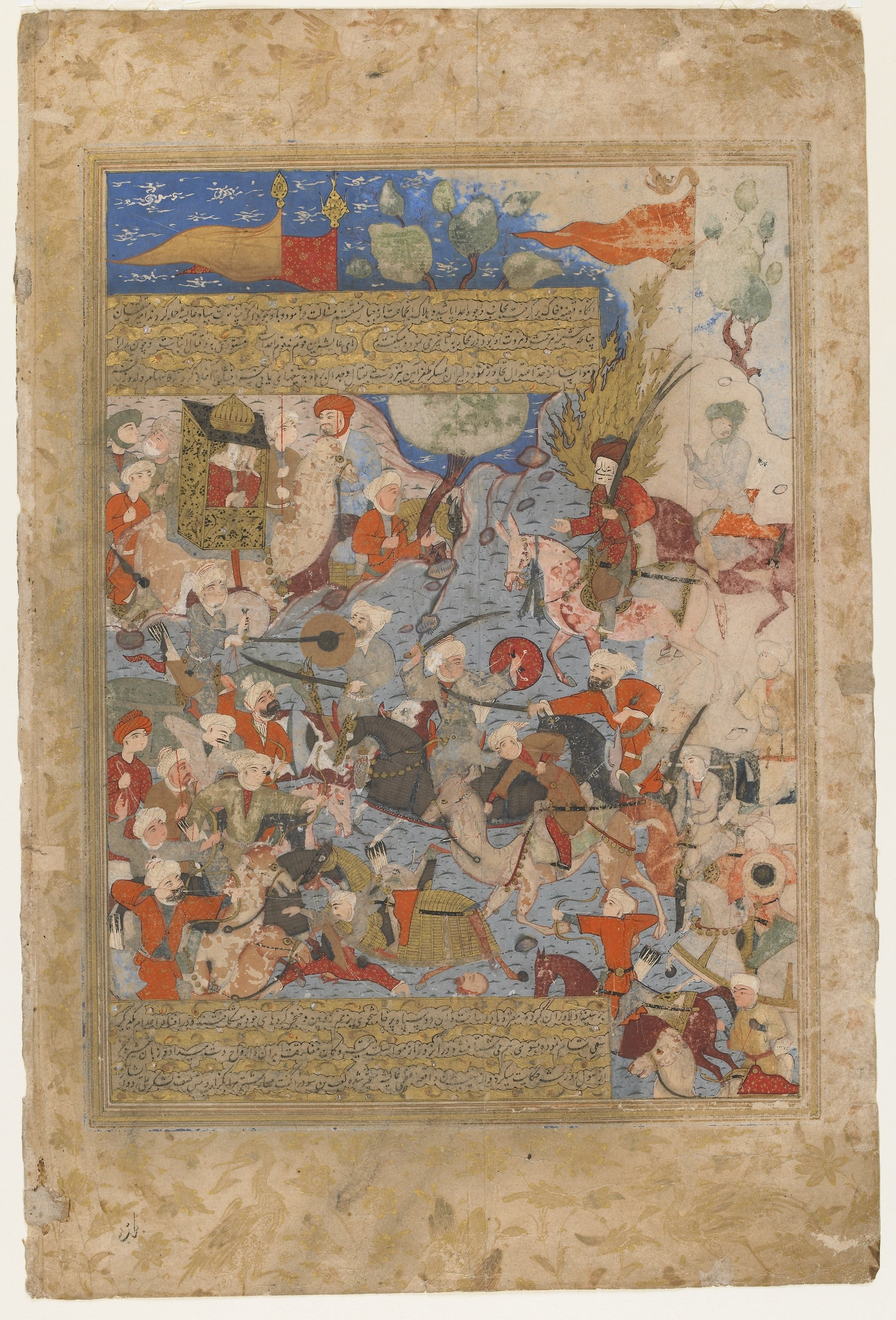
Battle of the Camel
The battle takes its name from an animal. In 656 CE, outside the garrison city of Basra, Aisha -- widow of the Prophet Muhammad -- sat in a howdah atop her camel at the center of the rebel lines. As fighters on both sides fell, one man after another stepped forward to grab the camel's reins and lead the charge. One by one, they were cut down. The fighting stopped only when Caliph Ali's troops hamstrung the camel and captured Aisha alive. This was the Battle of the Camel, the first armed conflict between Muslims, and it tore apart the community that Muhammad had built.
A Murder That Shattered Unity
The crisis began with an assassination. In 656 CE, Uthman, the third Rashidun caliph, was killed by discontented provincial groups who had traveled to Medina to demand reforms. Uthman had been widely accused of nepotism and corruption, and prominent companions -- including Talha, Zubayr, and Ali himself -- had criticized his conduct. Yet his murder shocked the Muslim community. Ali, the Prophet's cousin and son-in-law, was chosen as the fourth caliph. But the circumstances of his rise were poisoned from the start. Talha and Zubayr, both early converts and senior companions of Muhammad, pledged allegiance to Ali but later broke their oaths. Some early sources report they did so under duress, claiming swords had been held over their heads. Others dispute this. What is certain is that both men left Medina and joined forces with Aisha in Mecca.
The Widow's March
Aisha had called for the deposition of Uthman before his death. But when Ali succeeded him, she reversed course, publicly blaming Ali for the assassination. Her motivations were complex -- personal grievances against Ali dated back years, and the sources reflect competing loyalties within the early Muslim community. In October 656 CE, Aisha, Talha, and Zubayr marched from Mecca toward Basra with between six hundred and nine hundred fighters. The war chest was funded partly by Ya'la ibn Munya, Uthman's former governor of Yemen, who had brought public funds with him to Mecca. Talha and Zubayr, both ambitious for the caliphate, reportedly quarreled over who would lead the prayers during the march, with Aisha mediating between them. The rebels covered some 1,300 kilometers to reach Basra, where they hoped to rally support.
Blood Outside the Gates of Basra
Ali marched from Medina with his own forces, largely recruited from Kufa. Before the fighting began, he established rules of engagement: wounded and captured enemies were not to be killed, those who surrendered were not to be fought, and fleeing soldiers were not to be pursued. Only captured weapons and animals could be taken as war booty. These instructions would later form the basis for Islamic jurisprudence on the conduct of civil wars. Despite negotiations, the battle erupted. The fighting centered on Aisha's camel, which became both a rallying point and a target. Talha was struck by an arrow -- some sources attribute it to Marwan ibn al-Hakam, a figure on his own side -- and bled to death. Zubayr withdrew from the battle and was killed while departing. The lowest casualty estimates count 2,500 dead from Aisha's forces and 400 to 500 from Ali's.
Mercy and Its Limits
When the camel fell and Aisha was captured, Ali treated her with respect. Both Ali and his representative Ibn Abbas reprimanded her for the bloodshed and for leaving her home in violation of Quranic instructions for the Prophet's widows. But she was not harmed. Ali ordered her half-brother, Muhammad ibn Abi Bakr, to escort her back to the Hejaz. Ali pardoned the surviving rebels and entered Basra without further violence. He moved his capital to Kufa and attempted to reunify the community. It would not hold. The Battle of the Camel was only the opening act of the First Fitna, Islam's first civil war. The deeper conflict with Muawiya, the governor of Syria, still lay ahead -- a struggle that would eventually split Islam into its Sunni and Shia branches, a division that persists fourteen centuries later.
From the Air
Located at 30.500N, 47.817E, outside the city of Basra in southern Iraq. The battle took place on the flat alluvial plains near the confluence of the Tigris and Euphrates rivers. Nearest airport is Basra International Airport (ORMM), approximately 25 km to the east. The terrain is flat, arid, and marked by date palm groves along the waterways. The Shatt al-Arab waterway is the dominant geographic feature to the east. Best viewed at 5,000-10,000 feet for the full scope of the terrain.