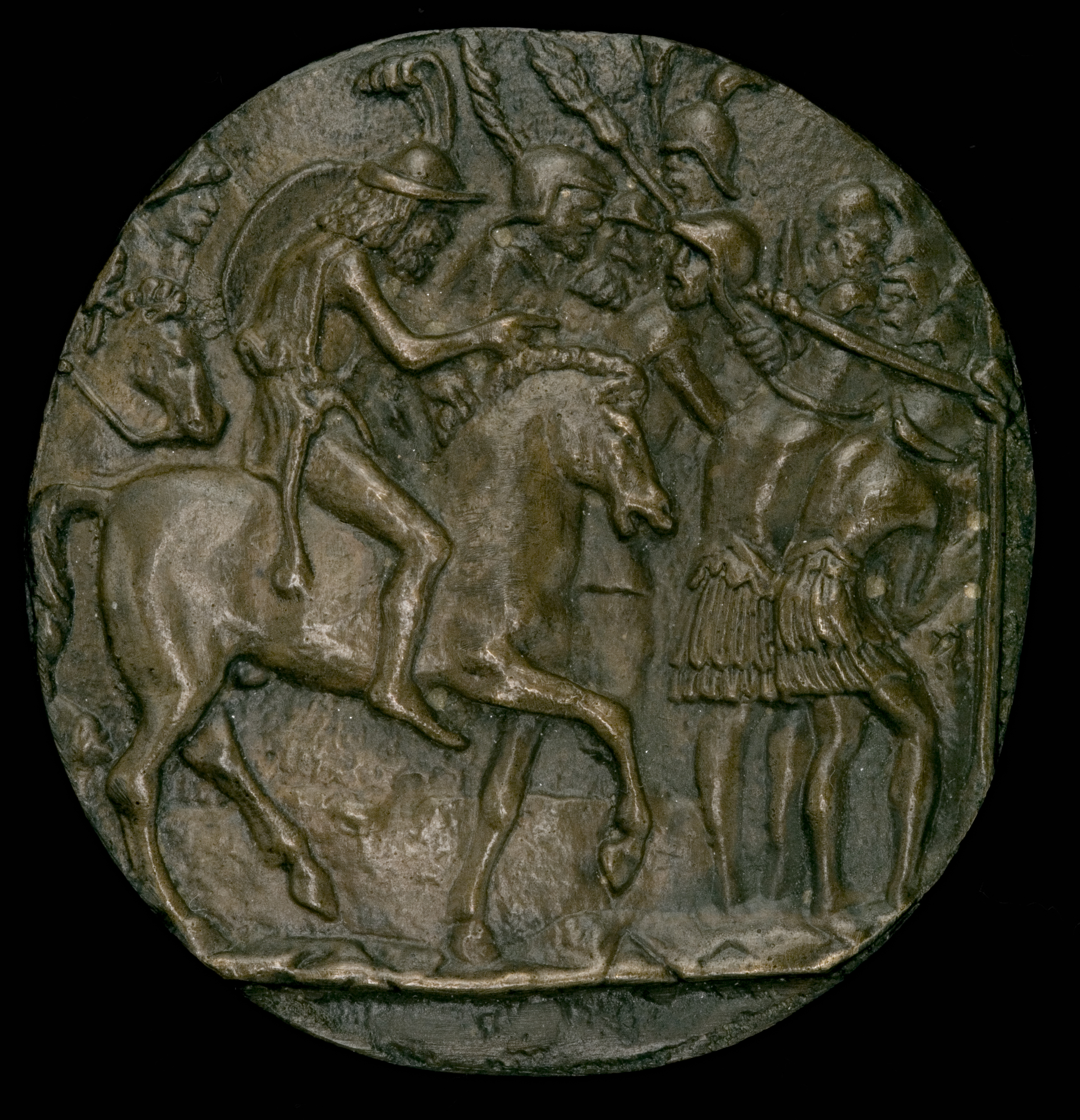
Battle of the Caudine Forks
It is called a battle, but no one fought. No soldier on either side was killed or wounded. In 321 BC, during the Second Samnite War, an entire Roman army marched into a mountain valley near Benevento in Campania, found the exit blocked, turned back, and discovered the entrance sealed behind them. The Samnites had executed one of the most elegant military traps in ancient history -- and then spent days debating what to do with their catch. The Battle of the Caudine Forks was not a clash of arms. It was a masterclass in deception, a philosophical argument about mercy and strategy, and a humiliation that Rome would neither forget nor forgive.
Ten Soldiers Dressed as Shepherds
According to the Roman historian Livy, the trap began with ten Samnite soldiers disguised as herdsmen. The Samnite commander Gaius Pontius had learned that the Roman army was camped near Calatia. He sent the ten men out with a single, rehearsed story: the Samnites were besieging Lucera in Apulia, far to the east. The Roman commanders swallowed the bait entirely and decided to march to Lucera's relief. Worse, they chose the faster route -- through the Caudine Forks, a valley flanked by mountains that could be entered only through two narrow defiles. The road they took would later become part of the Appian Way, Rome's most famous highway. On that day, it was a corridor into a cage. The Romans marched in through the western defile near the town of Arienzo, crossed the central plain, and found the eastern defile near Arpaia barricaded with felled trees and boulders. When they turned back, the western entrance was sealed and held by Samnite troops.
The Father's Impossible Advice
Gaius Pontius had won without shedding a drop of blood, and he had no idea what to do next. He sent a letter to his father, the elder statesman Herennius, asking for counsel. The reply was swift: release the Romans immediately, unharmed and without conditions. Pontius rejected this as absurd and wrote again. The second reply was the opposite: kill every last Roman soldier. Baffled by the contradiction, the Samnites summoned Herennius in person. The old man explained his logic with brutal clarity. If they freed the Romans with kindness, they would earn lasting Roman friendship and gratitude. If they killed the entire army, Rome would be so weakened that it could not threaten the Samnites for generations. But any middle course -- humiliating the Romans without destroying them -- would be the worst of all outcomes. It would leave Rome stinging for revenge while still strong enough to take it.
The Middle Way That Herennius Feared
The Samnites chose exactly what Herennius warned against. They forced the trapped Roman army to pass under a yoke -- a symbolic gateway of spears that signified total submission -- and extracted a peace treaty. The Romans were sent home alive but disgraced, burning with the kind of humiliation that nations remember for centuries. Herennius had predicted this precisely. The peace extracted under duress held no moral weight in Roman eyes, and the humiliation of the yoke became a wound in Roman honor that demanded blood. The Samnite Wars would continue for decades, and Rome would eventually crush Samnite independence entirely. The mercy that Herennius counseled might have changed the trajectory of Italian history. The ruthlessness he offered as an alternative would have at least bought time. The compromise his son chose accomplished neither.
What the Valley Actually Looked Like
Modern historians have questioned Livy's dramatic geography. The western defile near Arienzo is over a kilometer wide -- hardly the narrow throat of rock that Livy describes. The eastern end near Arpaia is narrower but still wide enough that a determined force could have marched through while staying out of range of missiles thrown from the surrounding hills. The distance between the two defiles is only 4.5 kilometers, raising doubts about whether the Samnites could have blocked the western entrance in the brief time it took the Romans to cross the plain, discover the eastern barricade, and return. The historian Nicholas Horsfall has suggested that Livy's account was influenced by contemporary descriptions of Alexander the Great's campaigns, which featured similar mountain-pass ambushes in the dramatic landscapes of Central Asia. Whether the geography was as imprisoning as Livy claims, the psychological reality was absolute: the Romans believed themselves trapped, and they surrendered without resistance.
From the Air
Located at 41.15°N, 14.53°E in the Campanian mountains east of Naples, near modern Benevento. The valley of the Caudine Forks lies between the towns of Arienzo (western defile) and Arpaia (eastern defile), roughly 4.5 km apart. The terrain is rolling hills and moderate mountains, not the dramatic gorge Livy described. Nearest major airport is Naples International (LIRN), approximately 50 km west. Best viewed from 4,000-6,000 feet to appreciate the valley's shape and the two approach defiles.