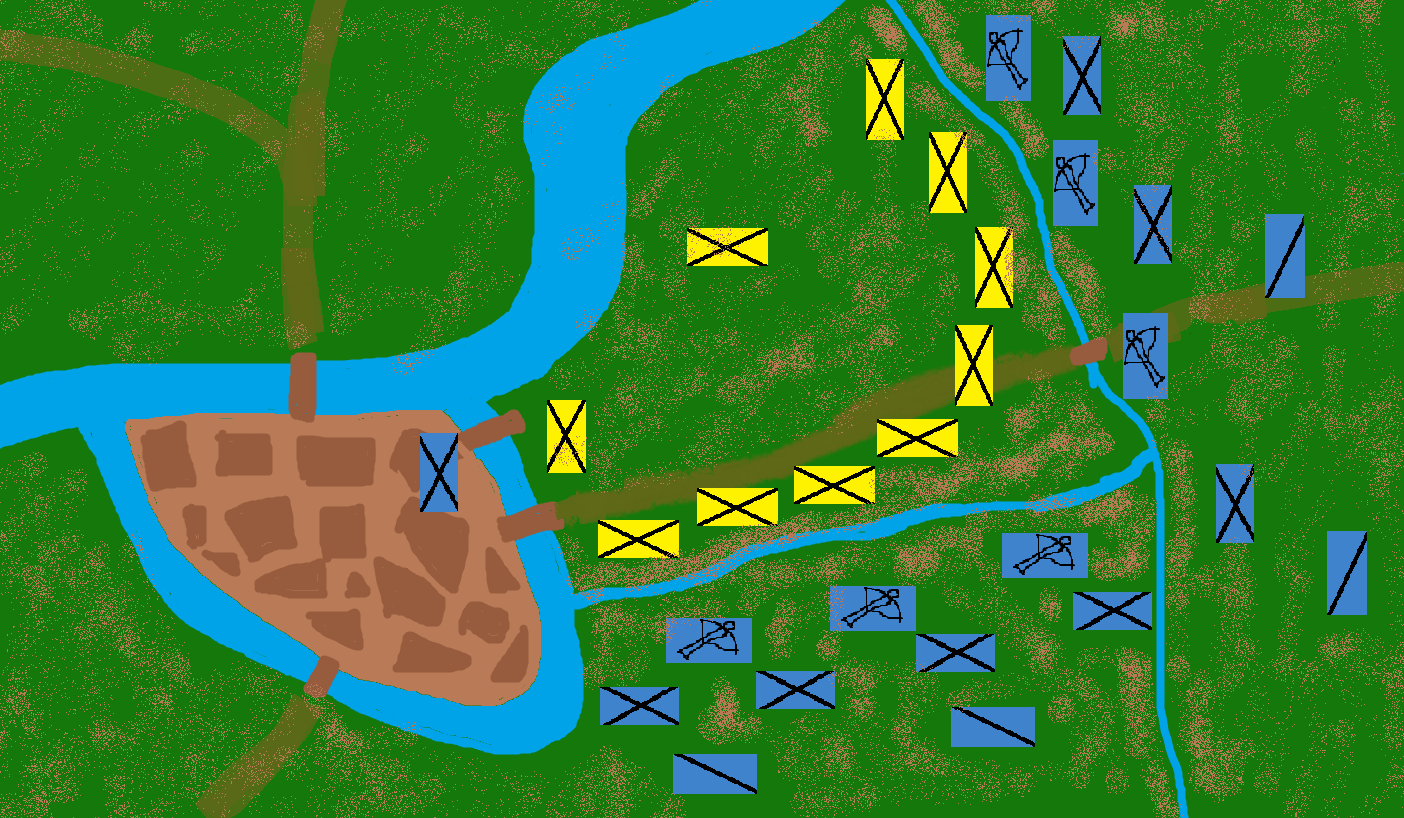
Battle of the Golden Spurs
They collected 500 pairs of golden spurs from the mud. On July 11, 1302, in a field outside Kortrijk crossed by streams and ditches, Flemish militia armed with pikes and a vicious spiked club called the goedendag had done the unthinkable: they had destroyed an army of French knights, the most formidable military force in Europe. The spurs, stripped from the bodies of fallen noblemen, were hung in the Church of Our Lady as trophies. The battle would reshape European warfare, prove that common men could defeat armored cavalry, and become the founding myth of Flemish national identity.
The Bruges Matins
The revolt began with a massacre. After two years of French military occupation, the cities of Flanders rose up on May 18, 1302. In Bruges, rebellious citizens who had fled the city returned and murdered every Frenchman they could find, an event known as the Bruges Matins. King Philip IV of France immediately organized an expedition of 8,000 troops, including 2,500 heavily armored men-at-arms under Count Robert II of Artois, to crush the rebellion. Meanwhile, 9,400 men from the civic militias of several Flemish cities assembled to face them. Most of the Flemish nobility had sided with France, leaving command of the rebel army to John and Guy of Namur. Even the city of Ghent refused to join, though 700 volunteers came anyway under Jan Borluut.
A Prepared Killing Ground
The Flemish chose their battlefield carefully. They assembled at Kortrijk on June 26 and laid siege to the French-held castle. When the French army approached, they positioned themselves in a field crossed by numerous ditches and streams, some draining from the Leie River, others dug by the Flemish themselves and concealed with dirt and branches. The terrain would limit cavalry charges, the main French battle tactic. The Flemish formed deep defensive lines in a square formation, their rear covered by a curve in the river, their front presenting a wedge of bristling pikes and goedendags. According to the Annals of Ghent, they had just ten cavalrymen. Against them came 2,500 mounted knights, each theoretically worth ten footmen.
The Charge That Failed
French crossbowmen opened the battle, forcing their Flemish counterparts back. Then Robert II of Artois made his decision. Worried that his infantry would be overwhelmed, he recalled them to clear the way for a cavalry charge. The French horsemen unfurled their banners and advanced. They struggled across the streams, some falling from their horses, but most completed the crossing. Then they charged. The Flemish wall of pikemen did not break as expected. Many French knights were knocked from their horses and killed with the goedendag, its spike designed to penetrate the gaps between armor plates. When the reserve of 700 men-at-arms was ordered forward, they turned back instead to protect the baggage train. Robert II himself rode forward with his remaining knights, was surrounded, unhorsed by a lay brother named Willem van Saeftinghe, and killed.
The Infantry Revolution
The death of Artois shattered French resolve. Survivors fled into the marshes, where they were easy targets, and the retreating infantry was pursued and cut down. Unusually for the period, the Flemish took few prisoners for ransom. The French lost over 1,000 men, including 75 important nobles, among them the Constable of France and two Marshals of France. Though France would win the overall Franco-Flemish War, the battle demonstrated that well-trained, well-equipped infantry could defeat heavy cavalry. The tactics used at Kortrijk would be copied at Bannockburn (1314), Crecy (1346), and Agincourt (1415). July 11 is now the official holiday of the Flemish Community in Belgium, and a museum in Kortrijk preserves the memory of the day common men made French chivalry bleed.
From the Air
The battlefield is located at 50.829N, 3.276E near the Groeninge stream on the outskirts of modern Kortrijk, Belgium. The Groeninge Monument and Museum mark the site today. The Leie (Lys) River flows through Kortrijk and was a key terrain feature in the 1302 battle. The flat Flanders plain is visible in all directions. Nearest airport: Kortrijk-Wevelgem (EBKT) just 5km southwest. Ghent is 45km northeast, Bruges 50km northwest. The medieval town center of Kortrijk with its belfry and churches provides visual reference points.