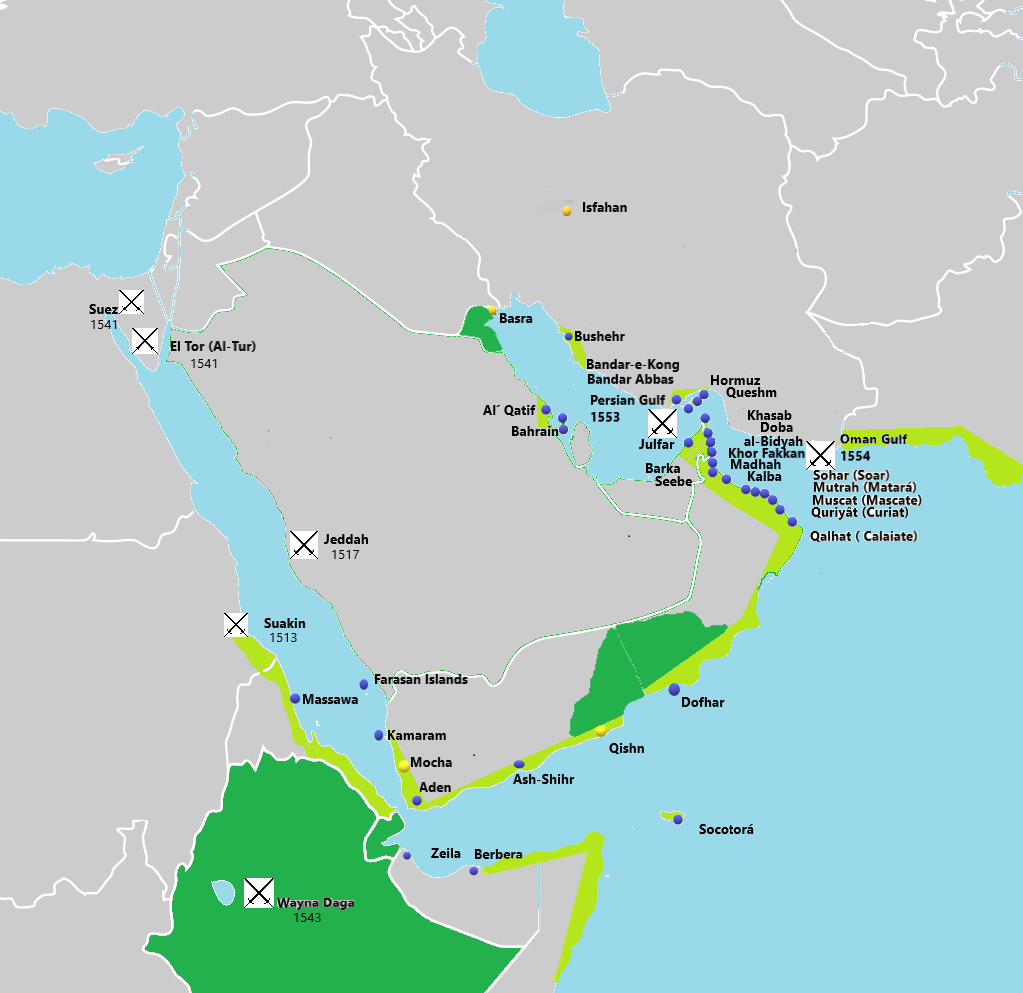
Battle of the Gulf of Oman
Seydi Ali Reis thought he had outsmarted the Portuguese. On August 10, 1554, the Ottoman admiral ordered his entire fleet to veer sharply toward shore at the last moment, slipping past the guns of Dom Fernando de Meneses's armada near Cape Musandam. The Turks crept along the Omani coast, their rowers exhausted, confident they had left their enemy far behind. What Seydi Ali did not know -- and would never fully grasp, even years later when he wrote his memoirs -- was that the very same fleet he thought he had eluded was already waiting for him at Muscat.
Empires on the Water
The Gulf of Oman in the mid-sixteenth century was a contested corridor between two expansionist empires. Since their failed Siege of Diu in 1538, the Ottomans had been trying to break Portugal's stranglehold on Indian Ocean trade routes. Admiral Piri Reis, famous for his cartographic brilliance, had led expeditions around the Arabian Peninsula with limited success. His replacement, Murat Reis, fared no better. By late 1553, Sultan Suleiman the Magnificent appointed Seydi Ali as the new commander of Ottoman naval forces at Basra, ordering him to sail his fifteen galleys to Suez and consolidate Ottoman sea power. The problem was stark: every nautical mile of the route passed through waters the Portuguese controlled. From Goa, the Portuguese dispatched six galleons, six caravels, twenty-five foists, and twelve hundred soldiers under Dom Fernando de Meneses, son of the Viceroy, to intercept any Ottoman movement.
The Pilot's Gamble
After Seydi Ali's ruse on August 10, the Portuguese captains gathered aboard the flagship Sao Mateus to debate their next move. An experienced pilot offered an audacious suggestion: the winds along the Persian coast blew eastward, and if the fleet sailed north and then east, they could ride those currents back to the Omani coast ahead of the slow-moving Ottoman galleys. It was a gamble rooted in intimate knowledge of monsoon patterns. Dom Fernando took it. The Portuguese sailed north across the gulf, caught the favorable winds, and within days had anchored again at Muscat. The Turks, rowing leisurely against headwinds and resting their oarsmen, had no idea. Portuguese light craft shadowed them from a distance, tracking every mile of their progress.
Fire on the Water
On the morning of August 25, the Ottomans rounded Cape Suadi and found themselves staring at the impossible: the same armada they had dodged two weeks earlier, now positioned with a favorable westward wind. The Portuguese flagship Sao Mateus dropped anchor close to shore and opened fire. Nine galleys slipped past under the barrage, but a cannonball struck the tenth, killing several men and causing it to veer sharply. The disabled galley blocked the path of those behind it, and the formation collapsed. Portuguese caravels surged forward at full sail. Dom Jeronimo de Castelo Branco rammed and grappled two galleys, his crew hurling clay fire bombs before boarding. Turkish sailors jumped into the sea, where Portuguese foists cut them down in the shallows. Within half an hour, the trapped galleys surrendered.
A Two-Year Walk Home
Seydi Ali Reis escaped eastward across the Arabian Sea with his surviving galleys, fleeing toward Gujarat. The Portuguese caravels pursued him into the harbor of Surat, where the Gujarati governor sheltered the Ottomans but agreed to destroy their ships under Portuguese pressure. Stripped of his fleet, Seydi Ali began an overland journey that would take more than two years, crossing India, Afghanistan, and Persia before reaching Constantinople. He documented his travels in a memoir that remains a valuable historical source. Remarkably, he never realized that the fleet he encountered on August 10 and the one that destroyed his galleys on August 25 were one and the same. The Portuguese, meanwhile, returned to Muscat with forty-seven captured bronze cannons and celebrated a victory that cemented their dominance of the Indian Ocean trade routes for decades to come.
Ghosts of Empire
The waters off Cape Musandam remain some of the busiest shipping lanes in the world. Oil tankers now trace routes where galleys and caravels once maneuvered for advantage. The strategic logic has not changed: whoever controls access to the Persian Gulf controls a chokepoint of global trade. The battle of 1554 is largely forgotten outside specialist naval history, but its consequences shaped the balance of power across the Indian Ocean for the rest of the sixteenth century. The Ottomans never again mounted a serious challenge to Portuguese naval supremacy in these waters. Seydi Ali's memoir, with its blend of navigational detail and human stubbornness, survives as a reminder that even the best-laid plans can founder on the wind.
From the Air
Coordinates: 25.00N, 58.00E, over the Gulf of Oman near Cape Musandam. Best viewed at 10,000-15,000 ft for the strait geography. The Musandam Peninsula's dramatic fjord-like coastline is visible to the west. Nearby airports include Muscat (OOMS) and Khasab (OOKB). Clear skies are typical; haze may reduce visibility over the water.