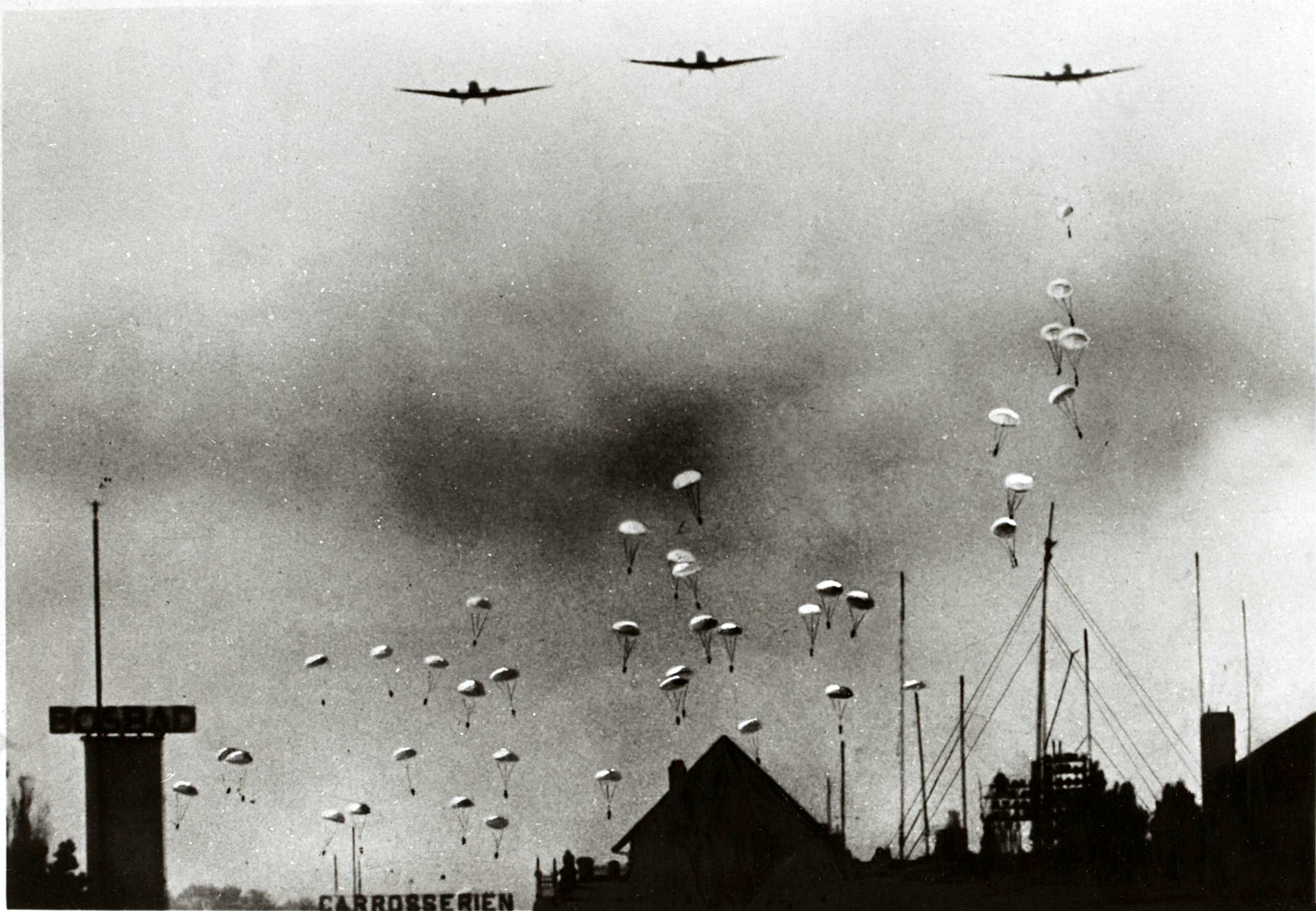
Battle of The Hague (1940)
Just before dawn on 10 May 1940, the people of The Hague heard the drone of aircraft and assumed - because the radio had been saying so for months - that the Germans were on their way to bomb Britain. Then bombs fell on the New Alexander Army Barracks. Sixty-six men died in their bunks. At the neighbouring Waalsdorp camp, another fifty-eight. By 4:15 a.m., transport planes were spilling Fallschirmjäger out over the airfield at Ypenburg with one specific objective on their orders: capture Queen Wilhelmina, capture the Dutch commander-in-chief Henri Winkelman, and end the war before breakfast.
The Largest Airborne Gamble of the War
It was the most ambitious paratroop operation any army had ever attempted against a capital city. Three airfields ringed The Hague - Ypenburg to the southeast, Ockenburg to the southwest, Valkenburg to the north - and at each one, the German plan was the same: bomb the runway, drop paratroopers, capture the field, fly in reinforcements, march on the palace. The Sponeck papers, later found on a captured officer, even included a map. They had thought of everything except the Dutch. The Hague's defenders were not the front-line army - that was off east, fighting along the Maas and the IJssel. Holding the capital were reserve units, depot troops, hussars on horseback, and conscripts who had been told repeatedly that the Netherlands would remain neutral as it had in 1914. They had hours, not days, to figure out that this was not a drill.
What Happened in the Sky Over Ypenburg
The first wave of Junkers Ju 52 transports lumbered in low and slow over the polders, three abreast, paratroopers crowded in the doors. Dutch machine gunners had time. They opened up on the transports themselves - not the parachutists, but the aircraft that carried them. Ju 52s caught fire mid-air. Others belly-landed in pastures and burned with men still aboard. The paratroopers who did jump came down scattered across drainage ditches and tulip fields, often in plain view of farmhouses where the people inside were trying to make sense of what they were watching. Some Germans drowned in the canals before they could shed their harnesses. Some were shot as they descended. Those who reached the ground found themselves in a country laced with water and fences, every road covered by a Dutch rifle. At Valkenburg, the runway was not even finished. The first wave of transports got down; the next wave found the strip blocked by burning aircraft and had to set down on the beach at Katwijk, where the destroyer HNLMS Van Galen turned her guns on them from offshore.
The Queen Refuses to Surrender
Wilhelmina was almost sixty when the bombs fell. She had been queen since she was ten years old. The Germans had assumed she would do what kings and presidents had done across the rest of occupied Europe - sign something, make a speech, hand over the keys. Instead, on 13 May, she boarded the British destroyer HMS Hereward at the Hook of Holland with her daughter Juliana and her grandchildren, sailed for England, and from a microphone in London began broadcasting back to her people as the voice of a government that had not surrendered, would not surrender, and was not in German hands. Her commander, Winkelman, was not so lucky. With Rotterdam burning and the Luftwaffe threatening to do the same to Utrecht and The Hague, he capitulated on 14 May to spare the cities. The official Dutch death toll for the Battle for The Hague alone was 515 soldiers. The civilian numbers were never tallied in full.
The Pyrrhic Victory in the Dunes
By the time the white flag went up, the German paratroopers were no longer paratroopers - they were fugitives in the dunes. Hans von Sponeck, who had jumped at Ockenburg expecting to march into the palace, was instead hiding in the sand with what remained of his men. Roughly 1,200 of his soldiers had already been packed onto ships and sent to England as prisoners of war - the first German POWs of the western campaign. Dutch sources count around 400 Germans killed, 700 wounded, 1,745 captured. But the most consequential number was metal, not men: 182 Junkers Ju 52 transports destroyed or stranded - the workhorse of the Luftwaffe's airborne arm, gone in a single morning. Albert Kesselring later wrote that the shortage of these aircraft contributed directly to Germany's defeat in the Battle of Britain and to the bloodbath at Crete a year later. The Dutch had lost. They had also broken the wing they were beaten with.
What the Dunes Remember
Walk the strip of coastline between Scheveningen and Katwijk today and the landscape gives almost nothing away. There are golf courses where transports burned. There are bike paths over ground where teenagers in field-grey lay dying for an idea their grandparents had not lived to question. The airfield at Ypenburg became a housing estate. Ockenburg is a park. Valkenburg is being redeveloped. The story is not in the soil but in the names on the small memorial stones: Dutch conscripts, mostly young, who had a few hours' notice that their country was at war and held on long enough to put Queen Wilhelmina on a destroyer bound for Britain. Without that, there is no government-in-exile. Without that, there is no Dutch voice on the BBC for five years. Without those few hours in the dunes, the war ends differently for the Netherlands.
From the Air
Coordinates 52.083°N, 4.317°E. The battle's three target airfields ring The Hague: Ypenburg (now a housing district just east of the city), Ockenburg (now parkland to the southwest near Kijkduin), and Valkenburg (north, near Katwijk and the Old Rhine). Recommended viewing altitude 2,500-4,000 ft for the whole arc. Nearest active airports today are Rotterdam The Hague (EHRD) about 12 nm south and Amsterdam Schiphol (EHAM) about 22 nm northeast. The North Sea coastline from Hook of Holland to Katwijk is the line of approach the Ju 52s flew at dawn.