Battle of the Head of Passes
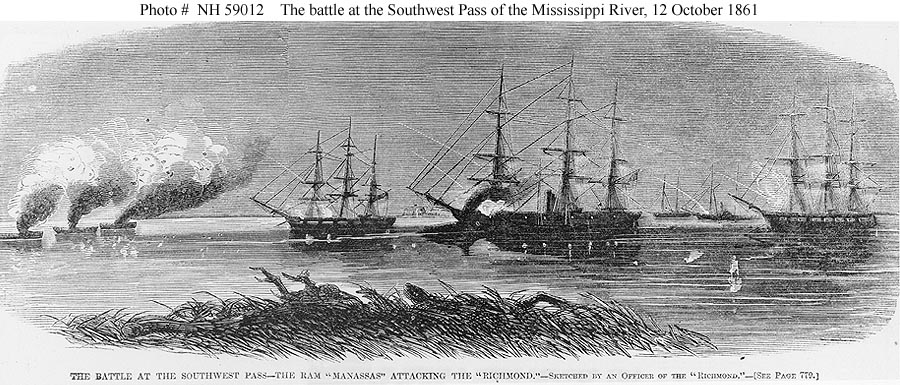
The first rocket flew backward. Inside the CSS Manassas -- a cigar-shaped ironclad with only two and a half feet of armored deck above the waterline -- the crew scrambled as the signal rocket they had fumbled ricocheted through their cramped, smoke-filled vessel. It was the early hours of October 12, 1861, and the Confederacy's motley 'mosquito fleet' was attempting something audacious: a pre-dawn assault on four heavily armed Union warships anchored at the Head of Passes, the point where the Mississippi River splits into its delta channels before emptying into the Gulf of Mexico. What followed was one of the most farcical, dramatic, and consequential small engagements of the Civil War -- a bloodless battle that routed the Union Navy, humiliated its commanders, and introduced a new weapon of war that would haunt the fleet for months.
Six Riverboats Against a Blockade
The Confederate naval defense of New Orleans was, by any conventional measure, hopeless. Confederate Naval Secretary Stephen Mallory sent Commodore Lawrence Rousseau to assemble a fleet, but President Jefferson Davis had authorized letters of marque and reprisal, and private investors snapped up every available ship in Louisiana hoping to profit from capturing Union merchantmen. Rousseau managed to purchase just six civilian riverboats for conversion into warships. Mallory replaced him with George N. Hollins, a former U.S. Navy veteran promoted to commodore, who arrived in New Orleans on July 31, 1861. Hollins organized the haphazard collection into something resembling a fighting force, though no one would have called it a navy. The strategy was to stall until two large ironclads -- the CSS Louisiana and CSS Mississippi -- could be completed. But those would not be launched until 1862. In the meantime, Hollins had his six lightly armed riverboats, three fire rafts, and a commandeered privateer ram.
The Ram That Changed Everything
The wild card was the CSS Manassas. Originally fitted out by private investors as a privateer, the ironclad ram was seized at gunpoint for the Confederate Navy when Lieutenant Alexander F. Warley led a boarding party to commandeer her at Fort Jackson. John A. Stevenson, representing the privateer owners, was so furious he left the vessel in tears. The Manassas was no warship by design -- she was slow, hard to maneuver, and armed with a single ram rather than guns. But she was armored, and in a river fight, that counted for everything. Hollins devised a plan: the Manassas would lead the attack, ramming the USS Richmond, the Union flagship. Behind her, three gunboats would advance abreast, each pushing a fire raft. Once the Manassas signaled success with three rockets, the gunboats would release the burning rafts to engulf the Union fleet. If the Manassas became an oven in the process, Hollins considered the sacrifice worthwhile.
A Fumbled Rocket and a Panicked Fleet
The Union force at the Head of Passes was formidable on paper. The Richmond, a screw sloop displacing 2,700 tons, mounted seven Dahlgren 9-inch smooth bores per side -- one broadside carried more firepower than the entire rebel fleet combined. Supporting her were two sailing sloops and a steam gunboat. But the fleet's commander, Captain John Pope, was rattled. Days earlier, the CSS Ivy's single rifled gun had lobbed shells over the Richmond from beyond range of Pope's smooth bores, and Pope had written in alarm that he might 'be captured at any time by a pitiful little steamer mounting only one gun.' He had neglected to set up picket boats, illumination fires, or any early warning system. After moonset on October 12, the mosquito fleet struck. The Manassas surged through the darkness trailing black smoke and sparks, struck the Richmond a glancing blow, then lost power when one of her two engines was torn free by the impact. The fumbled rockets eventually fired, the fire rafts blazed, and the Union fleet -- panicked, anchorless, unable to see -- fled downstream.
Pope's Run
The aftermath was chaos. The Richmond grounded broadside on a river bar while the mosquito fleet's rifled guns peppered her from beyond the range of her smooth bores. The Richmond took only two hits -- one wrecking a boat on deck, another lodging in the hull through a gun port. Captain Handy of the Vincennes, misreading a signal, ordered his engineer to light a fuse to the ship's magazine and the crew to abandon ship. The engineer obeyed by lighting the fuse, then calmly cut off the burning end and threw it overboard, saving the vessel. By mid-morning, Hollins was running low on coal and ammunition. He ordered the fleet back upriver to Fort Jackson. The only prizes were a cutter full of abandoned cutlasses and an old leaky coal schooner. No one was killed on either side. Yet the Union Navy was mortified. Flag Officer McKean called it disgraceful. Secretary Gideon Welles dubbed it 'Pope's Run.' Admiral David Dixon Porter later declared it 'the most ridiculous affair that ever took place in the American Navy.'
Ram Fever and What Came Next
The Manassas, the Civil War's first ironclad to see combat -- five months before the famous Battle of Hampton Roads -- proved to be a one-shot weapon. She was too slow and unwieldy to bring her ram into decisive action once the Union fleet was moving. But her psychological impact was enormous. Pope wrote on October 14: 'Everyone is in great dread of that infernal ram. I keep a guard boat out upriver during the night.' This dread became known as 'ram fever,' and it spread through the Union fleet well beyond the Mississippi. Hollins returned to a hero's welcome in New Orleans, with the newspapers publishing wildly exaggerated accounts of the victory. The celebration was short-lived. Captain Pope resigned for health reasons. Captain Handy was shipped east. The Union organized the West Gulf Blockading Squadron under David G. Farragut and sent it to the delta in overwhelming force. Six months later, Farragut's fleet ran past Fort Jackson and Fort St. Philip, and New Orleans fell.
From the Air
Located at 29.157N, 89.254W at the Head of Passes, where the Mississippi River divides into its major distributary channels before reaching the Gulf of Mexico. Best viewed at 2,000-4,000 feet AGL to appreciate the dramatic branching of the river delta. The Head of Passes is identifiable as the last point where the main channel splits into the Southwest Pass, South Pass, and Pass a Loutre. Nearest airports: Belle Chasse Naval Air Station (KNBG) approximately 40nm upriver, South Lafourche Airport (KGAO) approximately 45nm west. The area is characterized by low-lying marshland, navigational aids, and active shipping traffic. River fog and haze are common, especially in morning hours.