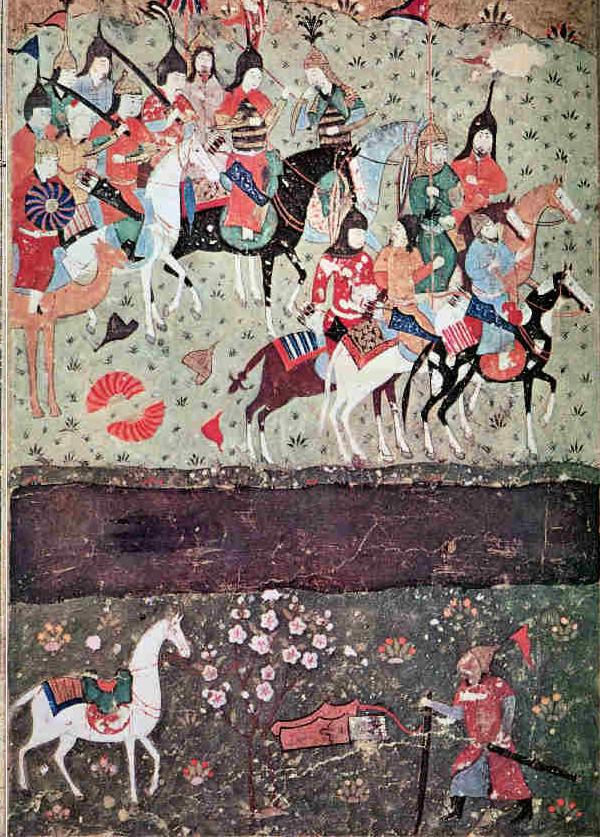
Battle of the Indus
Genghis Khan had destroyed cities, scattered armies, and hunted a shah across half of Central Asia. But on the banks of the Indus River on November 24, 1221, he witnessed something that stopped him mid-conquest: the last Khwarazmian prince, Jalal al-Din, cornered and defeated, riding his horse off a thirty-foot cliff into the churning river below rather than surrender. The Khan turned to his sons and said, according to the chroniclers, "Fortunate should be the father of such a son." He forbade his archers to shoot. It was, by any measure, one of the most dramatic moments of the Mongol conquests, a rare instance where Genghis Khan's respect for an enemy overruled his instinct to destroy.
An Empire in Collapse
The Khwarazmian Empire had been the dominant power in Central Asia, stretching from modern-day Iran to Afghanistan. That ended in late 1219 when Genghis Khan invaded with a force estimated between 75,000 and 200,000 soldiers. Shah Muhammad II, distrusting his own commanders, scattered his forces across garrison cities rather than meet the Mongols in the field. It was a catastrophic miscalculation. The Khan split his army and took Bukhara in February 1220, Samarkand in March. He dispatched Jebe and Subutai with 30,000 to 40,000 riders to hunt down the fleeing shah, who died on a Caspian Sea island in December 1220, stripped of everything he had ruled. His son Jalal al-Din inherited a title without a throne and enemies on every horizon.
The Prince Who Would Not Break
Where his father had run, Jalal al-Din fought. Escaping to Ghazni, he assembled roughly 65,000 soldiers from Khwarazmian loyalists, Qurlaq tribesmen, Khalaj fighters, and Turkmens. In the autumn of 1221, he achieved something nearly unheard of: he defeated a Mongol army. At the Battle of Parwan, his forces overwhelmed the general Shigi Qutuqu, sending shockwaves through occupied territories and sparking rebellions in Merv and Herat. But victory brought its own poison. Afghan troops under Saif al-Din Ighrak quarreled over the division of spoils and deserted, taking nearly half the army with them. Jalal al-Din understood immediately that without those men, he could not withstand what was coming. Genghis Khan took the defeat at Parwan personally. He gathered at least 50,000 troops and rode for Ghazni at the fastest possible pace, sending advance parties to seize the mountain passes between Ghazni and Peshawar.
Pinned Against the Water
Jalal al-Din retreated eastward toward the Indus with his diminished army and a column of refugees that slowed his march. The Mongols caught up on the morning the Khwarazmians were due to cross. With perhaps 30,000 men remaining, Jalal al-Din made the most of terrible circumstances. He anchored his left wing on a ridge running into the river and his right against the riverbank, eliminating the Mongols' preferred tactic of encirclement. In the confined space, superior numbers counted for less. Genghis Khan deployed his forces in a crescent, personally commanding the reserve to ensure his quarry could not escape. His sons Chagatai and Ogedei led the right and left wings. At dawn, the Khwarazmian left held firm despite wave after wave of Mongol reinforcements, while Ogedei's wing was actually driven back. For a few hours, the outnumbered defenders held their ground through sheer determination.
The Leap
Genghis found the solution on the ridge. He sent General Bela Noyan with an elite bahadur tumen to scale it and attack from the flank and rear. Many Mongols died during the climb, but those who reached the top shattered the Khwarazmian left. The right wing broke soon after. Amin Malik, commanding that wing, was caught and killed trying to flee toward Peshawar. Temur Malik fell in the melee at the center. Jalal al-Din fought on until noon, long past the point when the outcome was decided. When his cousin Akhash Malik finally persuaded him to flee, the prince charged through the Mongol lines on the ridge, reached the cliff edge, and rode his horse over. He hit the Indus in full armor and somehow reached the far bank. Genghis watched the entire feat and commanded his archers to hold their fire. Of the army that followed its prince into the water, only about four thousand survived. Mongol archers cut down the rest as they swam. The shah's camp, harem, and treasury were seized. His seven-year-old son and infant child were killed.
A Story Without an Ending
Jalal al-Din survived, and survival defined his remaining years. He rallied the remnants, defeated local Indian rulers, and carved out a small state in the Punjab. Genghis Khan, content with the destruction of Khwarazmian power, did not pursue aggressively. The Khan wintered in the Swat Valley, sent Ogedei to sack Ghazni, and eventually returned to Mongolia by 1225. Jalal al-Din later marched west across Makran, leaving India after three years to reassemble Khwarazmian authority in Persia and Anatolia. Queen Rusudan of Georgia, when he demanded her submission before the Battle of Garni in 1225, responded with a letter mocking how badly the Khwarazmshah had been beaten at the Indus. The insult stung because it was accurate, and because the defeat had produced the prince's finest moment. Today the battlefield on the Indus riverbank holds no markers or monuments. The river has shifted course over eight centuries, and the exact cliff from which Jalal al-Din leaped is unknown. What persists is the story itself: a cornered man choosing a thirty-foot fall over surrender, and a conqueror choosing admiration over annihilation.
From the Air
Located at 33.77°N, 72.18°E on the banks of the Indus River in what is now northern Pakistan, near the border of Punjab and Khyber Pakhtunkhwa provinces. The Indus flows south through a broad valley here, flanked by low ridges. Islamabad International Airport (OPIS) is approximately 60 km to the northeast. Attock Fort, where the Indus narrows between cliffs, is a nearby landmark. Best viewed at 5,000-10,000 ft AGL. The Indus is visible as a wide silver ribbon cutting through the landscape.