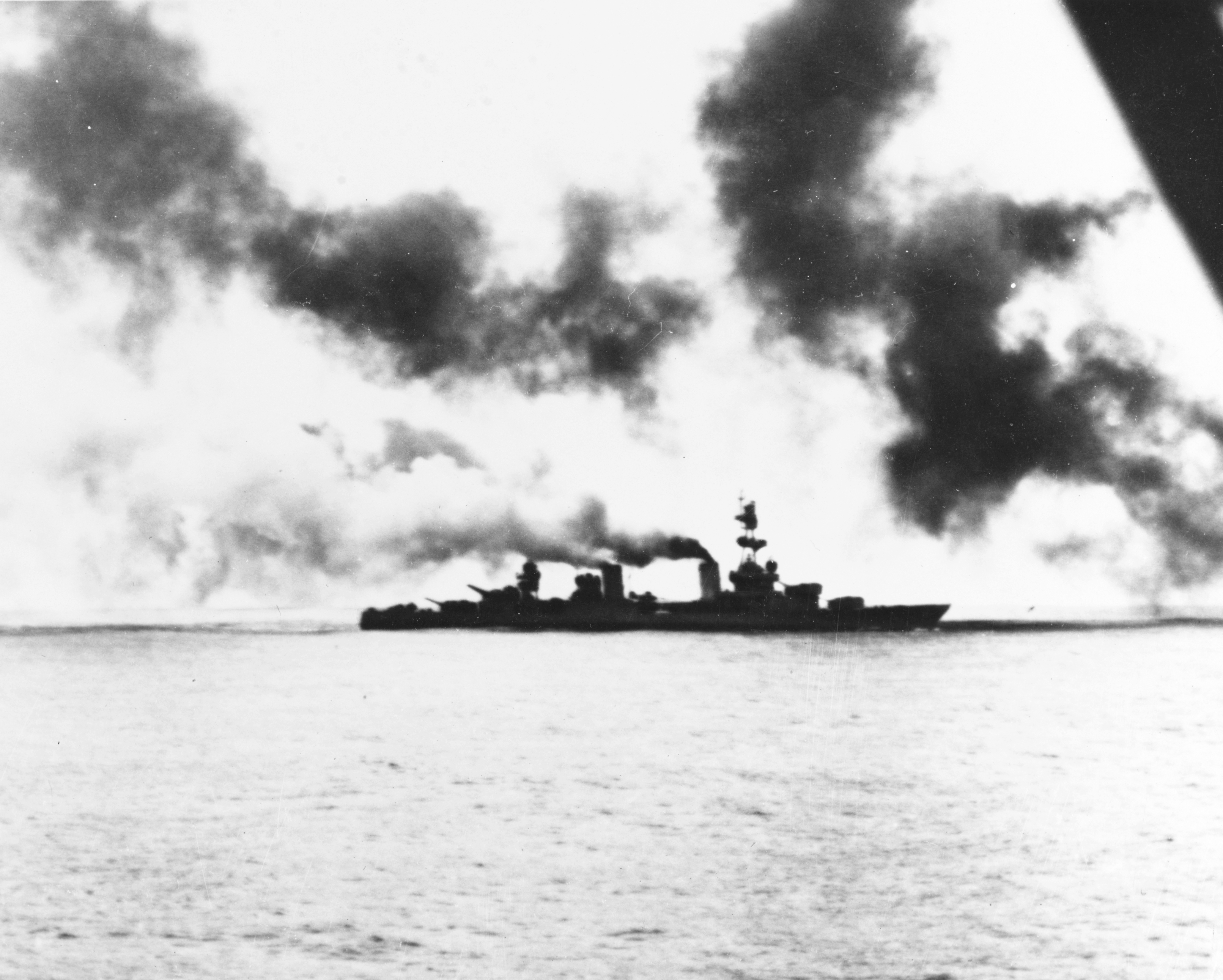
Battle of the Komandorski Islands
At 0840 on March 27, 1943, the heavy cruiser Nachi opened fire on the light cruiser USS Richmond at a range of 20,000 yards. The second and third salvos straddled the target. Within minutes, the waters south of the Soviet Komandorski Islands -- one of the loneliest stretches of the North Pacific -- erupted into what would become one of the last pure ship-to-ship gunnery engagements in naval history. No aircraft attacked. No submarines lurked beneath the gray swells. Two fleets slugged it out with their guns alone, as navies had done for centuries, in a battle that lasted nearly four hours and ended with the stronger force turning away.
The Aleutian Gambit
The battle's origins lay in one of the war's strangest campaigns. In June 1942, Japanese forces had occupied the western Aleutian islands of Kiska and Attu, the only American territory seized by a foreign power since the War of 1812. The occupation was a northern feint tied to the attack on Midway, and after Japan's devastating defeat there, the islands became a liability -- too far from Japan to supply easily, too symbolically important to abandon. American submarines and aircraft harassed Japanese shipping between the home islands and the Aleutians, so the Imperial Navy switched to nighttime convoy runs through fog and storm. Admiral Thomas C. Kinkaid, commanding American naval forces in the region, deployed a surface patrol group around Attu to intercept these convoys. On the night of February 19-20, 1943, the patrol sank the Japanese transport Akagane Maru west of Attu, signaling that the supply route was no longer safe.
Outgunned at Dawn
American intelligence estimated the next Japanese convoy escort at one heavy cruiser, one light cruiser, and four destroyers. They were wrong. The Japanese 5th Fleet had been reinforced, and the actual escort comprised two heavy cruisers -- Nachi and Maya -- two light cruisers, and four destroyers, under Vice Admiral Boshiro Hosogaya. Rear Admiral Charles McMorris commanded the American force: the heavy cruiser Salt Lake City, the light cruiser Richmond, and four destroyers. When the two forces stumbled upon each other in the gray predawn, McMorris found himself outgunned and outnumbered, facing a superior force with no possibility of air support. A squadron of B-24 Liberators launched from Adak to help but became lost in the fog and turned back.
Four Hours of Gunfire
What followed was a running battle across cold, heaving seas. Richmond drew first blood, landing 6-inch shells on Nachi's signal bridge at 0850, killing 11 and wounding 21 sailors, then hitting the flagship's torpedo compartment and control room in quick succession. Nachi's radio communications were severed, and she lost electrical power to her ammunition hoists. But the Japanese had weight of fire, and Maya began methodically punishing Salt Lake City. Between 0910 and 1152, five 8-inch shells struck the American cruiser, killing two men, starting fires, flooding compartments, and forcing her crew to transfer ballast water to correct a dangerous list. At 1153, saltwater contaminated an active fuel tank, extinguishing Salt Lake City's boiler fires entirely. The cruiser drifted to a stop, dead in the water, with Japanese shells still falling around her.
The Destroyers' Charge
With their heavy cruiser motionless and helpless, the American destroyers did the only thing they could: they charged. Bailey, Coghlan, and Monaghan turned toward the Japanese cruiser line for a torpedo attack while Richmond and Dale laid smoke screens to shield Salt Lake City. It was a desperate gambit -- three small destroyers against two heavy cruisers and their escorts. Bailey launched five torpedoes at 9,500 yards. All missed. She was hit twice by 8-inch shells, losing five men and coming to a stop herself. But in Salt Lake City's engineering spaces, her crew was fighting their own battle, manhandling powder and shells aft from forward magazines to keep the after guns firing. They relit the boilers, and the cruiser began to move again. By 1213, she was making 22 knots.
The Battle That Closed a Supply Line
Then, at 1230, the Japanese turned away. Hosogaya, concerned about fuel and ammunition after the prolonged engagement, and wary of the air attack he assumed must be coming, ordered his ships westward. The convoy never delivered its supplies. The decision cost Hosogaya his career -- he was relieved of command upon returning to Japan -- but it achieved something larger than anyone realized at the time. The battle ended all Japanese attempts to resupply their Aleutian garrisons by surface ship. Only submarines could make the run, and they could not carry enough to sustain the occupation. The airstrip under construction at Attu was never finished. Within months, American forces would recapture both islands. In the cold waters south of the Komandorski Islands, where Salt Lake City's crew had fought with their ship dead beneath them, the Japanese grip on American soil had been broken by an outnumbered force that simply refused to stop fighting.
From the Air
The battle occurred at approximately 53.10N, 168.21W, south of the Komandorski (Commander) Islands in the North Pacific, between the Kamchatka Peninsula and the western Aleutian Islands. This is open ocean with no nearby airports. The nearest airfields are Attu (now abandoned) and Shemya (PASY) in the western Aleutians, approximately 300 km east. Expect severe weather, persistent fog, high winds, and heavy seas typical of the North Pacific. The Komandorski Islands are visible from altitude as low-lying landmasses in otherwise featureless ocean. Nikolskoye on Bering Island is the nearest settlement.