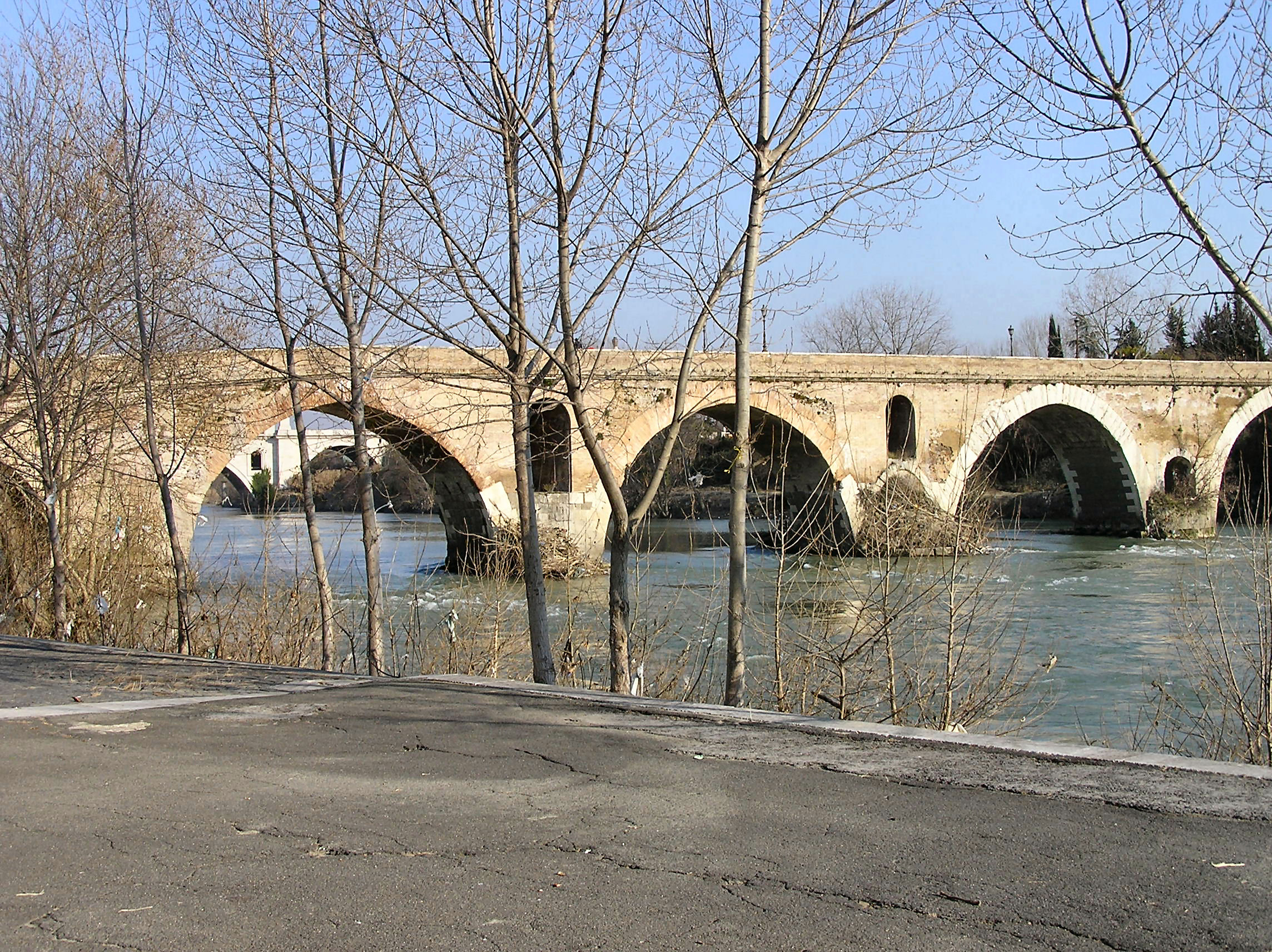
Battle of the Milvian Bridge
On the evening of October 27, AD 312, an emperor looked up and saw something in the sky. What Constantine actually witnessed above the Tiber that night - a solar halo, a cross of light, or nothing at all - has been debated for seventeen centuries. What is not debated is what happened the next morning. At the Milvian Bridge, where the Via Flaminia crosses the Tiber into Rome, Constantine's army destroyed the forces of his rival Maxentius, who drowned in the river while fleeing. The Western Roman Empire had a new master, and the world's largest religion had found its imperial champion.
A System Designed to Fail
The battle was the product of a political architecture that could not hold. Emperor Diocletian had designed the Tetrarchy - rule by four - as a solution to the empire's chronic succession crises. When he stepped down on May 1, AD 305, the system immediately began to unravel. Constantine, son of the Western Emperor Constantius, was proclaimed Augustus by his father's troops at Eboracum (modern York, England) when Constantius died on July 25, AD 306. In Rome, Maxentius, son of the retired emperor Maximian, seized the title of emperor that same October. By 312, the two men were brothers-in-law - Constantine had married Maxentius's sister Fausta - but family ties meant nothing when the empire was at stake. Constantine gathered roughly 40,000 soldiers and marched south into Italy, winning battles at Turin and Verona before approaching Rome itself.
The Sign in the Sky
The vision is the part of the story everyone remembers, and no two ancient sources tell it the same way. Lactantius, writing closest to the event, says Constantine had a dream the night before the battle commanding him to mark his soldiers' shields with a Christian sign. Eusebius of Caesarea, in his later Life of Constantine, describes something far more dramatic: the emperor saw a cross of light above the sun, accompanied by the Greek words meaning "In this sign, conquer." Modern historians have proposed everything from a solar halo phenomenon known as a sun dog to pure invention. Constantine's own coinage tells a more ambiguous story - he continued minting coins depicting the solar deity Sol Invictus until 325, more than a decade after the battle. His triumphal arch in Rome, erected to celebrate the Milvian Bridge victory, attributes his success to divine intervention but displays no overtly Christian symbols.
Collapse at the River
Maxentius made a critical error in positioning. Rather than defending from behind Rome's formidable walls, he arrayed his army on the north bank of the Tiber with the river at their backs, likely near a pontoon or wooden bridge constructed alongside the partially destroyed stone Milvian Bridge. Constantine opened with a cavalry charge that shattered Maxentius's horsemen, then advanced his infantry. Maxentius's troops fought stubbornly but were steadily pushed toward the water. When Maxentius ordered a retreat, there was only one way out - across the makeshift bridge. The structure collapsed under the weight of fleeing soldiers. Those stranded on the north bank were killed or captured. Maxentius's elite Praetorian Guard, knowing they would receive no pardon, fought to the death where they stood. Maxentius himself drowned in the Tiber, dragged under by his armor. His body was fished from the river, decapitated, and his head paraded through the streets of Rome.
The World After the Bridge
Constantine entered Rome on October 29, AD 312, staging a grand arrival ceremony. In a calculated act of clemency, he promised the Senate there would be no revenge against Maxentius's supporters - a sharp break from the bloody purges that typically followed Roman civil wars. The following year, Constantine and his Eastern co-emperor Licinius issued the Edict of Milan, granting official tolerance to Christianity throughout the empire. Within a generation, a faith whose adherents had been fed to lions in Roman arenas became the dominant religion of the state that had persecuted it. The Milvian Bridge itself still stands, remodeled over the centuries but occupying the same crossing point on the Tiber where the Via Flaminia has carried travelers into Rome for over two thousand years. In Italian, it is called Ponte Milvio - or sometimes Ponte Molle, the "soft bridge" - and today it is better known for its love locks than its legions.
From the Air
Located at 41.94N, 12.47E, the Milvian Bridge (Ponte Milvio) crosses the Tiber in northern Rome. It is visible from low altitude as one of many bridges spanning the river. The Via Flaminia, the ancient road it carries, runs northeast from the bridge. Fiumicino Airport (LIRF) lies approximately 25 km to the southwest. Ciampino Airport (LIRA) is about 18 km to the southeast. Best viewed at 2,000-4,000 feet to see the bridge's relationship to the Tiber and the ancient road network.