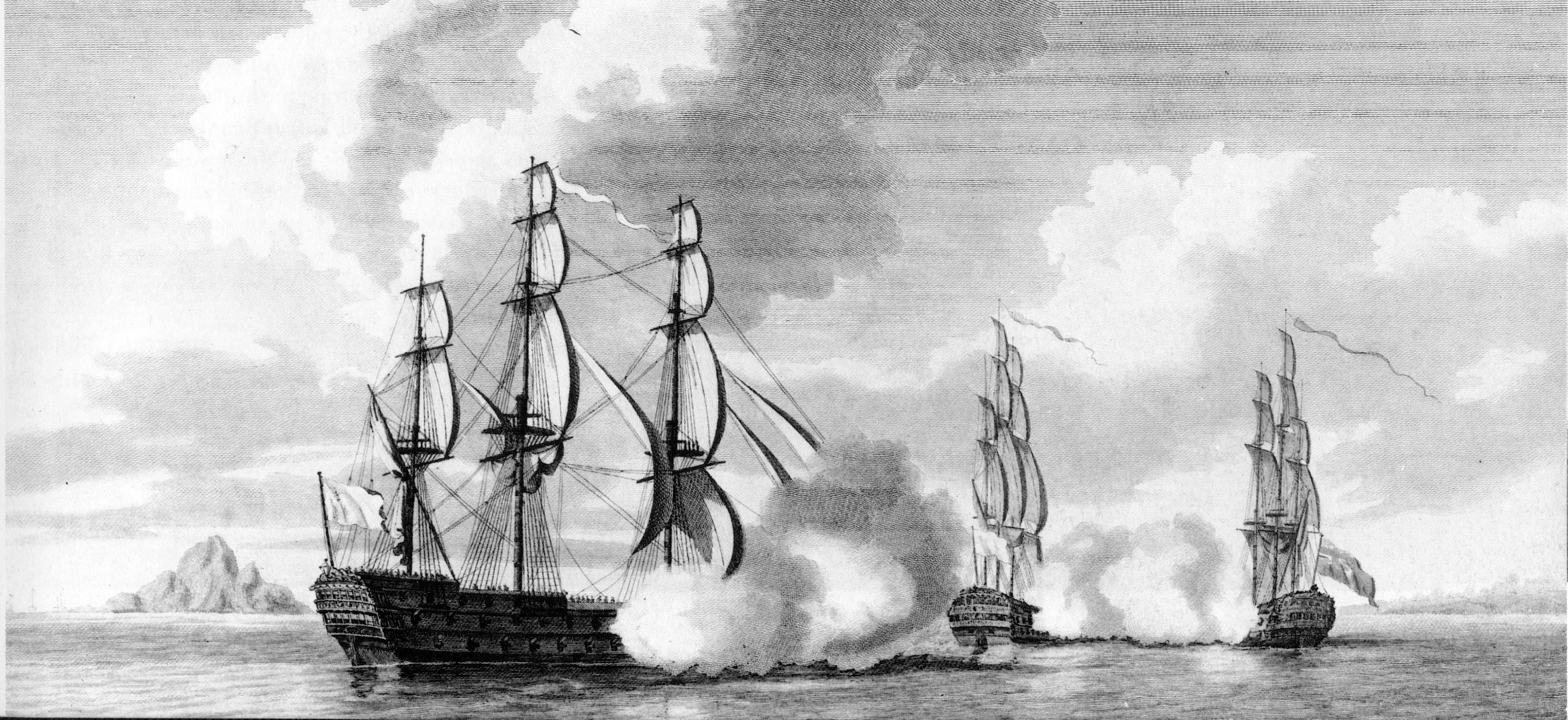
Battle of the Mona Passage
The French ships were already broken when Samuel Hood found them. A week earlier, at the Battle of the Saintes, Admiral Rodney's fleet had smashed the Comte de Grasse's invasion force and ended France's plan to take Jamaica. Most of the French navy scattered or surrendered. But a handful of damaged vessels under Captain Georges-Francois de Framond limped through the Mona Passage -- the eighty-mile strait separating Hispaniola from Puerto Rico -- hoping to reach the safety of Cap-Francais before the British noticed they were gone. Hood noticed.
The Saintes and Its Aftermath
Between April 9 and April 12, 1782, one of the decisive naval engagements of the American Revolutionary War unfolded near a cluster of small islands between Guadeloupe and Dominica known as Les Saintes. Admiral George Brydges Rodney commanded the British fleet; the Comte de Grasse led the French. The stakes were Jamaica itself -- France intended to invade, and de Grasse's fleet was escorting the troop transports that would make it happen.
Rodney's victory was thorough. He broke the French line, captured de Grasse's flagship, and scattered what remained of the invasion force. The immediate threat to Jamaica dissolved. But Rodney knew that damaged French vessels were still at large in the Caribbean, and any that reached a friendly port could be repaired and returned to service. On April 17, he dispatched Rear-Admiral Sir Samuel Hood with a division of ten warships to hunt them down.
Copper Against Canvas
Hood's squadron sailed toward Saint-Domingue and found the French in the Mona Passage. Framond commanded a small, battered flotilla: two 64-gun ships of the line -- his own vessel and the Jason -- along with a pair of frigates and a smaller ship. The Caton had taken damage at the Saintes on April 9. The Jason had collided with another ship the following day and was limping badly. They were making sail for Cap-Francais, but making it slowly.
The technological gap sealed their fate. Hood's ships carried copper sheathing on their hulls, a relatively recent British innovation that prevented barnacle growth and maintained speed over long voyages. The damaged French vessels, already slower from battle damage, could not outrun copper-bottomed pursuers. Hood's ten ships bore down on Framond's five with the inevitability of arithmetic. The chase was less a question of seamanship than of physics -- clean hulls against fouled ones, fresh rigging against torn canvas.
Four Ships Taken
The engagement on April 19 was brief and lopsided. Hood's warships overtook the French and forced them to fight on unfavorable terms. The Jason and the Caton, both 64-gun ships of the line, were captured together at the cost of four British sailors killed and six wounded. One of the French frigates was also taken, with four British dead and eight wounded in that action. A fourth vessel, captured by HMS Champion, rounded out the haul. Only one French ship -- a 32-gun frigate -- managed to escape with minimal damage.
Framond's small fleet had never stood a realistic chance. Outnumbered two to one, outgunned by Hood's 98-gun flagship alone, and sailing crippled ships, his options had been limited to flight from the moment the British sails appeared on the horizon. The battle was less a contest than a conclusion -- the final act of the Saintes, played out a week later and a hundred miles to the east.
Captured Hulls, Long Afterlives
Hood rendezvoused with Rodney at Port Royal, Jamaica, on April 29. The combined fleet needed nine weeks of repair before it could sail again -- a measure of how badly both sides had been mauled at the Saintes.
The captured French ships found second lives under British colors. The Jason was renamed and pressed into Royal Navy service. The Caton became a prisoner-of-war hospital ship, moored off Saltash in Cornwall, where she served well into the Napoleonic Wars -- a warship turned into a floating ward for the enemies of a later conflict. The frigate Aimable was renamed HMS Aimable and served until 1811. The Ceres, originally a British sloop the French had captured, was rechristened HMS Raven, then recaptured by France in January 1783 and eventually sold in 1791 -- a ship that changed flags three times in a decade. As for Framond, the French navy court-martialed him on February 27, 1783. Found guilty, he was expelled from the service. His career ended not at sea but in a courtroom.
From the Air
Located at approximately 18.5N, 68.0W in the Mona Passage, the strait between the eastern tip of Hispaniola (Dominican Republic) and the western coast of Puerto Rico. The passage is roughly 80 miles wide and clearly visible from altitude as the gap between the two large islands. Nearest airports: Las Americas International Airport (SDQ/MDSD) in Santo Domingo to the west, or Luis Munoz Marin International Airport (SJU/TJSJ) in San Juan to the east. Mona Island, a small uninhabited plateau, sits in the center of the passage and serves as a useful visual reference point. The waters appear deep blue from altitude, contrasting with the lighter turquoise of the island shelves on either side.