Battle of the Plains of Abraham
The field was named for a farmer. Abraham Martin owned the plateau west of Quebec City's walls, a stretch of high ground overlooking the St. Lawrence River that, on the morning of September 13, 1759, became the stage for one of the most consequential battles in North American history. Fewer than 10,000 soldiers fought that day. The engagement lasted barely an hour. Both commanding generals died of their wounds. And when the musket smoke cleared, the course of an entire continent had shifted -- France's grip on its vast North American territories was broken, and the political geography that would eventually produce modern Canada began to take shape.
The Audacious Climb
General James Wolfe had spent a frustrating summer. After arriving with roughly 7,000 regulars and a fleet of 49 ships under Admiral Charles Saunders, the British had besieged Quebec for three months without breaching its defenses. A failed assault at Beauport on July 31 cost Wolfe 450 casualties against only 60 French losses. Illness swept the British camps; Wolfe himself was bedridden in August. But the young general, just 32 years old, devised a plan that depended entirely on secrecy and nerve. On the night of September 12, British troops drifted downstream in boats toward L'Anse-au-Foulon, a cove at the base of a steep cliff three kilometers upstream from Cap Diamant. When French sentries challenged the boats, a French-speaking Highland officer answered convincingly -- the defenders were expecting a supply convoy. Twenty-four volunteers under Colonel William Howe climbed the slope with fixed bayonets, overran a garrison of perhaps 40 militia, and secured the road. By sunrise, 5,000 British soldiers stood atop the Plains of Abraham.
Two Generals, One Fatal Hour
The French commander, the Marquis de Montcalm, faced a decision that has been debated by military historians ever since. He could have waited for Colonel Bougainville's 3,000-man column to arrive from upstream and attacked the British from two sides. Instead, Montcalm chose to strike immediately. "We cannot avoid action," he told an artillery officer. "If we give him time to establish himself, we shall never be able to attack him with the troops we have." At roughly 10 a.m., Montcalm rode forward on his dark horse, sword raised, leading approximately 3,500 soldiers toward the British line. Wolfe had prepared his men carefully -- each musket was loaded with two balls. The British held their fire as the French advanced, waiting in disciplined silence. When the range closed, the redcoats delivered what Captain John Knox described as "a remarkable close and heavy discharge." A second volley shattered the French formation. Wolfe, already wounded in the wrist, was struck twice more -- in the stomach and chest. Learning the French had broken, he murmured, "Now, God be praised, I will die in peace." He died on the field.
Montcalm's Last Words
The retreat turned into chaos. The 78th Fraser Highlanders pursued the fleeing French all the way to the city gates in what became the last successful Highland Charge in recorded military history, though they paid dearly for it, suffering the highest casualties of any British regiment that day. Montcalm, still mounted during the retreat, was struck by canister shot or musket fire in the lower abdomen and thigh. He managed to ride back into Quebec City, but his surgeon told him he had only hours to live. "All the better," Montcalm replied. "I will not see the English in Quebec." He died in the early hours of September 14 and was buried in a shell crater in the floor of the Ursuline chapel, a hole gouged by a British bombardment. British casualties totaled 658 killed or wounded. Five days later, on September 18, the city's garrison commander signed the Articles of Capitulation. Quebec belonged to Britain.
A War Not Yet Finished
The story did not end with one battle. The following April, the Chevalier de Levis marched 7,000 French troops back to Quebec and defeated the British at the Battle of Sainte-Foy, a bloodier engagement with roughly 850 French and 1,100 British casualties. The British garrison, ravaged by scurvy and reduced to 4,000 men during a terrible winter, retreated behind Quebec's walls. Both sides then waited for naval reinforcements from Europe. When the first ships appeared in mid-May, they flew British colors. The French cause in Canada was effectively finished. Montreal fell that September, and the Treaty of Paris in 1763 formally transferred New France to Britain, along with the eastern half of French Louisiana.
The Plateau Today
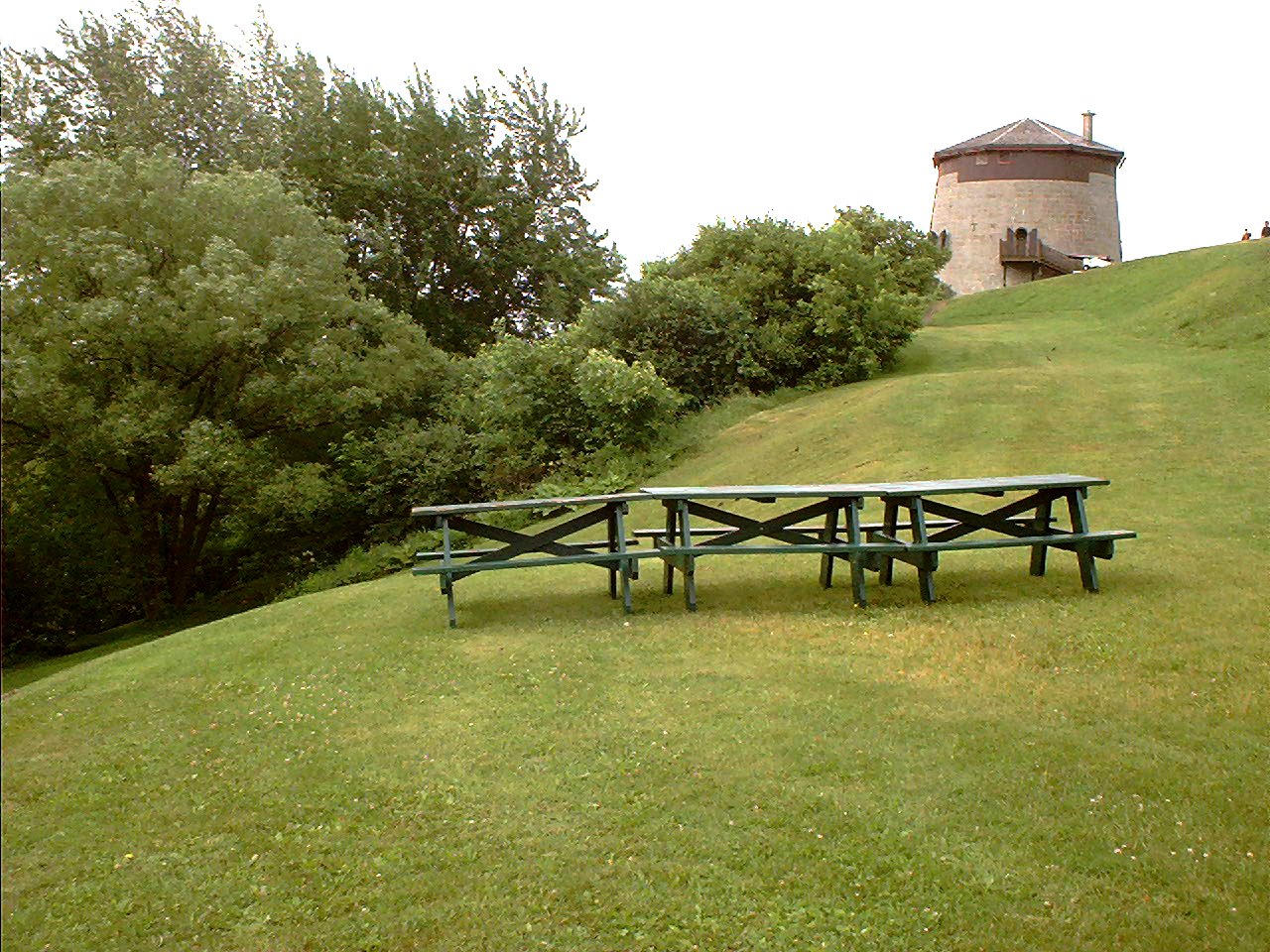
The Plains of Abraham are now The Battlefields Park, a sprawling green space within Quebec City where joggers, cyclists, and families share the ground where two armies collided. Martello towers built by the British between 1808 and 1812 still stand among the trees. The battlefield remains a charged symbol in Quebec. A planned reenactment for the 250th anniversary in 2009 was cancelled after separatist leaders called it an insult to francophone Quebecers and some groups threatened public disorder. Instead, thousands gathered for the Moulin a paroles, listening to recitations of 140 significant texts from Quebec history. In 2017, during construction in the Old City, workers unearthed a cannonball believed to have been fired during the 1759 siege -- a reminder that beneath the quiet parkland, the evidence of that pivotal hour still lies embedded in the earth.
From the Air
The Plains of Abraham sit at 46.80N, 71.22W on the Promontory of Quebec, a dramatic headland above the St. Lawrence River. From 3,000-5,000 feet, the rectangular green space of Battlefields Park is clearly visible west of Old Quebec's walled citadel. The Terrasse Dufferin boardwalk and Chateau Frontenac mark the eastern edge. Nearby airports include Quebec City Jean Lesage International (CYQB), approximately 10 nm to the west. The St. Lawrence River narrows dramatically here, and the steep cliffs the British climbed at L'Anse-au-Foulon are visible along the southern riverbank west of the citadel.