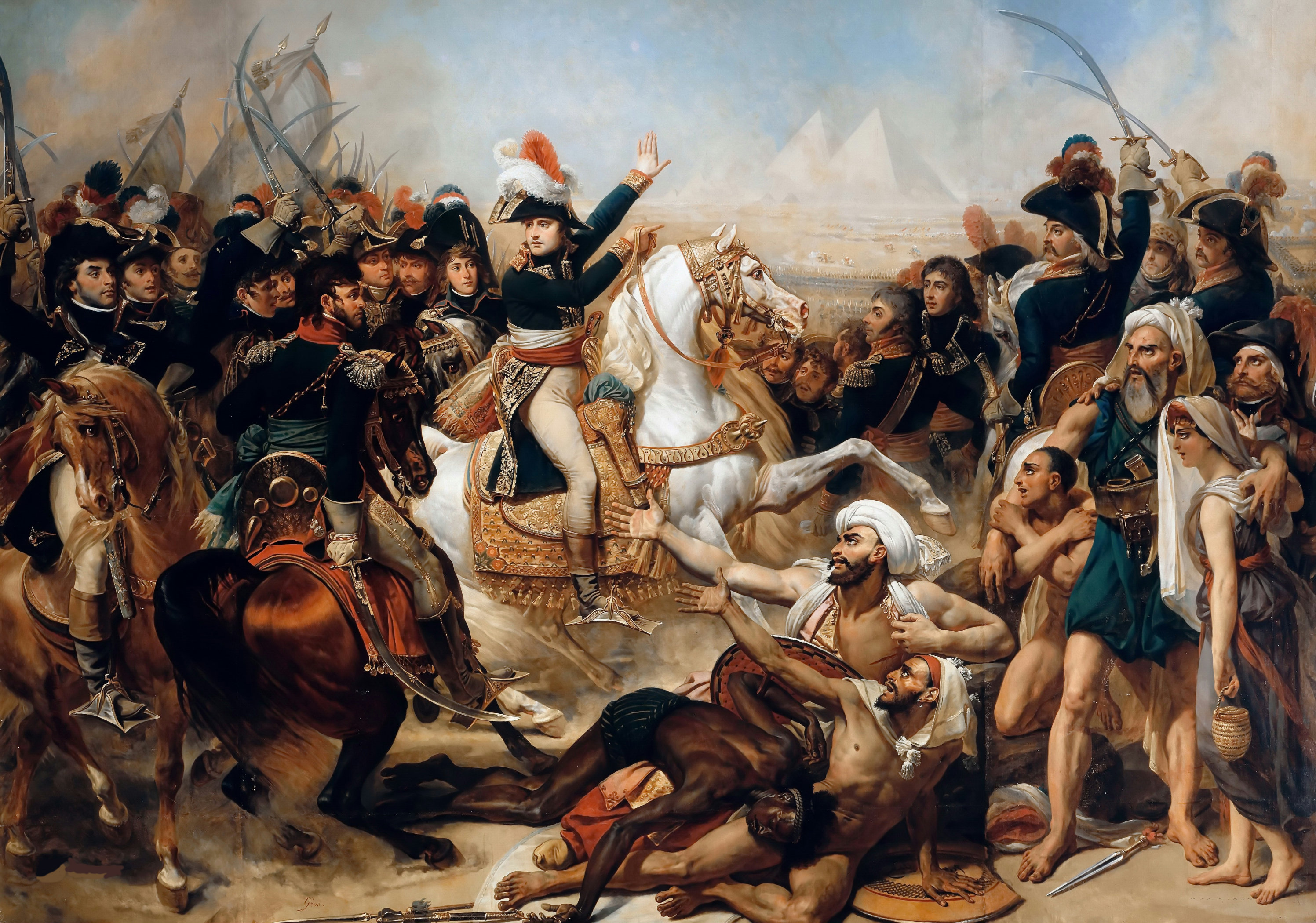
Battle of the Pyramids
Napoleon named the battle himself, of course. The pyramids were nine miles away, barely visible through the desert haze, but "Battle of Embabeh" lacked the grandeur a 28-year-old conqueror demanded. On 21 July 1798, near the village of Imbaba on the west bank of the Nile, French infantry squares met Mamluk cavalry charges head-on -- and the collision ended seven centuries of Mamluk military dominance in Egypt in a single afternoon. The victory opened Cairo's gates to Napoleon and announced France's ambitions in the East. It also set in motion a chain of events that would reshape Egypt permanently, even as Napoleon's own grand plans unraveled ten days later on the waters of Aboukir Bay.
A Desert March and a Dictator's Gamble
Napoleon had landed at Alexandria on 2 July 1798, seizing the city before marching his army of roughly 25,000 men across the scorching Nile Delta toward Cairo. The objective was to destroy the Mamluk beys -- a warrior caste of Georgian and Circassian origin that had dominated Egypt for centuries under nominal Ottoman suzerainty. Murad Bey and Ibrahim Bey, the two most powerful Mamluk commanders, gathered their forces to block the French advance. On 13 July, a preliminary clash at Shubra Khit gave Napoleon his first taste of Mamluk tactics: spectacular cavalry charges by armored horsemen who relied on speed, ferocity, and jewel-encrusted weapons that made each warrior a small fortune on horseback. French artillery shattered the Mamluk flotilla on the Nile that day, and Bonaparte learned what he needed: concentrated firepower could break anything the Mamluks threw at him.
Steel Against Silk
After an all-night march, the five French divisions reached Embabeh on the morning of 21 July. Napoleon arranged each division into a hollow rectangle -- infantry on the outside, cavalry and baggage within, cannon at the corners. Murad Bey anchored his right flank on the Nile, fortified the village of Embabeh with infantry and guns, and placed his magnificent cavalry in the center. Across the river, Ibrahim Bey's army watched helplessly, unable to cross. When the French advanced in echelon, Murad unleashed his horsemen. Wave after wave of Mamluk cavalry thundered against the French squares. One armored rider galloped to within steps of the formation and demanded single combat; he was shot down by a volley. At around 3:30 pm, Murad ordered a mass assault led by his defterdar, Ayyub Bey. The divisions of Desaix, Reynier, and Dugua held firm, pouring musket fire and grapeshot into the charging horsemen. The assault broke.
The Nile Ran Red
While the cavalry attacks failed in the center, General Bon's division stormed Embabeh itself. The garrison collapsed. Hundreds of defenders, trapped between the French advance and the river, plunged into the Nile and drowned. French losses were remarkably light -- 29 killed and 260 wounded by their own reports. The Mamluk side suffered catastrophically: thousands dead or wounded, including Ayyub Bey and perhaps 3,000 of the elite cavalry. Murad himself took a saber wound to the cheek but escaped southward into Upper Egypt with several thousand surviving horsemen, where he waged a guerrilla campaign until Desaix finally defeated him in late 1799. In Cairo, the remaining Mamluk forces simply dissolved. Bonaparte entered the capital three days later, on 24 July.
Triumph Turned Trap
Napoleon moved quickly to establish a French administration, attempting to win over the Egyptian ulama -- the religious scholars who held real social authority. The reception was cool. The chronicler Al-Jabarti poured scorn on French cultural pretensions, and clerics like Abdullah al-Sharqawi, who served on Napoleon's Cairo divan, privately described the occupiers as "materialist, libertine philosophers." Whatever goodwill existed evaporated under the weight of taxation and suppression. Yet the real blow came not in Cairo but at sea. On 1 August, ten days after the pyramids battle, Admiral Horatio Nelson caught the French fleet anchored in Aboukir Bay and destroyed it at the Battle of the Nile. Napoleon's army was now stranded in Egypt, cut off from France. The battle that was supposed to launch an Eastern empire instead became the beginning of a retreat. The Mamluks were broken, but France's grip on Egypt would last only three more years.
Painted Glory, Harsher Truths
The Battle of the Pyramids became one of the most painted episodes in Napoleonic mythology. Artists like Antoine-Jean Gros and Carle Vernet rendered the French squares and Mamluk charges in canvases that hung in the salons of Paris, and the battle earned an inscription on the Arc de Triomphe. Ridley Scott's 2023 film Napoleon depicted the engagement -- inaccurately, with French cannon firing at the pyramids themselves. The romanticized image endured partly because the reality was so lopsided: disciplined European infantry annihilating a medieval warrior aristocracy in the shadow of monuments older than both civilizations. For Egypt, the battle marked the beginning of the end of Mamluk power and the start of a turbulent modern era shaped by European intervention, Ottoman reassertion, and eventually the rise of Muhammad Ali Pasha.
From the Air
Coordinates: 30.08N, 31.20E, near the village of Imbaba on the Nile's west bank opposite central Cairo. The Giza Pyramids are visible approximately 9 miles to the southwest. From the air, look for the dense urban area of Imbaba along the Nile with the pyramids on the desert plateau to the west. Cairo International Airport (ICAO: HECA) is 25 km to the northeast; Sphinx International Airport (ICAO: HESX) is closer at roughly 10 km south. Best viewed at 5,000-8,000 ft AGL with the Nile and pyramids as landmarks.