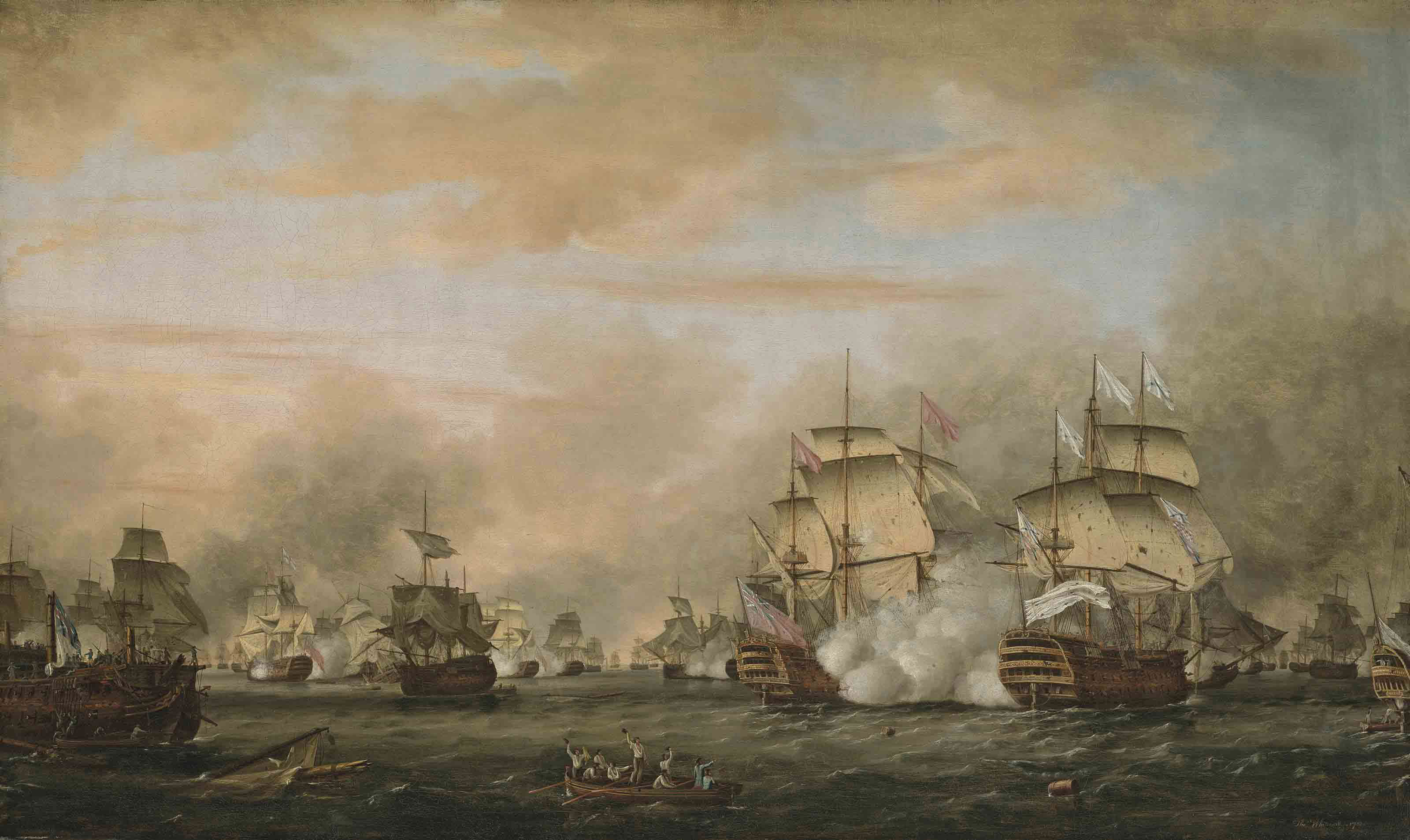
Battle of the Saintes
On the morning of April 12, 1782, a shift in the Caribbean wind changed the course of history. Somewhere between Guadeloupe and Dominica, in waters named for the tiny Iles des Saintes below, Admiral George Rodney's flagship HMS Formidable found a gap in the French battle line and drove straight through it. The maneuver - whether deliberate brilliance or opportunistic luck, historians still argue - broke a fleet that had been winning the war. Six months earlier, France's navy had bottled up the British at Chesapeake Bay and handed America its revolution. Now, in a single afternoon of smoke and splintered timber, Britain clawed back control of the Caribbean and the bargaining power that came with it.
The Stakes at Sea
The French fleet had good reason for confidence. Under the Comte de Grasse, they had achieved what no other navy could: a decisive intervention at Yorktown that forced Cornwallis to surrender and effectively ended Britain's hold on the American colonies. Now de Grasse was assembling an even more ambitious plan. With Spanish allies, France intended to seize Jamaica, Britain's most valuable Caribbean possession. A combined armada of 35 ships of the line, 10 frigates, and over 100 smaller vessels gathered at Fort Royal, Martinique, carrying troops for the invasion. Rodney, stationed at St. Lucia with 36 ships of the line, watched and waited. When French sails appeared on the horizon on April 8, the British gave chase through the channel between Dominica and Guadeloupe - waters where the trade winds could be fickle and the currents treacherous.
Through the Gap
What happened next became the most debated tactical moment in Age of Sail warfare. As the two fleets passed each other on opposite tacks, exchanging broadsides in the conventional manner, the wind suddenly shifted south. The French line buckled and gaps opened between their ships. Formidable, with Rodney aboard, turned to starboard and sailed through one of those gaps, her port guns blazing into ships that could not bring their own cannon to bear. Five more British vessels followed through the breach. The effect was devastating. Ships equipped with carronades - a relatively new short-range weapon that the British had recently installed on nearly half their fleet - poured fire into the exposed French vessels at close range. The French ship Glorieux lost all her masts and drifted helplessly. The flagship Ville de Paris, the largest warship in the world, fought on alone for hours before de Grasse finally struck his colors. He became the first French commander-in-chief captured at sea in living memory.
The Price of Breaking Through
The human cost was staggering and unevenly distributed. French casualties numbered around 2,000 dead and wounded, with over 5,000 taken prisoner, against roughly 250 British dead and 800 wounded. Four French ships of the line were captured and one sunk. De Grasse was brought to England as a prisoner, where he was treated with the courtesy that 18th-century warfare reserved for high-ranking captives but never allowed to forget his failure. The captured Ville de Paris, badly damaged, sank in a storm while being sailed back to England as a prize - along with HMS Ramillies and several other vessels in a hurricane that claimed more lives than the battle itself. The victory was real, but the sea took its own toll regardless of flags.
A War Reshaped at the Negotiating Table
When news of the battle reached Paris in June 1782, it landed like a cannonball on the peace talks already underway. The Franco-American alliance, which had seemed unshakeable after Yorktown, began to fracture. American negotiators led by John Jay recognized that French naval support was unlikely to continue and quietly dropped their more ambitious territorial demands. They abandoned their commitment to making no separate peace without France. Britain, no longer humbled, stiffened its bargaining position on the Newfoundland fisheries and Canadian borders. The planned invasion of Jamaica was permanently abandoned. France and Spain lost their leverage. The final Treaty of Paris in 1783 still recognized American independence - that horse had left the barn - but the terms were shaped as much by this Caribbean battle as by Yorktown. The Saintes did not undo the American Revolution, but it ensured that Britain's empire would survive it.
Ghosts Between the Islands
Today the Iles des Saintes are a quiet French archipelago where ferry passengers from Guadeloupe come for beaches and Tourment d'Amour pastries. The waters where broadsides once thundered are popular with divers and sailing yachts. Nothing on the surface marks where the Ville de Paris surrendered or where hundreds of sailors drowned in wreckage. But the battle echoes in unexpected places: in Derek Walcott's Nobel Prize-winning poem Omeros, set on nearby St. Lucia, where a retired British officer obsessively researches the engagement; in a Scottish pirate-metal band's 2017 album that takes its title track from the battle; in the simple fact that Jamaica remained British for another 180 years. The wind still shifts unpredictably in the channel between Guadeloupe and Dominica. From the air, the small islands that gave the battle its name appear as green dots in an immensity of blue - beautiful, tranquil, and bearing no trace of the day they accidentally became the fulcrum on which an empire's fate turned.
From the Air
Located at 15.78°N, 61.60°W in the channel between Guadeloupe and Dominica. The Iles des Saintes are visible as a small archipelago south of Guadeloupe's Basse-Terre. Best viewed from 5,000-10,000 ft for the full channel perspective between the two larger islands. Nearby airports: Pointe-à-Pitre Le Raizet (TFFR) on Guadeloupe, 40 nm north; Douglas-Charles (TDCF) on Dominica, 25 nm southeast; Canefield (TDCF) on Dominica's west coast. Terre-de-Haut has a small airstrip (TFFS). Clear weather typical except during hurricane season (June-November). The narrow channel between the islands funnels trade winds, creating variable conditions similar to those that shaped the 1782 battle.