Battle of the Scheldt
Admiral Bertram Ramsay had warned them in September: with the Germans controlling the Scheldt estuary, the port of Antwerp would be 'as useful as Timbuktu.' But Field Marshal Montgomery was focused on his gamble at Arnhem, and so the warning went unheeded. By the time the First Canadian Army finally turned to the Scheldt in October 1944, the Germans had flooded the polders, fortified the islands, and transformed Walcheren into what Hitler called 'Fortress Walcheren.' What followed was five weeks of the most brutal fighting Canadians would experience in the entire war: 12,873 casualties to open a port that could have been seized almost unopposed a month earlier.
The Cost of Delay
Antwerp's port fell to the British 11th Armoured Division on September 4, 1944, with its harbor 90% intact. It was the largest surviving port in Western Europe, captured almost undamaged. But Montgomery halted his forces short of the Albert Canal, focused instead on the audacious Operation Market Garden at Arnhem. Unknown to the Allies, only a single German division opposed them at that moment. The pause proved catastrophic. General Kurt Student's First Parachute Army arrived and dug in along the Scheldt. The Germans flooded vast stretches of low-lying polder, transforming the landscape into a waterlogged nightmare. When the Canadians finally attacked in October, they faced an enemy that had been given precious weeks to prepare.
Crossing the Leopold Canal
Lieutenant-General Guy Simonds planned to surprise the Germans with 'a barrage of flame.' On October 6, Canadian-built Wasp Universal Carriers equipped with flamethrowers advanced to the Leopold Canal, their fire intended to incinerate the defenders without a preliminary bombardment. The 7th Brigade was supposed to hold alone for forty hours until reinforcements arrived. They held for sixty-eight hours instead, under relentless German counterattack. Slit trenches filled with water and had to be dug out multiple times daily. The Germans had concentrated over one hundred 20mm anti-aircraft guns in the Breskens Pocket, using them as super-heavy machine guns that could shred a man to pieces within seconds.
Amphibious Assault
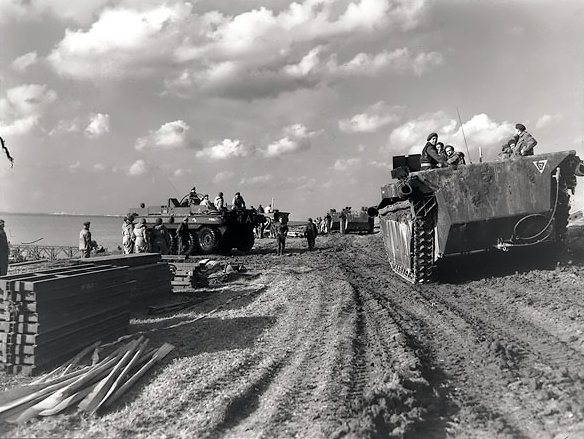
Simonds appreciated that the flooded polders made conventional advance impossible. He ordered amphibious vehicles called Buffaloes and Terrapins to carry the 9th Brigade across the flooded countryside, outflanking the German defenses. The vehicles' airplane engines roared so loudly that German anti-aircraft gunners over Flushing, thinking aircraft were approaching, fired into the dark. The amphibious assault caught the Germans off guard, but Field Marshal Model ordered General Eberding to 'annihilate' the Highland Brigade. Eberding threw in his reserves. When finally captured, Eberding told Canadian General Spry that his methodical approach showed 'weakness.' Spry replied that having lost 700 men in five days, he preferred keeping his soldiers alive.
The Walcheren Causeway
The approach to Walcheren Island narrowed to a single causeway, barely wide enough for two vehicles. The Black Watch regiment, already devastated at Verrieres Ridge in July, was ordered to attack down this exposed corridor. They were slaughtered. The Calgary Highlanders and Regiment de Maisonneuve followed. Finally, the 52nd Lowland Division, a Scottish mountain unit with unusual strength and stamina, arrived. Rather than continue the frontal assault, Major-General Hakewill-Smith outflanked the Germans, landing troops south of the causeway. On November 1, Royal Marine commandos landed at Westkapelle in daylight, supported by the battleship Warspite. The message to proceed, sent after agonizing deliberation, was simply 'Nelson.'
Blood and Logistics
The five-week campaign cost 12,873 Allied casualties, with 6,367 of them Canadian. The 3rd Canadian Division had fought almost continuously since D-Day, and ninety percent of battle exhaustion cases were men who had been in combat for three or more months. The soldiers complained bitterly that the Army was trying to 'get blood from a stone.' But when the minesweepers finally cleared the Scheldt on November 28, the first supply convoy reached Antwerp. Between November 1944 and April 1945, 2.5 million tons of supplies flowed through the port. Without it, the Allied advance into Germany would have been impossible. The Scheldt had been the key all along, just as Admiral Ramsay had warned. The delay made it one of the longest and bloodiest battles the Canadian Army would ever fight.
From the Air
The Battle of the Scheldt took place in the waterways and polders of the Scheldt estuary, centered around 51.42N, 4.17E, spanning northern Belgium and southwestern Netherlands. Key locations include Walcheren Island (visible from 3,000 feet), the South Beveland peninsula, the Leopold Canal, and the Breskens Pocket area. The terrain is extremely flat with extensive drainage canals. Antwerp's port (EBAW nearby) lies to the southeast. Much of the 1944 battlefield has returned to agricultural use, but the waterways and polders remain recognizable from the air.