Battle of the Shirts
The name tells you how the battle was fought. Blar-na-Leine -- the Battle of the Shirts -- earned its title because the fighting on that July day in 1544 was so intense, and the weather so warm, that the combatants threw off their plaids and fought in their linen undershirts. The violence that erupted on the shores of Loch Lochy was clan warfare at its most devastating. By the time the killing stopped, both sides had been effectively destroyed as fighting forces. According to tradition, the Frasers could muster only five survivors, while the MacDonalds and Camerons fared little better.
A Chieftainship Disputed
The cause of the battle was a succession crisis within Clan Ranald, a branch of the MacDonalds. The details of the dispute are tangled in competing clan loyalties and political maneuvering, but the essential question was who would lead the Clanranald. The matter drew in Clan Fraser of Lovat, whose chief Hugh Fraser, 3rd Lord Lovat, supported one faction, and Clan Cameron, who backed the opposing side along with the bulk of the Clanranald MacDonalds. The regent of Scotland, James Hamilton, 2nd Earl of Arran, had appointed Ranald Gallda as captain of Clanranald, but the clan rejected this external imposition. What might have been settled through politics or negotiation was instead resolved on the battlefield -- a pattern familiar across centuries of Highland history, where kinship, honor, and territorial control left little room for compromise.
Carnage at the Lochside
The battle took place on the north shore of Loch Lochy, in the Great Glen between Fort William and Fort Augustus. The Frasers, reinforced by Grants, faced the combined strength of the Clanranald MacDonalds and Camerons. The scale of the slaughter was extraordinary even by the standards of Highland warfare. Hugh Fraser, 3rd Lord Lovat, was killed in the fighting -- a blow from which the Clan Fraser took years to recover. The casualties on all sides were so severe that later accounts describe the battle as mutual annihilation. The traditional figure of five Fraser survivors is likely exaggerated, but the core truth -- that the clans involved suffered devastating losses -- is consistent across all accounts. The dead were buried near the shore where they fell.
A Battlefield Preserved
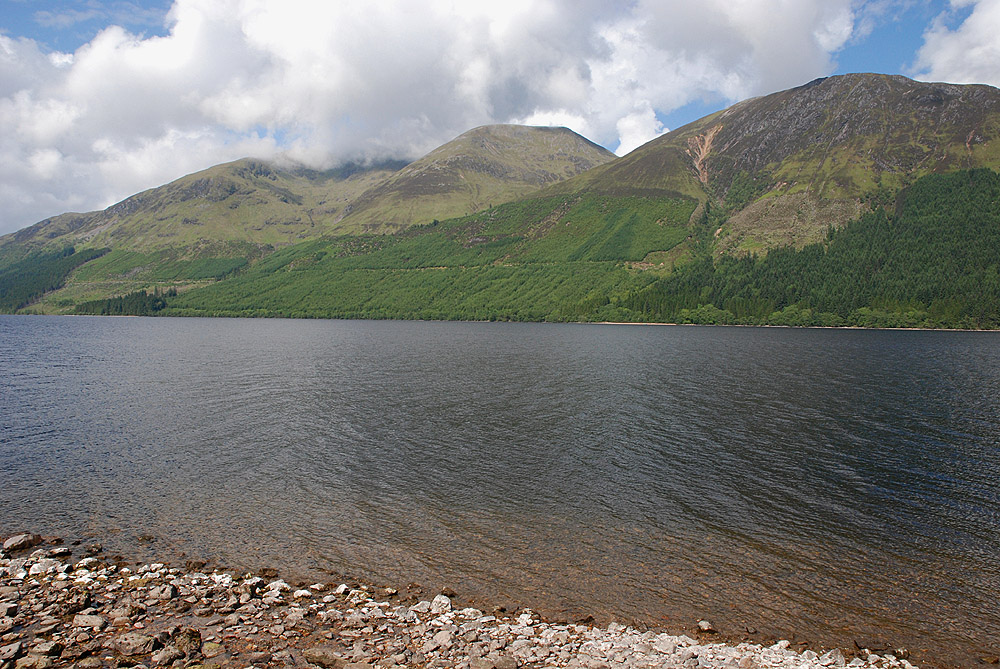
The site of the Battle of the Shirts is now protected by Historic Scotland as a designated battlefield. Loch Lochy stretches along the Great Glen in the same long, narrow ribbon of dark water that the combatants would have seen in 1544. The landscape has changed -- the trees are different, the roads are modern -- but the essential geography remains. The steep-sided glen, the loch, and the narrow strips of flat ground along its shores still define the space where the battle was fought. Lord Lovat, killed in the battle, was carried to Beauly Priory for burial, where his tomb can still be seen. The Battle of the Shirts belongs to a category of Highland conflict that defined the region for centuries: disputes over chieftainship and territory that were settled not by law but by the sword, at costs that neither side could afford.
From the Air
The Battle of the Shirts took place at approximately 57.03°N, 4.82°W on the north shore of Loch Lochy, in the Great Glen between Fort William and Fort Augustus. Loch Lochy is a narrow freshwater loch clearly visible from the air, aligned northeast-southwest along the Great Glen fault. The A82 road runs along its western shore. Nearest airports: Inverness (EGPE) approximately 35 nm northeast; Fort William/Ben Nevis airstrip approximately 15 nm southwest.