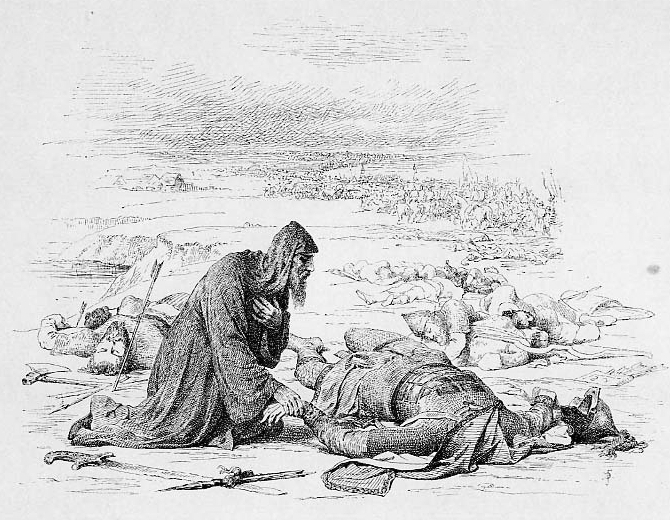
Battle of the Sit River
The scout Dorozh returned with the worst possible report: the army was already surrounded. Grand Prince Yuri II of Vladimir had sent 3,000 men ahead to locate the Mongol forces, and the answer came back as a death sentence. It was March 4, 1238, somewhere along the Sit River in what is now Tver Oblast, and the prince who had fled the burning ruins of his own capital was about to learn that there was nowhere left to run. The battle that followed lasted hours at most. Its consequences lasted two hundred years.
A Capital in Flames
The Mongol invasion of Kievan Rus' had been swift and catastrophic. Batu Khan, grandson of Genghis Khan, led his forces westward through the Russian principalities in the winter of 1237-1238, exploiting the frozen rivers as highways for his cavalry. Vladimir, the capital of the principality of Vladimir-Suzdal and one of the most important cities in medieval Russia, fell to the Mongols after a siege. Grand Prince Yuri II was not in the city when it was sacked -- he had gone north across the Volga to Yaroslavl to assemble a relief army. By the time he gathered his forces and marched back toward Vladimir, it was too late. The city was ashes. His family had perished in the Assumption Cathedral, where they had taken refuge and where the Mongols burned them alive.
Surrounded on the Sit
Yuri's army encamped along the Sit River, a modest waterway in the marshlands of northern Tver Oblast. The location was poor for defense -- the terrain offered no natural strongpoint, and the forces were spread thin. When the Mongol detachment under the commander Burundai struck, the Russians had barely begun to form battle lines. The engagement was less a battle than a rout. Yuri attempted to flee but was overtaken and killed on the riverbank. His nephew, Prince Vsevolod of Yaroslavl, died alongside him. The army of Vladimir-Suzdal, the last significant military force opposing the Mongol advance in northeastern Russia, ceased to exist in the space of a single afternoon.
The Weight of Two Centuries
The destruction on the Sit River ended unified Russian resistance to the Mongol invasion. In the years that followed, the Russian principalities submitted to the authority of the Golden Horde. Princes traveled to the Horde's capital at Sarai to receive permission to rule their own lands. Tribute flowed eastward. For nearly two centuries, the political, economic, and cultural life of the Russian lands operated under what historians call the Tatar Yoke -- a period of subjugation that shaped Russian identity, institutions, and foreign relations in ways that are still debated. The spot on the Sit River where Yuri II fell is now a quiet rural area near the village of Bozhonka in Sonkovsky District. There are no grand monuments, no fortress walls, no cathedral built to commemorate the dead. The landscape itself is the memorial: the marshes, the small river, the flat terrain where a prince's army was caught and destroyed, opening the door to an occupation that would not end until the reign of Ivan III in the late 15th century.
Echoes Across the Principalities
The ripple effects of the Sit River reached every corner of medieval Russia. With Yuri dead and his army annihilated, the Mongols faced no further organized opposition as they pushed westward. Cities that might have resisted chose submission instead, having seen what resistance brought. The battle accelerated the rise of Moscow, which proved more adept at navigating Mongol politics than its rivals, eventually collecting the authority and the tax revenue that would make it the dominant principality. In a sense, the disaster on the Sit River in 1238 set in motion the chain of events that would produce the centralized Russian state -- a state forged not in victory but in the long humiliation of foreign rule, and in the slow, patient accumulation of power by Moscow's princes under the Mongol shadow.
From the Air
Located at 58.07°N, 37.85°E near the village of Bozhonka, Sonkovsky District, Tver Oblast. The Sit River is a small waterway in flat, marshy terrain -- no visible monuments mark the battlefield. Best appreciated at low altitude (2,000-4,000 feet) where the river course and surrounding marshlands are visible. Nearest airports: Migalovo (UUEM) near Tver approximately 150 km south, Moscow Sheremetyevo (UUEE) approximately 280 km south-southwest.