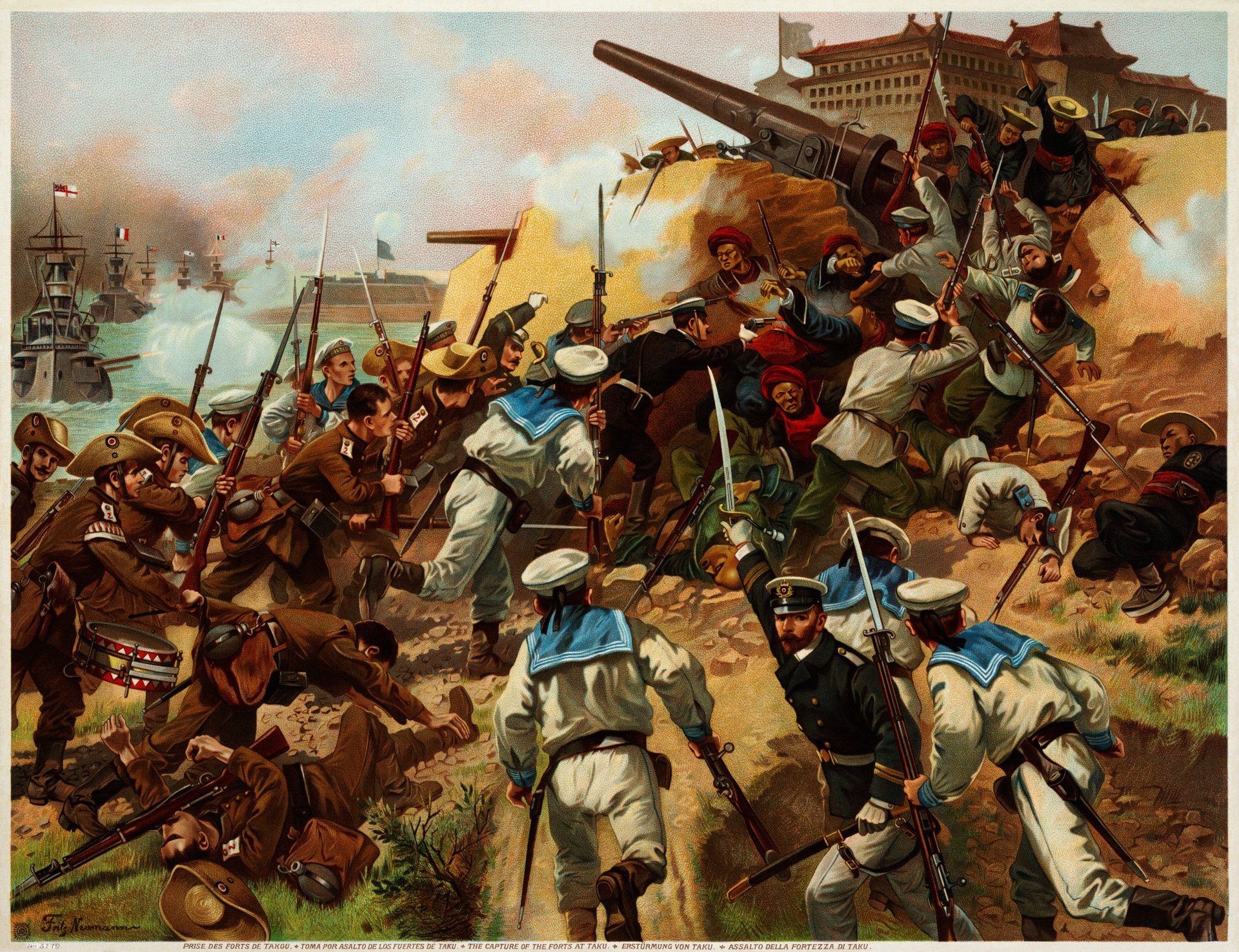
Battle of the Taku Forts (1900)
At 2 a.m. on June 17, 1900, the ultimatum expired. Nine hundred sailors and soldiers from Russia, Britain, Japan, Italy, Austria, France, and Germany prepared to assault four Chinese forts at the mouth of the Hai River. Only the Americans abstained. Rear Admiral Louis Kempff of the United States Navy refused to participate, calling the attack an 'act of war' for which he had no authorization. He was right about what it was. The Battle of the Taku Forts would not just capture a fortification. It would push the Qing dynasty definitively to the side of the Boxers and ignite one of the most dramatic sieges of the modern era.
Outnumbered in Every Direction
By mid-June 1900, the foreign position in northern China was desperate. In Beijing, 450 soldiers and marines from eight countries guarded the diplomatic legations. Somewhere on the railroad between Tianjin and the capital, Admiral Seymour's 2,000-man expedition was trying to fight its way through. In Tianjin itself, 2,400 allied soldiers, mostly Russian, held an increasingly precarious position. All of them were surrounded by thousands of Boxers, members of an indigenous peasant movement intent on driving all foreigners from Chinese soil. The Qing government wavered between crushing the Boxers and joining them. Offshore in the Yellow Sea, Western and Japanese warships waited. On June 15, Chinese forces laid electric mines in the Hai River. The allied commanders met on June 16 and decided the forts at the river's mouth had to be taken. Control of the Taku Forts meant control of the only supply line into northern China.
An Audacious Demand
Vice Admiral Hildebrandt of the Imperial Russian Navy sent the ultimatum: surrender the forts by 2 a.m., or they would be taken by force. It was a bold threat. Only ten allied ships could cross the shallow bar at the river's mouth to enter the two-hundred-yard-wide Hai River, and only 900 men could be assembled for the assault. The Chinese garrison numbered about 2,000, reinforced by four modern German-built destroyers docked at Taku. Those warships alone could have overpowered the allied flotilla, but for reasons that remain unexplained, they never moved. When the Chinese opened fire, two British destroyers commanded by Lieutenant Colin Mackenzie and Roger Keyes darted alongside the Chinese ships and boarded them. The crews offered only weak resistance before abandoning their vessels.
Dawn Assault
The artillery duel raged through the night, with the Russians taking the worst punishment: 18 killed and 65 wounded after a searchlight on the gunboat Giliak drew Chinese fire. Near dawn, the allies stripped their ships of crew and sent them ashore. Two hundred Russians and Austrians led the ground assault on the Northwest Fort, followed by 380 British and Italians, with 300 Japanese at the rear. Fortune intervened. Just as the ground attack began, a gunpowder magazine inside the fort exploded, and in the chaos the Japanese stormed through. The North Fort fell next, taken by British and Italian troops. The allies then turned every captured gun on the two forts across the river, detonating another magazine. By 6:30 a.m., it was over. The allies had suffered 172 casualties. Chinese losses were described in some accounts as 'rivers of blood,' though other assessments suggest they were not heavy.
The Siege Begins
The consequences were immediate and far-reaching. The fall of the Taku Forts pushed the Qing government irreversibly to the side of the Boxers. The Chinese army was ordered to resist all foreign military forces on Chinese soil. The next day, Admiral Seymour's expedition was attacked by regular Chinese troops along the Beijing-Tianjin railroad, forcing him to abandon his march and retreat to Tianjin. On June 19, a Chinese ultimatum gave the foreign diplomats in Beijing 24 hours to leave the capital. They refused, and on June 20, the Siege of the Legations began, a 55-day ordeal that would become one of the defining crises of the era. The Taku Forts remained in foreign hands for the rest of the Boxer Rebellion. Allied officers, it was noted, praised the courage and skill the Chinese defenders had shown.
From the Air
The battle site is at the Hai River estuary near 38.98N, 117.71E, in the Binhai New Area, approximately 60 km southeast of Tianjin's urban center. The flat coastal terrain and wide river mouth are visible from altitude. Tianjin Binhai International Airport (ZBTJ) is approximately 30 km to the northwest. Remnants of the Taku Forts line both banks of the river.