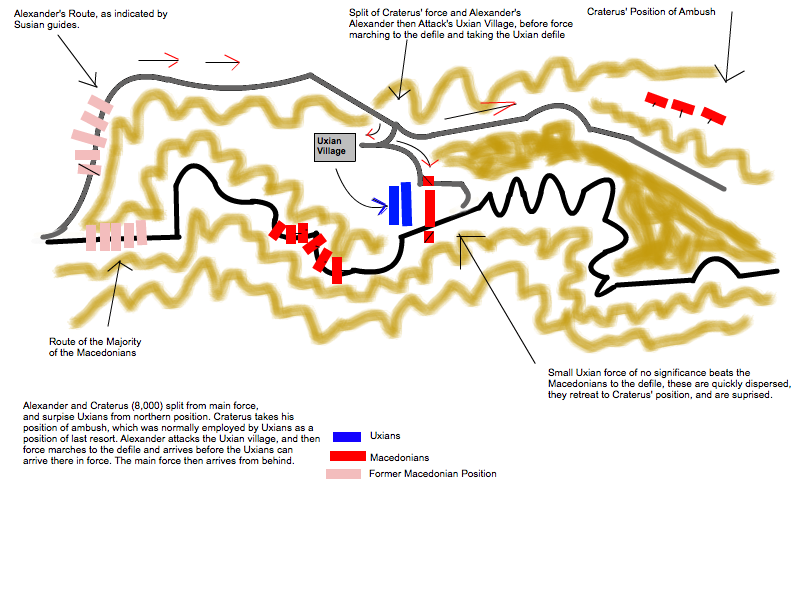
Battle of the Uxian Defile
The Uxians made a simple demand: pay the toll. Every Persian army that wanted to cross the mountain defile between Susa and Persepolis had to pay, and the Uxians saw no reason why the Macedonian conqueror should be any different. They sent ambassadors to Alexander the Great in late 331 BC, expecting the same tribute the Great King himself had always paid. Alexander agreed. He would come along the main road on the appointed day and settle up. It was a lie -- and the kind of lie that Alexander told best.
The Road Between Two Capitals
The mountain pass the Uxians controlled sat between two of the most important cities in the Persian Empire. Susa, the winter capital, had just fallen to Alexander without a fight. Twenty days of marching from Babylon -- itself surrendered by the pragmatic satrap Mazaeus -- had brought the Macedonians to Susa's gates and its treasury of 50,000 talents. But the real prize lay ahead. Persepolis, the ceremonial heart of the empire, still stood. The Persians believed that whoever held Persepolis held the empire itself. Between Alexander and that symbolic prize stood a narrow mountain defile and a tribe that had never been conquered -- not even by the Persians who surrounded them.
Toll Collectors of the Zagros
The Uxians occupied the rugged highlands of what is now Khuzestan province in southwestern Iran. They had carved out a remarkable independence within the Persian Empire. While other tribes paid tribute to the Great King, the Uxians reversed the arrangement entirely. Persian armies paid them for the privilege of passage. It was a toll system enforced by terrain: the defile was narrow, the mountains steep, and the Uxians knew every rock and ravine. Generations of Persian kings had found it cheaper to pay than to fight. When Alexander arrived, the Uxians assumed they had met just another army in need of passage.
The Promise and the Ambush
Alexander sent word that he accepted their terms. On the appointed day, the Uxians gathered along the main road, waiting for their payment. Instead, Alexander split his forces. He took Craterus and his shield-bearing guards, along with 8,000 soldiers, up a northern route that the Uxians had left unguarded. Craterus positioned his men on the high ground where the Uxians would most likely flee as a last resort. Then Alexander struck at their undefended village. The assault was swift and devastating. By a series of forced marches, the Macedonians seized the defile itself. The Uxians, caught between Alexander's assault force and Craterus's blocking position on the heights, had nowhere to run. Those who retreated uphill ran directly into Craterus, who dispatched them. The battle was effectively over before the Uxians understood what had happened.
The Price of Survival
The surviving Uxians sued for peace, and the terms Alexander imposed carried a pointed irony. The tribe that had extracted tolls from the Persian Empire for generations would now pay annual tribute to the Macedonians: 100 horses, 500 head of cattle, and 30,000 sheep. The toll collectors had become the toll payers. Alexander's deception at the Uxian Defile was characteristic of his generalship -- he preferred maneuver and surprise to frontal assault. The same cunning that had won at Gaugamela, where he broke Darius III's army, served him in the Zagros Mountains against a few thousand mountain fighters. The path to Persepolis was now open. Within weeks, Alexander would stand in the ceremonial capital of the empire he was dismantling, one strategic passage at a time.
From the Air
Located at 32.19N, 48.26E in the Zagros Mountains of Khuzestan province, southwestern Iran. The terrain is rugged and mountainous, with narrow defiles visible between ridgelines. The ancient route between Susa and Persepolis follows natural passes through the Zagros range. Nearest airports include Ahvaz International Airport (OIAW) to the southwest and Isfahan International Airport (OIFM) to the northeast. Best viewed at 8,000-15,000 feet to appreciate the mountain passes and the strategic geography that made this position so defensible.