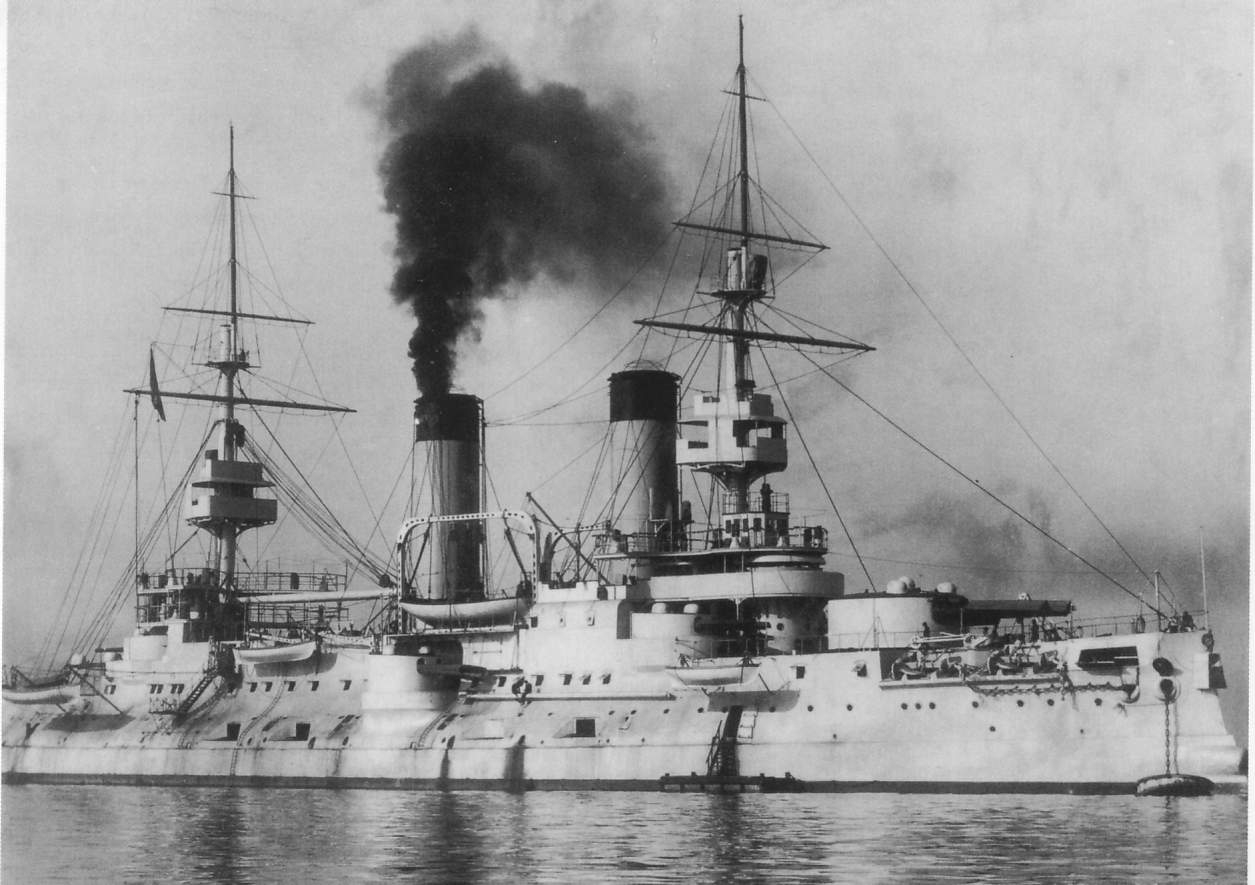
Battle of the Yellow Sea
Of the 7,382 shells fired during the Battle of the Yellow Sea, 98.3 percent missed. Naval gunnery in 1904 was educated guesswork at extreme range, and both the Russian and Japanese fleets spent seven hours hurling steel at each other across miles of open water, scoring hits at a rate that would have been laughable in any other context. But the 1.7 percent that connected changed history. One salvo killed the Russian admiral. Another jammed his flagship's steering wheel. And a single Russian captain's decision to charge his damaged battleship directly into the Japanese battle line may have been the most audacious act of seamanship in the entire Russo-Japanese War.
A Fleet Ordered to Run
Admiral Wilgelm Vitgeft did not want this battle. Trapped in Port Arthur since February, he had argued for keeping his fleet safely at anchor -- a 'fleet in being' that tied down Japanese resources simply by existing. His superior, Viceroy Yevgeni Alekseyev, demanded an aggressive breakout to Vladivostok. The two exchanged increasingly tense letters until Alekseyev appealed to Tsar Nicholas II, who telegraphed his support for the sortie. Faced with the legal consequences of defying a direct imperial order, Vitgeft yielded. His fleet left Port Arthur on the morning of 10 August 1904 -- six battleships, four cruisers, and fourteen torpedo boats, heading southeast along the Shandong Peninsula. Many of his ships were missing guns that had been sent ashore to defend the besieged fortress.
Seven Hours of Steel
Admiral Togo Heihachiro intercepted the Russians with four battleships, two armored cruisers, and a screen of lighter vessels. The engagement began at extreme range -- over 8 miles -- with both sides firing 305mm main guns at distances their rangefinders could barely measure. Russian battleships carried Lugeol rangefinders effective to 4 kilometers; the Japanese had newer Barr and Stroud instruments reaching 6 kilometers. Neither side expected to score hits at 8 miles, yet both did. Togo's flagship Mikasa took 20 hits during the engagement, and two of the Russian flagship Tsesarevich's 305mm shells knocked out Mikasa's wireless communications early in the battle. The fight devolved into a stern chase, with the faster Japanese ships trying to overhaul the slower Russian battleship Poltava, which could not maintain fleet speed due to engine trouble.
The Shell That Killed an Admiral
By 18:30, with darkness thirty minutes away, Togo was running out of time and ammunition. His Shimose explosive shells were detonating prematurely inside overheated gun barrels, knocking out three of his sixteen 305mm guns. Mikasa was so battered that Togo signaled the battleship Asahi to take over the fight against the Russian flagship. Within ten minutes of being handed the mission, Asahi fired a devastating salvo into Tsesarevich. The shells killed Vitgeft instantly, along with his immediate staff, and jammed the flagship's steering wheel hard to port. The wounded ship heeled twelve degrees and began an uncontrolled turn back into her own formation. The ships behind, not understanding what had happened, followed in her wake as she swung 180 degrees, scattering the Russian battle line into chaos.
The Charge of the Retvizan
Captain Eduard Schensnovich of the battleship Retvizan saw the flagship lose control and acted immediately. He turned his ship directly toward Togo's battle line and charged, all weapons firing, despite Retvizan already being down by the bow from earlier damage. The Japanese shifted their fire to the charging battleship, but so many shells were splashing around Retvizan that Japanese gunners could not adjust their aim. Togo, running low on main-battery ammunition with several guns out of action, decided not to risk his fleet against a ship that seemed intent on ramming. He turned the fight over to his cruisers and destroyers. As the Japanese ships came about, a final salvo struck Retvizan, seriously wounding Schensnovich in the stomach. He would die from his wounds in January 1911, at age 57. But his solo charge had ended the battleship duel and saved the Russian flagship from destruction.
Scattered in the Dark
The Russian fleet fell apart in the darkness. Five battleships, a cruiser, and ten destroyers made it back to Port Arthur. The damaged Tsesarevich limped to Kiaochou and was interned by the Germans. The cruiser Askold reached Shanghai, where the Chinese interned her under Japanese pressure. Diana escaped to French Saigon. Only the small cruiser Novik tried to reach Vladivostok by sailing east around Japan, but Japanese cruisers forced her aground at Sakhalin. The breakout had failed. The Russian Pacific Squadron would never leave Port Arthur again, and its fate was sealed when the fortress fell in January 1905. But the battle had proven something unexpected: that modern steel battleships could absorb extraordinary punishment and keep fighting. The hit rate of 1.7 percent also convinced naval planners worldwide that gunnery accuracy needed radical improvement -- a lesson that would reshape warship design for the next forty years.
From the Air
The battle took place at approximately 38.40N, 121.70E in the Yellow Sea, between the Shandong Peninsula and the Liaodong Peninsula. Open water with the Chinese coast visible to the west and the Korean Peninsula to the east. Nearest airports: Dalian Zhoushuizi International Airport (ZYTL) to the north; Yantai Penglai International Airport (ZSYT) to the south. Best observed from high altitude where the geography of the Yellow Sea's strategic position between peninsulas becomes apparent.