Battle of the Yser
On the night of 26 October 1914, a fifty-one-year-old skipper named Hendrik Geeraert climbed onto the Spanish Sluices at Nieuwpoort and began turning the iron wheels that opened the gates to the North Sea. The tide was high. The Belgian army at his back had been retreating for two months across its own country, from Liege through Antwerp to the last strip of unoccupied ground between the Yser river and the sea. Twenty thousand of them were already dead or wounded. The German army on the far bank had crossed the river in force five days earlier and was preparing the final assault. Geeraert turned the wheels. Salt water rose into the polders. Over the next four nights, the wheels turned again and again, timed to the spring tides, until an impassable shallow sea spread south from Nieuwpoort almost to Diksmuide, three to four kilometres wide, the German army stranded inside it. The Belgian front held on that line until 1918.
The Country That Lost
By October 1914 the kingdom of Belgium had nearly ceased to exist as a territory. The Germans had crossed the border on 4 August. The forts at Liege had fallen, then Namur, then Antwerp on 9 October. The Belgian field army, which had begun the war with about a hundred and twenty thousand men, had been fighting and retreating without rest for two months. Brussels had been occupied on 20 August. The government had fled first to Antwerp, then to Ostend, then to French soil at Le Havre. King Albert, who refused to leave, moved his headquarters to Veurne, his villa to De Panne, and his army to a thin defensive line along the Yser from Diksmuide to the coast. Ninety-five per cent of Belgium was behind German lines. What remained was perhaps a few hundred square kilometres of West Flanders. If the Germans crossed the Yser, the army would have to surrender or evacuate by sea, and Belgium as a sovereign entity would be over.
Diksmuide
The southern anchor of the Belgian line was the town of Diksmuide, garrisoned by Belgian troops alongside the Brigade de Fusiliers Marins under Rear Admiral Pierre Alexis Ronarc'h, six battalions of French naval reservists, mostly young men who had been mobilised from Brittany three weeks earlier. The Germans attacked Diksmuide on 16 October. The defenders held. The town was bombarded almost continuously for three weeks, reduced to rubble street by street, and the French press turned its defence into a national story. Colonel Alphonse Jacques, who commanded the Belgian troops in the town, became a Belgian hero. Many of his soldiers and Ronarc'h's fusiliers did not leave Diksmuide alive. The town finally fell on 10 November. By then the inundation had already saved the rest of the line.
The German Push to the Sea
The German Fourth Army under Albrecht, Duke of Wurttemberg, drove south from the captured ports of Bruges and Ostend with III Reserve Corps from Antwerp and four new reserve corps from Germany, supported by cavalry and heavy artillery. Some of these reserve units were filled with university students sent into combat after only a few weeks training, and the heavy losses they suffered in October became known in Germany as the Massacre of the Innocents, the Kindermord von Ypern. The German objective was to break the Belgian line, deny the British access to the Channel ports of Calais, Boulogne and Dunkirk, and end the war on the Western Front. On 18 October the general offensive began. By 21 October the Germans had established a small bridgehead on the west bank of the Yser. The Belgian counter-attack failed. The last bridge across the river was blown on 23 October. Belgian losses were already catastrophic. The army had been fighting continuously for almost three months without rest.
The Sluice Gates
The Ganzepoot lock complex at the mouth of the Yser in Nieuwpoort had been built in the nineteenth century to drain the polders. Six channels converged at a single hub. In peacetime the gates kept the sea out and let the river drain at low tide. The idea of flooding the polders to stop the Germans had been discussed for weeks. Karel Cogge, a local bargeman with intimate knowledge of the canal system, helped plan the operation. Hendrik Geeraert, lock-keeper, operated the gates. An abortive attempt on 21 October failed for reasons of inadequate timing and damage to the gates. From 26 to 30 October, on four successive high tides, Geeraert and his colleagues opened the gates correctly and kept them open long enough for sea water to flood the low ground south of town. The water rose night by night, slowly, until an inundation about three to four kilometres wide and stretching south almost to Diksmuide became impassable to men, horses, and field artillery.
Ramskapelle, 30 October
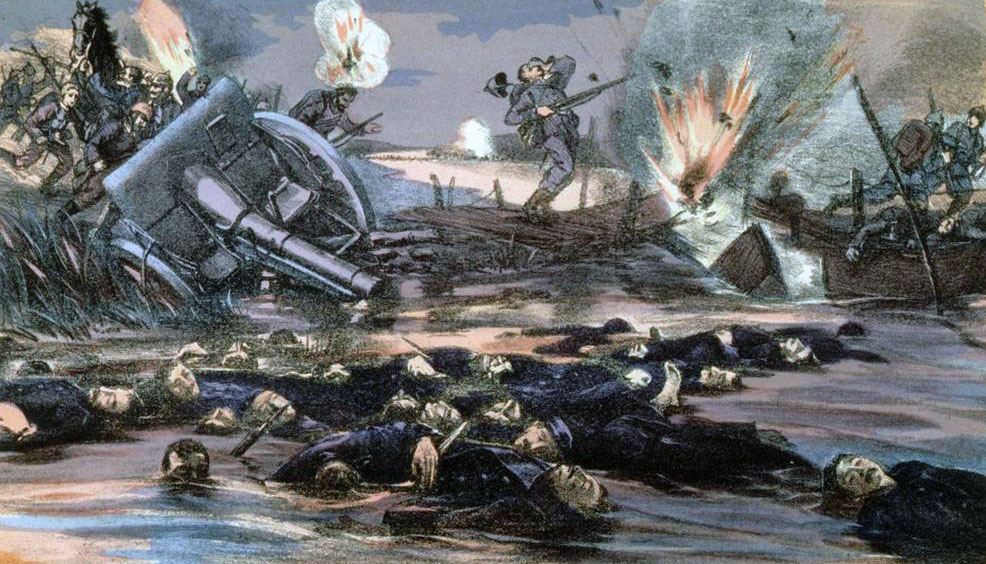
The Germans attacked again on 30 October before they understood what was happening behind them. They broke the Belgian second line. They reached Ramskapelle and Pervijze. Belgian and French counter-attacks recovered Ramskapelle that day. The final German assault, scheduled for the next morning, was called off when commanders realised the ground in their rear was filling with water and their supply lines were being cut. The Germans withdrew on the night of 30 to 31 October. The Belgian army had held. The cost was about twenty thousand Belgian casualties from 18 to 30 October, against German losses that were probably greater but never precisely tallied. The British official historian James Edmonds estimated that between 18 October and 30 November, between Gheluvelt and the coast, German losses amounted to about 76,250 men. Many of those fell at Diksmuide and along the inundation line, in attacks that ran into water before they reached defenders.
What the Soldiers Were
The numbers in this battle are easy to recite and hard to feel. The Belgian army that held the Yser was not a professional force in the British or German sense. Most of its soldiers were Flemish farmers and labourers conscripted in August, who had been retreating and fighting for ten weeks before they reached the river. Many spoke only Flemish, the language their officers, drawn from a French-speaking elite, did not always share. Their experiences during the four years that followed, holding the same waterlogged trenches in the only piece of Belgium they could call free, fed the Flemish national movement. The Frontbeweging, the soldiers' party that became the first organ of modern Flemish nationalism, was founded in 1917 by men who had fought here. The country they helped save was not entirely the country they returned to.
The Front That Held
The Yser front ran the line of the inundation for the next four years. The trenches west of the flood became one of the strangest sectors of the Western Front, soldiers wading in waist-deep water to reach forward posts, snipers picking off men silhouetted against the sky on the dyke roads, French Senegalese troops and Belgian carabineers serving alongside each other in the same sodden line. King Albert visited the front almost daily from his villa at De Panne. Queen Elisabeth nursed the wounded. The flooded zone froze in some winters and became briefly walkable, then thawed back into mud. In 1918 the same army, reinforced and rebuilt, broke out of the Yser pocket in the final Hundred Days offensive and helped liberate the country. Hendrik Geeraert lived to see it. He was decorated, photographed, briefly famous, then quietly retired. He died in 1925. A square in Nieuwpoort carries his name.
From the Air
The Battle of the Yser took place along the river between Nieuwpoort and Diksmuide, roughly the line 51.15 N, 2.72 E. From altitude the lower Yser is now drained farmland with the river clearly visible as a curving north-south line. The Ganzepoot lock complex at Nieuwpoort, where the sluices were opened, is unmistakable: six channels converging at a single hub. The King Albert I Memorial rotunda overlooks the locks. Closest airports are Ostend-Bruges (EBOS) about 20 km northeast and Lille-Lesquin (LFQQ) about 70 km south. Recommended viewing altitude 3,000 to 5,000 feet to see the inundation zone in its entirety; descend to 2,000 feet to read individual landmarks. North Sea fog is common in autumn.