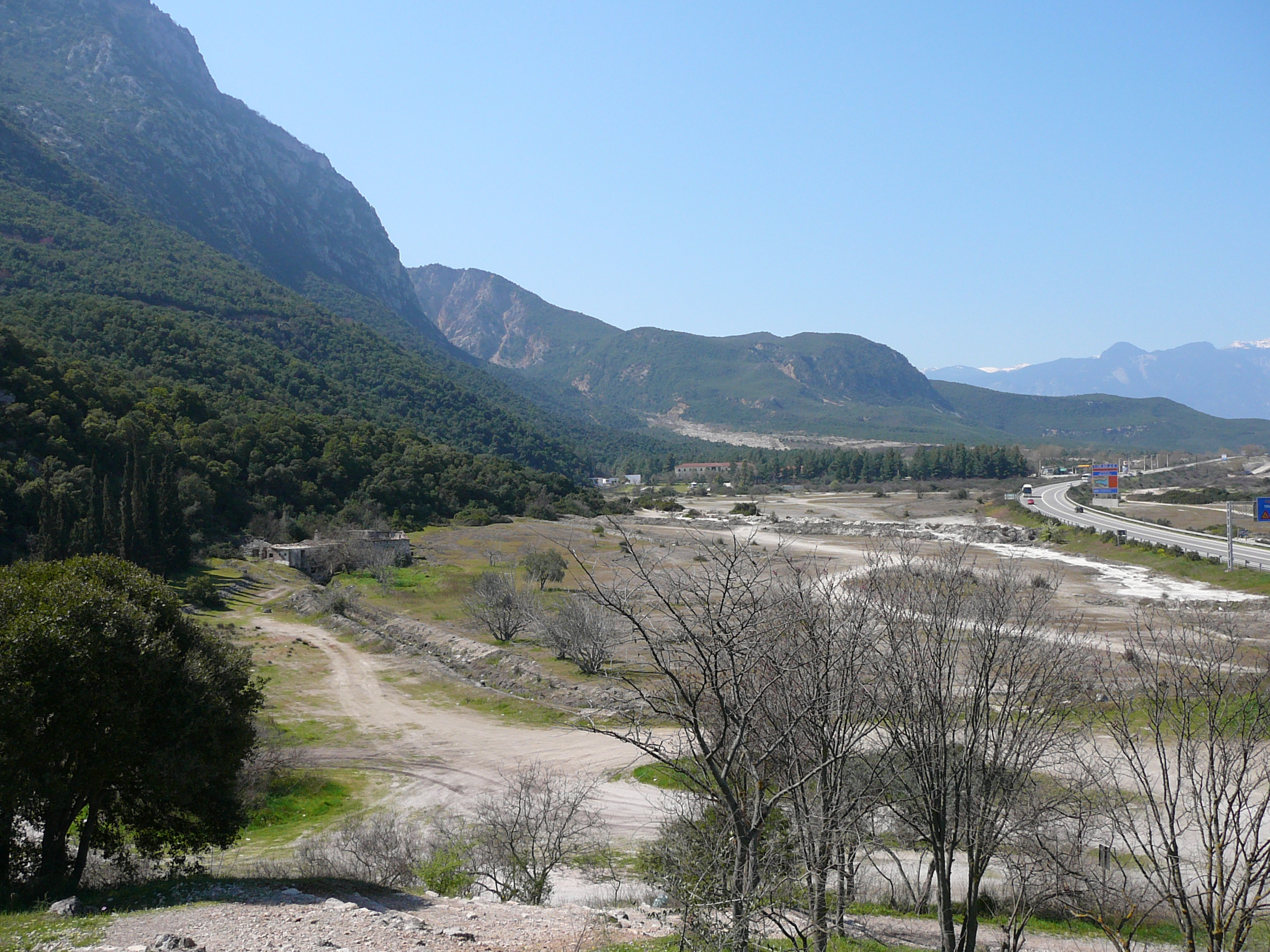
Battle of Thermopylae (191 BC)
Hannibal was at his court in Ephesus. Six war elephants stood behind his cavalry. The phalanx of his ancestors - twelve thousand sarissas, sixteen feet long, locked in formation - sat behind a stone rampart 90 metres long across the narrowest point of the pass. Antiochus III the Great had spent his career rebuilding the Seleucid Empire from Bactria to the Aegean, and on the morning of 24 April 191 BC he believed he was about to do to Rome what Leonidas had done to Persia three centuries earlier: hold an army at Thermopylae until reinforcements changed the war. He was wrong by one Roman senator and a confused march.
How a Seleucid King Ended Up in Greece
Antiochus III had inherited a crumbling empire in 222 BC and spent the next three decades rebuilding it. He campaigned to Bactria and the borders of India, retook Coele-Syria from the Ptolemies in the Fifth Syrian War, and turned his attention to Asia Minor. By 196 BC his troops had crossed into Europe and were rebuilding the city of Lysimachia on the Hellespont, which alarmed Rome. The crucial recruit on his diplomatic side was Hannibal, who fled Carthage in 195 BC and joined the Seleucid court at Ephesus. Negotiations with Rome stuttered. The Aetolian League - a confederation of mountainous central Greek states with old grievances against the Roman peace - convinced Antiochus that Greece would rise behind him. In autumn 192 BC he landed at Demetrias with 10,000 infantry, 500 cavalry, and 6 war elephants. Most Greek states stayed neutral; only Elis, the Boeotian League, and the small kingdom of Athamania declared for him. The promised uprising never came.
The Pass That Wasn't Wide Enough
In April 191 BC the consul Manius Acilius Glabrio crossed from Brundisium with 20,000 infantry and 15 elephants. Combined with allies and Philip V of Macedon, Roman strength in Greece reached 36,000. Antiochus, who had hoped to face the Romans on open ground after reinforcements arrived from Asia Minor, found himself outnumbered before he could fight. He withdrew to Thermopylae, where the road from Thessaly to central Greece narrows to ninety metres between the cliffs of Mount Kallidromos and the Malian Gulf. The geography that had defeated Xerxes in 480 BC was Antiochus' best chance. He reinforced an existing wall, extended it 1,800 metres up the slope to an inaccessible cliff, dug ditches across to the sea, and posted projectile troops on the gradual hill above. He sent two thousand Aetolian troops to garrison the three forts above the pass - Callidromus, Teichius, and Rhoduntia - because he had read his Herodotus. He knew exactly which path Persian collaborators had used to outflank Leonidas.
The Roman Who Read the Same Book
Marcus Porcius Cato - later remembered as Cato the Elder, the senator whose Carthago delenda est punctuated every speech he gave for years - was 43 years old in April 191 BC and serving as one of Glabrio's military tribunes. On the night of 23 April, Glabrio sent Cato with 2,000 men against Fort Callidromus and Lucius Valerius Flaccus with another 2,000 against the forts of Teichius and Rhoduntia. At dawn on 24 April, Glabrio led the main force of 18,000 in a frontal attack against the Seleucid wall. The frontal attack went exactly as Antiochus had expected: Roman legionaries took fire from the slingers and archers above the wall, broke against the Macedonian phalanx, and could not cross the rampart. Flaccus, meanwhile, made no progress against his two forts. Cato had got lost in the dark on his approach march. He found Callidromus at first light and discovered, to his surprise, that the 600-man Aetolian garrison was asleep. He took the fort almost without a fight.
The Panic Below
Cato came down the slope into the rear of the Seleucid camp not knowing he had a small force; the Seleucid quartermasters and rear guard, looking up at a dust cloud and a Roman standard where there should have been Aetolian sentries, did not know either. They assumed Cato's 2,000 men were the vanguard of a much larger force coming down from the heights. The morale of the camp gave way. Word travelled forward to the phalanx, and the formation that Roman legionaries had been unable to break by direct assault came apart from inside as men turned to look behind them. Antiochus extracted himself with his cavalry and fled east. The phalanx, the elephants, and most of the army did not. The whole Seleucid force in Greece - barring the king and his horsemen - was destroyed in a battle that had been technically won until the moment Cato found his way down the wrong side of the mountain.
Endgame in Asia
Antiochus reached Chalcis, then Ephesus. The Greek allies who had welcomed him as liberator now welcomed the Romans the same way. The naval war went the same direction: in September 191 BC Rome won the Battle of Corycus; the next August, the Rhodians defeated Hannibal's fleet at the Eurymedon; a month later a combined Roman-Rhodian fleet won at Myonessus. In 190 BC the Roman army crossed into Asia Minor, and at Magnesia the Macedonian phalanx that Antiochus had spent his life rebuilding was broken on a single afternoon by Roman maniples that worked together more flexibly than spears could be lowered. The Treaty of Apamea in 188 BC stripped the Seleucids of Asia Minor west of the Taurus. A king who at his peak had been called Megas, the Great - the Persian title shahanshah translated for Greeks - died four years later, killed by an angry crowd while looting a temple to pay his Roman war indemnity. Hannibal, hunted, took poison rather than be handed over to Rome.
From the Air
38.80N, 22.53E. The Thermopylae pass runs along the southern shore of the Malian Gulf in central Greece, between the foot of Mount Kallidromos and what is now a coastal plain - in 191 BC the sea came much closer, and the pass was narrower. From 5,000-7,000 ft, look for the long ridge of Mount Kallidromos rising 1,400 m to the south of a flat coastal strip; the modern E75 highway and rail line run through what was the ancient pass. The hot springs that gave Thermopylae its name (the 'hot gates') are still active near the modern monument to Leonidas. Lamia (LGLM, civil airport) lies 22 km northwest. Athens International (LGAV) is 175 km southeast. Athens-Tanagra Air Base (LGTG) is 100 km southeast. The pass and surrounding peaks are often dramatic in winter when Mount Kallidromos carries snow above the silver-green olive belt of the lower slopes.