Battle of Thermopylae (1941)
Brigadier George Vasey said it standing on the road south of Lamia on 23 April 1941, with a Panzer division grinding south behind him and the rest of the Allied army in Greece already running for the boats. The phrasing was Australian. The sentiment was older than the road he was standing on. "Here we bloody well are," Vasey told his officers, "and here we bloody well stay." The Australian 19th Brigade and the New Zealand 6th Brigade had been ordered to delay the German advance long enough for two divisions to reach the evacuation beaches. They had no air cover, no reinforcements, and no realistic hope of holding more than a day. They held thirty-six hours.
Why the Road South Was Closing
The German invasion of Greece had begun on 6 April 1941. Within two weeks the defensive line on the Aliakmon River had been outflanked through Yugoslavia, the Greek First Army had surrendered in Epirus, and the British, Australian, and New Zealand expeditionary force - around 60,000 men - was retreating through mountain country it had not had time to fortify. By 21 April the line at Mount Olympus was breaking. The decision to evacuate was made on 23 April. Two ANZAC brigades, drawn from Lieutenant-General Bernard Freyberg's New Zealand 2nd Division and Major-General Iven Mackay's Australian 6th Division, were ordered to hold the coastal pass at Thermopylae and the inland pass at Brallos. Behind them, the rest of the force would withdraw to embarkation points on the Peloponnese. Freyberg had won the Victoria Cross at the Somme; Mackay had commanded a brigade at Tobruk three months earlier. Both knew exactly what holding a rearguard at a famous pass meant.
The Brigades on the Line
The New Zealand 6th Brigade, under Brigadier Harold Barrowclough, dug in at the foot of Mount Kallidromos along the coastal road south of Lamia near the Spercheios River. The Australian 19th Brigade, under Vasey, took up positions at Brallos in the inland pass. The 5th and 4th New Zealand Brigades were positioned to cover the bridges and the right flank. They had 25-pounder field guns, 2-pounder anti-tank guns, and the same low expectation that ANZAC troops had carried at Gallipoli twenty-six years earlier and would carry at El Alamein the following year: that the staff officers had calculated the cost in their lives and someone, somewhere, had decided it was worth paying. On 21 April a Luftwaffe reconnaissance flight reported that the defensive lines were only lightly fortified and that British troops were already evacuating from Salamis. The Germans came on confident.
The Tank Hunt
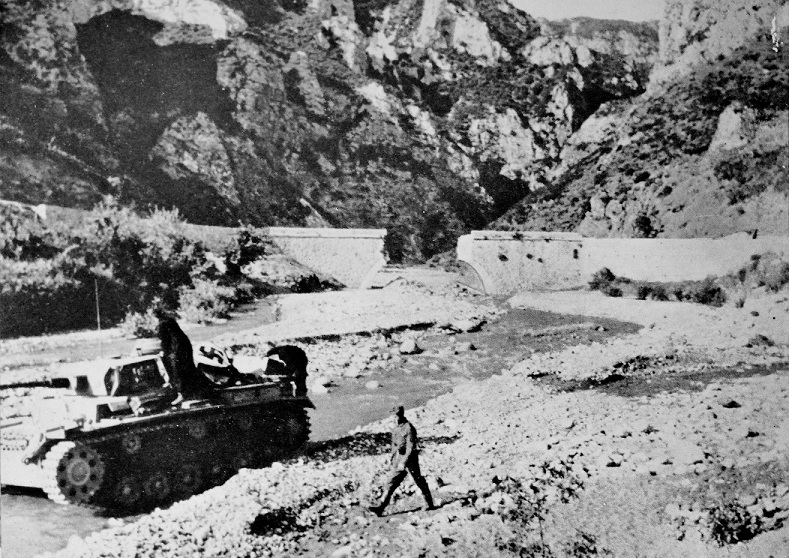
The 25th Battalion of the New Zealand 6th Brigade was the first unit the Panzer columns ran into on the afternoon of 24 April 1941. Two German tanks attempted to push through the 25th's positions and were killed by long-range fire from the field guns. Later in the day, four more tanks and a column of trucks carrying infantry tried again. The 2-pounders and 25-pounders, sited along the road and in the foothills, hit them in defilade. Fifteen German tanks were destroyed during the day-and-night engagement at Thermopylae. The Brallos pass, where Vasey's 19th Brigade fought a similar action, accounted for more. Casualties on both sides were significant. The Allies lost ground gradually but never collapsed. By midnight the last vehicles withdrew south. When the Germans launched their formal attack three hours later, the positions they overran were empty - the rearguard had pulled out cleanly.
What the Defence Bought
The 36-hour stand at Thermopylae and Brallos covered the withdrawal of roughly 50,000 Allied troops to Athens, Megara, Kalamata, and the smaller embarkation beaches. Around 43,000 of them were lifted off by Royal Navy destroyers between 24 and 29 April, mostly at night, under intermittent Luftwaffe attack. The men left behind became prisoners of war. The Royal Navy lost six ships including the destroyers Diamond and Wryneck, sunk while evacuating troops. The 2nd New Zealand Division and the Australian 6th Division reformed in Crete, where most of them would be captured five weeks later in the next German airborne operation. Some thousands made it home. They went on to fight in North Africa and Italy and the Pacific, and a generation of New Zealand and Australian veterans came back with strong feelings about Greece - the country, the people, the impossible situation, the way the locals had hidden British soldiers in barns and sheep pens during the months that followed.
What Greece Remembered
The absence of the Greek Army from the defence of Thermopylae was politically painful in Greece for decades after the war. General Georgios Tsolakoglou had surrendered the Greek Army of Epirus to the Germans on 20 April 1941 and would soon serve as the puppet prime minister of the German occupation. After the war, the partisan leader Aris Velouchiotis - who had himself fought in the 1941 campaign before going underground to lead the Greek People's Liberation Army against the occupation - argued that Tsolakoglou's surrender at Thermopylae, of all places, was an eternal shame for the regime. Today the New Zealand and Australian dead lie at Phaleron War Cemetery near Athens, and a small monument near the modern coastal road marks where the 25th Battalion's guns destroyed the first Panzers. The 480 BC monument to Leonidas stands a few hundred metres away, on the same pass, looking the same direction. The road south is wide and quiet now. It was the last narrow place between an army and the sea three different times in twenty-five centuries.
From the Air
38.80N, 22.54E. The Thermopylae pass and the inland Brallos pass form a narrow north-south chokepoint in central Greece between the Malian Gulf and Mount Kallidromos. From 5,000-7,000 ft, look for the long ridge of Kallidromos south of a coastal plain; the E75 motorway and rail line follow the ancient pass route. The Brallos pass winds through the mountains 12-15 km southwest, marked by the modern village of Brallos and the dramatic switchbacks of the old road. Lamia airport (LGLM) lies 22 km north - the New Zealand 5th Brigade was deployed in the foothills directly south of Lamia. Athens International (LGAV) is 175 km southeast. Tanagra Air Base (LGTG) is 100 km southeast. The Spercheios River valley, where the New Zealand brigades held bridges in 1941, is visible northwest of the pass; the river drains into the Malian Gulf.