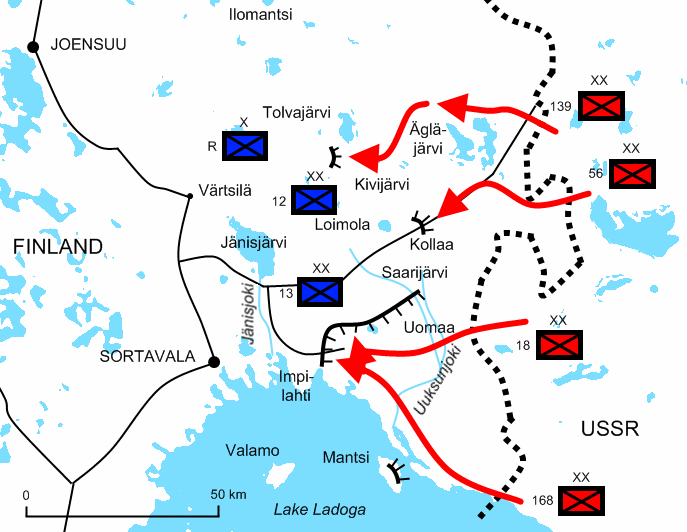
Battle of Tolvajarvi
For ten days, the Red Army had seemed unstoppable. Soviet forces had captured Suojarvi on 2 December 1939, threatening the railroad to the Karelian Isthmus and the rear of the Mannerheim Line. Finland's defense in Ladoga Karelia was collapsing. Then, on the shores of a frozen lake in the deep forest east of Ilomantsi, a counterattack changed the trajectory of the Winter War. The Battle of Tolvajarvi, fought on 12 December 1939, became the first large Finnish offensive victory of the conflict, and it arrived at a moment when Finland desperately needed proof that the Soviet advance could be reversed.
A Commander Named for Winter
Marshal Mannerheim recognized the crisis on 6 December and reorganized the IV Army Corps into a fighting group under Paavo Talvela, a decisive officer who understood that defense alone would not hold the line. Talvela immediately ordered Colonel Aaro Pajari to defend the western shore of Lake Tolvajarvi while Per Ole Ekholm maintained the defense of Ilomantsi further north. Neither assignment was simple. The Soviets had momentum, numbers, and armor. What Finland had was terrain, winter skills, and commanders willing to gamble on a counterattack when the textbook called for retreat. On 10 December, Talvela issued offensive orders to both Pajari and Ekholm for the following day.
The Counterattack
The battle took place in Ladoga Karelia, a landscape of lakes, dense forest, and roads so few that an army dependent on them became predictable. The Soviets were prepared to advance along those roads, but they were not prepared for what happened when the roads ran out. Finnish ski troops, moving cross-country through terrain the Red Army could not follow, struck at the flanks and supply lines of the advancing Soviet columns. The T-26 tanks that had rolled through Suojarvi now burned on the frozen ground near Tolvajarvi. Photographs from the battle show Finnish officers inspecting destroyed Soviet armored cars, and Finnish skiers of the Talvela Group moving through white forests with the fluid ease of men who had grown up in them.
What a Sausage Meant
A story from the battle has entered Finnish lore: that the Soviet advance stalled partly because hungry Red Army soldiers stopped to eat sausages they found in an abandoned Finnish field kitchen. Whether the detail is legend or fact, it captures something true about the asymmetry of the conflict. Soviet troops, many conscripted from warmer regions and unfamiliar with subarctic conditions, faced Finnish soldiers fighting on home ground in temperatures that could kill as efficiently as any weapon. The Finnish forces knew how to move, how to stay warm, and how to fight in forests where visibility dropped to meters. The Soviets, road-bound and struggling to coordinate in the frozen landscape, could not adapt quickly enough.
The Cost of Victory
The Soviet commander, General Belyaev, was dismissed on 16 December 1939 for the defeat, though he retained his rank and was later promoted to major general after a re-attestation in June 1940. The Soviet losses were severe enough to reverberate through the Red Army's command structure, but the significance of Tolvajarvi went beyond numbers. For Finland, it proved that Soviet divisions could be beaten, that the overwhelming numerical advantage of the invading force was not destiny. For the international community watching the small nation resist a superpower, Tolvajarvi became shorthand for Finnish determination.
The Ground Remembers
The battlefield lies in what was once Finnish territory, now part of the Republic of Karelia in Russia. The lakes that gave the battle its name still freeze each winter, and the forests that sheltered Finnish ski patrols still stand thick and dark. The landscape has not changed in ways that matter. Flying over this region, you see the same pattern the combatants knew: lakes strung together like beads, narrow isthmuses of land between them, and roads that trace the only passable routes through the wilderness. It is easy to understand, from above, why an army that controlled the forest controlled the battle, and why an army confined to the roads was fighting on someone else's terms.
From the Air
Located at 62.29N, 31.49E in Ladoga Karelia, now part of Russia's Republic of Karelia. The terrain is a mosaic of lakes and dense boreal forest with very few roads. Recommended viewing at 3,000-5,000 feet to see the chain of lakes including Lake Tolvajarvi. No nearby civilian airports; the area is remote. Joensuu (EFJO) is the nearest major airport, approximately 120 km to the west. The lake chains and forest corridors that defined the battle are clearly visible from the air.