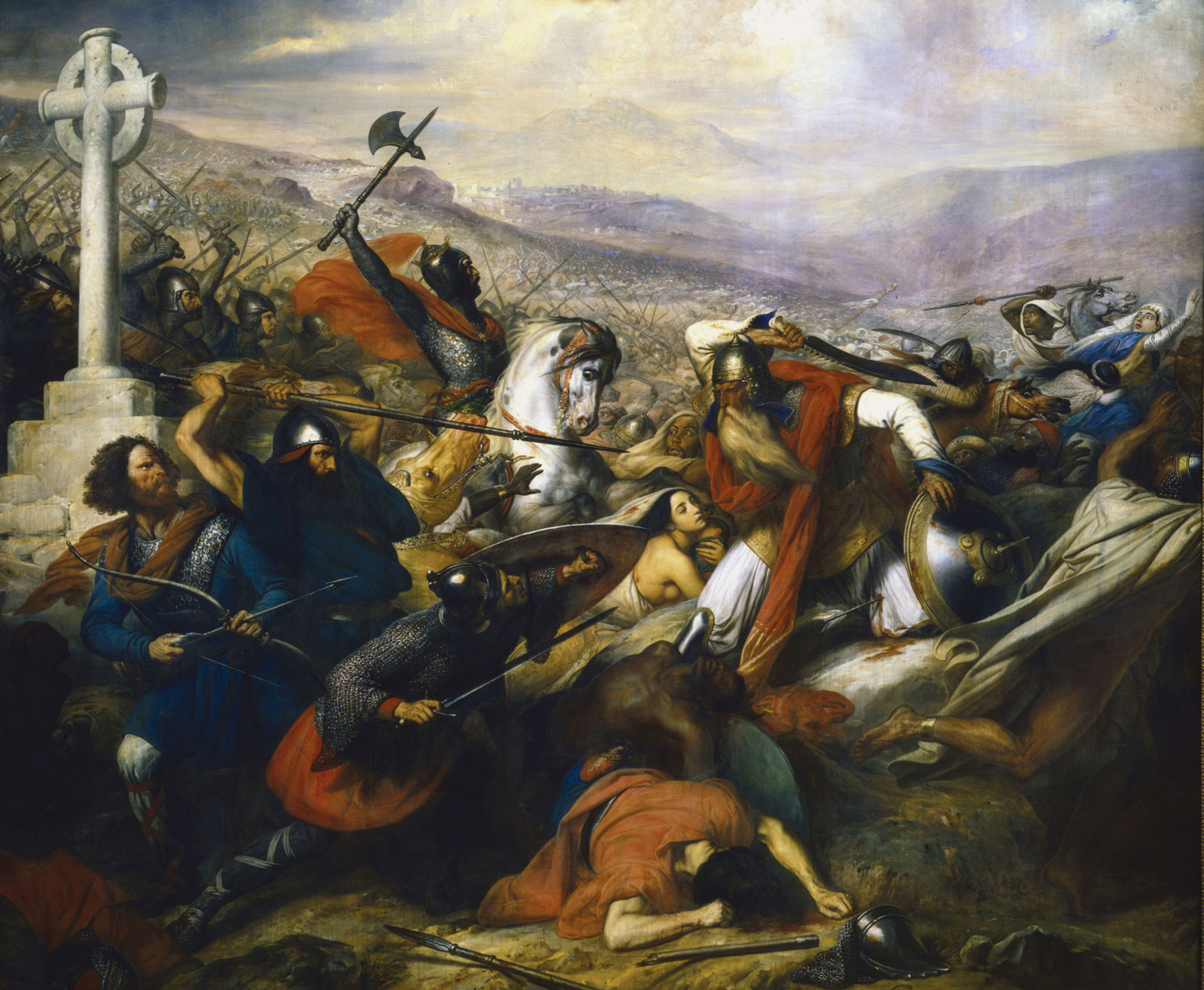
Battle of Tours
On an October day in 732, somewhere between Tours and Poitiers where the Clain and Vienne rivers converge, an army of Frankish infantry stood in a tight phalanx against mounted Umayyad cavalry. The Franks had no armor. Their commander, Charles — the Mayor of the Palace who held the real power behind a Merovingian puppet king — had chosen the ground and forced his enemy to attack uphill. By nightfall, the Umayyad commander Abd al-Rahman al-Ghafiqi lay dead, and the most ambitious Islamic military campaign into Western Europe had been broken. The battle would earn Charles a surname that echoes across thirteen centuries: Martel, the Hammer.
The Umayyad Tide
The army that crossed the Pyrenees in 732 was no raiding party. Under Abd al-Rahman, governor of al-Andalus, Umayyad forces had already conquered most of the Iberian Peninsula and were pressing deep into Aquitaine. They surprised Duke Eudes of Aquitaine, taking Bayonne and Bordeaux in June 732 and scattering his army. Eudes, despite his hostility toward Charles, had no choice but to ride north and beg for help from the Frankish strongman. Charles agreed, but on his own terms. He spent weeks positioning his forces, choosing terrain that negated the Umayyad cavalry advantage — rolling, wooded ground where horsemen could not charge effectively and where his infantry could form a dense defensive line.
Six Days of Waiting
For six days the two armies watched each other, exchanging only minor skirmishes. Abd al-Rahman was a capable general, and he recognized the trap: Charles had picked both the place and the conditions for battle. The Umayyad commander waited for his full strength to arrive, but even at full numbers his army remained uneasy. Charles had turned the Franks' greatest weakness — their lack of cavalry — into a strength. His infantry stood shoulder to shoulder in a dense formation that contemporary accounts compared to a wall of ice or a frozen sea. When the Umayyad horsemen finally charged, they crashed against a line that would not break.
The Hammer Falls
The battle's turning point came when Frankish scouts struck at the Umayyad camp, threatening the plunder the army had accumulated during its campaign through Aquitaine. Portions of the Umayyad cavalry broke off to protect their spoils, creating disorder in the ranks. Abd al-Rahman rode into the chaos to rally his troops and was surrounded and killed. Both Frankish and Arab chroniclers agree on this detail: the commander died trying to hold his army together. Without their leader, the Umayyad forces withdrew to their camp. The Franks, disciplined to the end, did not pursue. Charles kept his men in formation through the night, wary of a feigned retreat.
A Legacy Debated
By morning, Frankish scouts discovered the Umayyad camp abandoned — the army had retreated south under cover of darkness. Edward Gibbon later wrote that the battle decided the fate of Christendom. Modern historians are more measured, noting that the Umayyad Caliphate was already fracturing from internal dissent and that the expedition may have been a large-scale raid rather than a permanent conquest. What is beyond dispute is the battle's effect on Frankish politics. Charles Martel's victory consolidated his authority over the Frankish territories, establishing the foundation for the Carolingian dynasty that would produce his grandson Charlemagne. The battlefield itself has never been precisely identified, though it lay somewhere in the rolling country between Tours and Poitiers — terrain that still looks much as it did when the Hammer met the cavalry.
From the Air
Located at approximately 47.39°N, 0.69°E, between the cities of Tours and Poitiers in central France. The exact battlefield site has never been conclusively identified, but it lay in the rolling terrain where the Clain and Vienne rivers converge. Nearest airports: Tours Val de Loire (LFOT) to the north, Poitiers-Biard (LFBI) to the south. The landscape remains largely agricultural. Best viewed at 3,000–5,000 ft AGL to appreciate the terrain that shaped the battle.