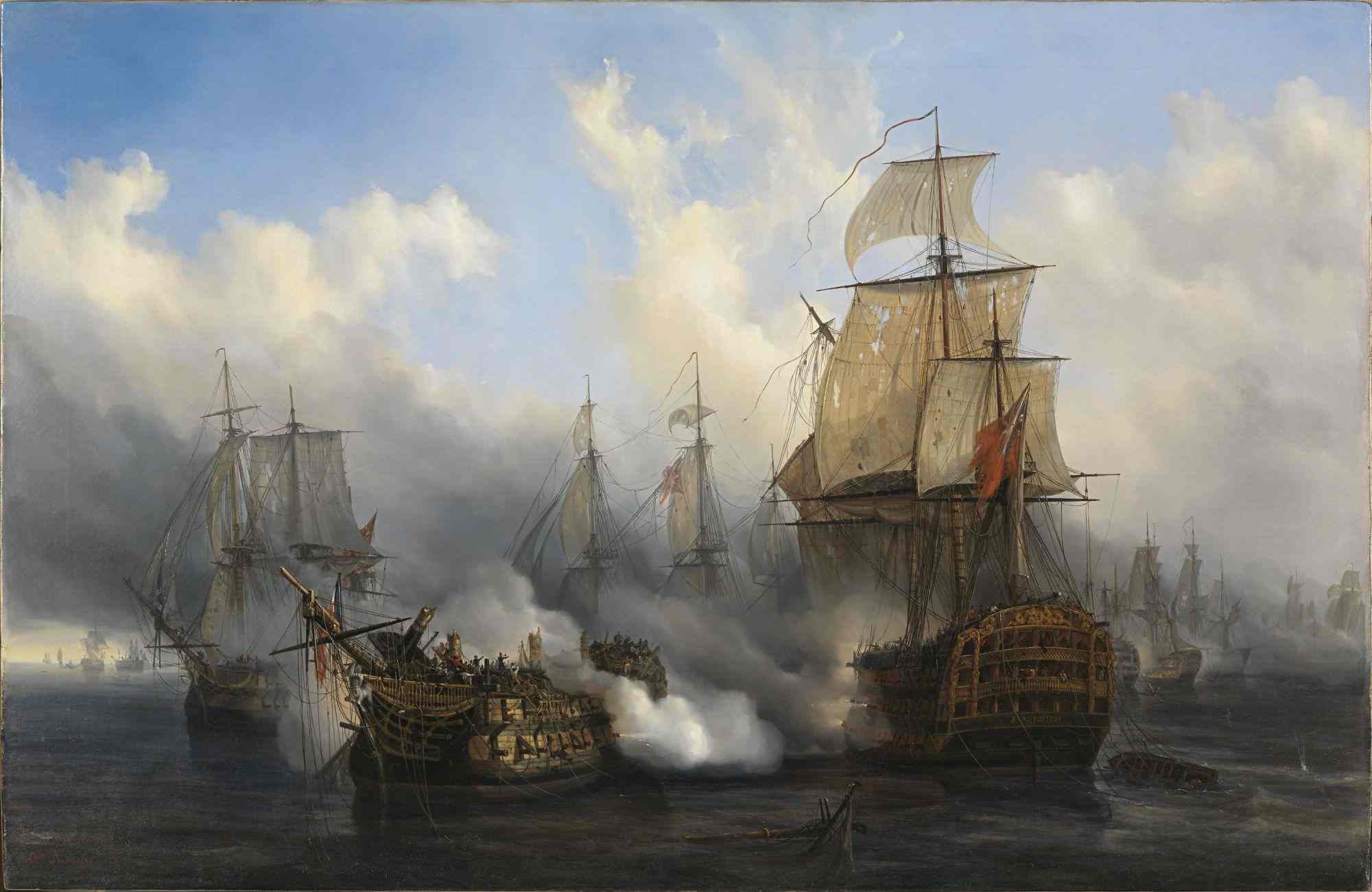
Battle of Trafalgar
"England expects that every man will do his duty." The signal flew from the mast of HMS Victory on the morning of October 21, 1805, as 27 British ships of the line bore down on a combined Franco-Spanish fleet of 33 vessels off Cape Trafalgar. The wind was light, the swell was heavy, and Admiral Lord Nelson was sailing his outnumbered fleet directly into the enemy's broadside -- a tactic so reckless that it either had to be genius or suicide. By nightfall, 18 allied ships had been captured or destroyed. Not a single British vessel was lost. And Nelson was dead.
Napoleon's Channel Gamble
The battle was born from Napoleon's ambition to invade Britain. By 1805, France dominated Europe on land, but the Royal Navy controlled the seas. Napoleon needed to wrest control of the English Channel long enough for his Grande Armee to cross from Boulogne. The plan was elaborate: Vice-Admiral Villeneuve would break out of Toulon with the Mediterranean fleet, link up with the Spanish fleet at Cadiz, lure the British across the Atlantic to the Caribbean, then double back and join the Brest fleet to sweep the Channel clear. Nelson chased Villeneuve to the West Indies and back, missing him by days. The plan unraveled when Villeneuve, losing confidence after an inconclusive engagement at Cape Finisterre, retreated south to Cadiz instead of sailing north to Brest. Napoleon abandoned the invasion scheme and marched east to fight Austria. But the fleet at Cadiz remained, and Nelson was coming.
Breaking the Line
Nelson's battle plan violated every convention of 18th-century naval warfare. Instead of forming a parallel line and trading broadsides -- the orthodox approach -- he divided his fleet into two columns and drove them perpendicular to the Franco-Spanish line. The leading ships would absorb punishing fire during the approach, unable to return it until they reached point-blank range. But once through, they would split the enemy fleet into isolated groups that could be overwhelmed piecemeal. Villeneuve had predicted Nelson might attempt exactly this, but his poorly trained crews and low morale made a coordinated response impossible. Nelson was characteristically blunt in his instructions to his captains: "No captain can do very wrong if he places his ship alongside that of the enemy." He ordered his ships painted in a distinctive yellow and black pattern -- the Nelson Chequer -- so they could tell friend from foe in the smoke and chaos of close combat.
Death on the Quarterdeck
HMS Victory, leading the windward column, endured 40 minutes of unanswered fire before reaching the Franco-Spanish line at 12:45. She cut between Villeneuve's flagship Bucentaure and the 74-gun Redoutable, unleashing a devastating raking broadside through Bucentaure's stern that killed or wounded up to 400 of her 800-man crew in a single volley. Victory then locked masts with Redoutable in a brutal close-quarters fight. It was during this engagement that a French musketeer in Redoutable's mizzentop shot Nelson through the left shoulder. The ball passed through his spine and lodged beneath his right shoulder blade. "They finally succeeded, I am dead," Nelson said as he was carried below. He lived three more hours, long enough to learn that the battle was won. His last confirmed words were "God and my country." Collingwood's column, meanwhile, had smashed into the allied rear, and the combined fleet disintegrated into isolated clusters of desperate fighting.
Preserved in Brandy, Remembered in Stone
When the guns fell silent, 18 Franco-Spanish ships had been taken as prizes and none of the British fleet was lost. Villeneuve was captured aboard his flagship. The Spanish Admiral Federico Gravina escaped with the surviving third of the fleet but died six months later from wounds sustained in the battle. A storm struck that night, and many damaged prize ships sank or were wrecked on the shoals near Cadiz. Nelson's body was preserved in a barrel of brandy for the voyage home to a hero's funeral. Villeneuve, paroled to France in 1806, was found dead in his inn room with six stab wounds from a dining knife; it was officially ruled suicide. Trafalgar confirmed British naval supremacy for a century, though ironically it had little impact on the wider war -- Napoleon won the Battle of Austerlitz less than two months later. London's Trafalgar Square, with Nelson atop his 52-meter monument, commemorates the victory. The battle itself is remembered less for its strategic consequences than for its human cost: the admiral who planned the impossible, executed it perfectly, and did not survive to see the signal flags lowered.
From the Air
Coordinates: 36.18N, 6.25W. Cape Trafalgar is a low headland on the Atlantic coast of southern Spain, between Cadiz to the southeast and the Strait of Gibraltar to the south. The battle took place about 21 miles northwest of the cape, in open Atlantic waters. Nearest airports: LERT (Rota Naval Base, 40 km north), LXGB (Gibraltar, 60 km southeast). The Strait of Gibraltar and the Moroccan coast are visible to the south.