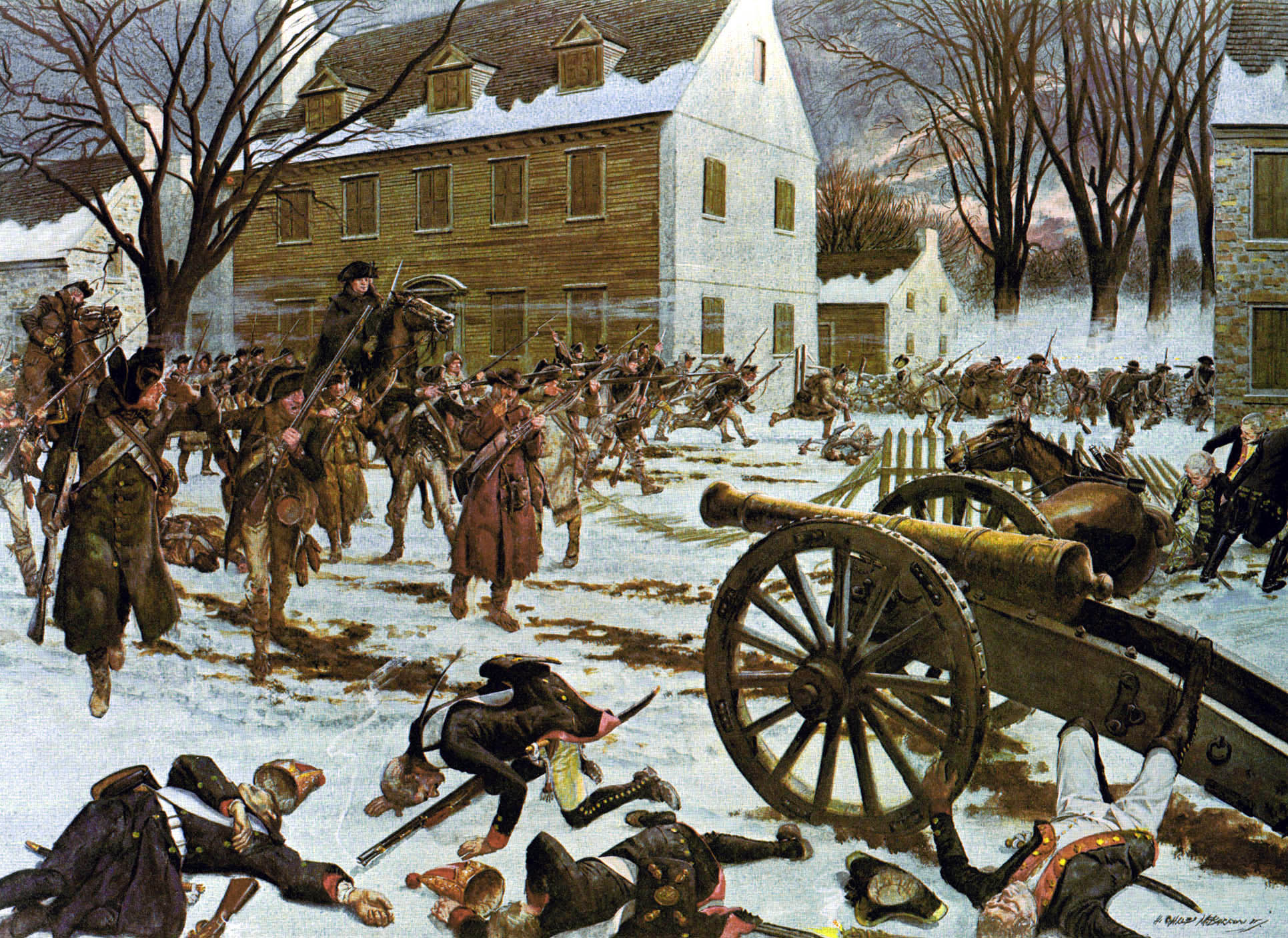
Battle of Trenton
Before Washington and his men boarded the boats, Benjamin Rush visited the general's tent and noticed a scrap of paper on the table. On it, Washington had written two words: "Victory or Death." It was not rhetoric. By late December 1776, the Continental Army was disintegrating. Defeated in New York, chased across New Jersey, reduced to a few thousand exhausted men huddled along the Pennsylvania bank of the Delaware River, the revolutionary cause was days from extinction. Enlistments expired at year's end. Washington needed a victory -- any victory -- before the army simply walked home. He chose to cross the ice-choked Delaware on Christmas night and attack the Hessian garrison at Trenton, New Jersey. What followed was one of the most consequential small battles in military history.
A Spy in the Butcher Shop
Washington had planned the Trenton attack with intelligence gathered from an unlikely source. John Honeyman, a butcher and bartender posing as a Tory loyalist, had been planted in Trenton as a spy. Honeyman traded freely with the British and Hessians, building trust while cataloguing their dispositions. He convinced the Hessian commander, Colonel Johann Rall, that the Continental Army was too demoralized to attack. Shortly before Christmas, Honeyman arranged to be "captured" by American soldiers who had orders to bring him to Washington unharmed. After a private interrogation, he was imprisoned in a hut -- and conveniently escaped when a small fire broke out nearby. Meanwhile, on Christmas Eve, Rall celebrated at the farm of Abraham Hunt, a Trenton merchant playing the role of friendly Loyalist host, feeding the colonel's false sense of security while Washington's troops assembled in the freezing darkness across the river.
Blood on the Snow
The plan called for three coordinated crossings: Cadwalader would feint at Bordentown, Ewing would seize the bridge over Assunpink Creek, and Washington's 2,400 men would cross nine miles north of Trenton and split into two assault columns. The weather destroyed the timetable. Rain turned to sleet, then to snow. The icy river delayed the crossing until three in the morning, three hours behind schedule. Cadwalader and Ewing never made it across at all. Washington was on his own with fewer than half the planned force. The army marched south through the storm, soldiers without boots wrapping rags around their feet. Some of the men's feet bled, staining the snow dark red. Two men died on the march from exposure. Washington rode up and down the line, urging his men forward. Near the town, they were startled by fifty armed men who turned out to be Americans -- a detachment under General Adam Stephen that had independently raided a Hessian outpost, nearly blowing the element of surprise.
Forty-Five Minutes
The Hessians had not sent patrols into the blizzard. At eight in the morning on December 26, Washington led the charge against a Hessian outpost on Pennington Road, riding in front of his soldiers. Lieutenant Andreas Wiederholdt stepped out of the cooper shop to find Americans firing volleys at him. Both Hessian detachments retreated in good order into Trenton, but the trap was closing. Sullivan's column entered from the south along the abandoned River Road and blocked the Assunpink Creek crossing, cutting off escape. American artillery formed at the heads of King and Queen streets -- the town's two main thoroughfares -- and poured fire down the length of both. Colonel Rall rallied his men and counterattacked toward the American flank, his brigade's band playing fifes and drums in the storm. His soldiers briefly recaptured two cannons before six American troops sprinted forward, seized the guns, and turned them back on the Hessians. Rall fell, mortally wounded. His formations shattered. The battle lasted roughly forty-five minutes.
The Haul That Saved an Army
The Hessians lost 22 killed, 83 wounded, and 896 captured -- nearly two-thirds of their garrison. American casualties were astonishingly light: two men dead on the march, five wounded in the fighting. Among the wounded was eighteen-year-old Lieutenant James Monroe, the future fifth President of the United States, who took a musket ball to the left shoulder that severed an artery. A battlefield surgeon, Doctor John Riker, clamped the artery and saved his life. Beyond the prisoners, the Americans captured the entire Hessian supply depot: tons of flour, dried and salted meats, ale, shoes, boots, clothing, and bedding -- provisions desperately needed by the ragged Continental forces. Washington reportedly shook a young officer's hand and said, "This is a glorious day for our country."
The Morning the Revolution Survived
Trenton was a small battle by any military measure -- a few thousand men on each side, less than an hour of fighting. But its consequences were enormous. A week earlier, the Continental Army had seemed on the verge of dissolution. The victory at Trenton proved the revolution was not a lost cause, inspiring soldiers whose enlistments were expiring to stay and attracting new recruits to the ranks. Washington, emboldened, would follow up with a victory at Princeton days later. Emanuel Leutze immortalized the crossing in his 1851 painting, now one of the most recognized works in the Metropolitan Museum of Art. Today, local enthusiasts reenact Washington's crossing of the Delaware every Christmas Day at Washington Crossing Historic Park, weather permitting. The spot where frozen, bleeding men launched a desperate gamble is now a quiet stretch of river between Bucks County, Pennsylvania, and Mercer County, New Jersey -- peaceful ground that once held the fate of a nation.
From the Air
The Battle of Trenton took place in what is now downtown Trenton, New Jersey, at approximately 40.226N, 74.765W. Washington's crossing point is about 9 miles north, at Washington Crossing Historic Park along the Delaware River. The Delaware River is clearly visible from altitude, winding between Pennsylvania and New Jersey. Trenton-Mercer Airport (KTTN) is approximately 5 nm to the northwest. Philadelphia International Airport (KPHL) is about 30 nm to the southwest. At 2,000-3,000 feet AGL, the river crossing site and the grid of downtown Trenton streets where the battle raged are identifiable landmarks.