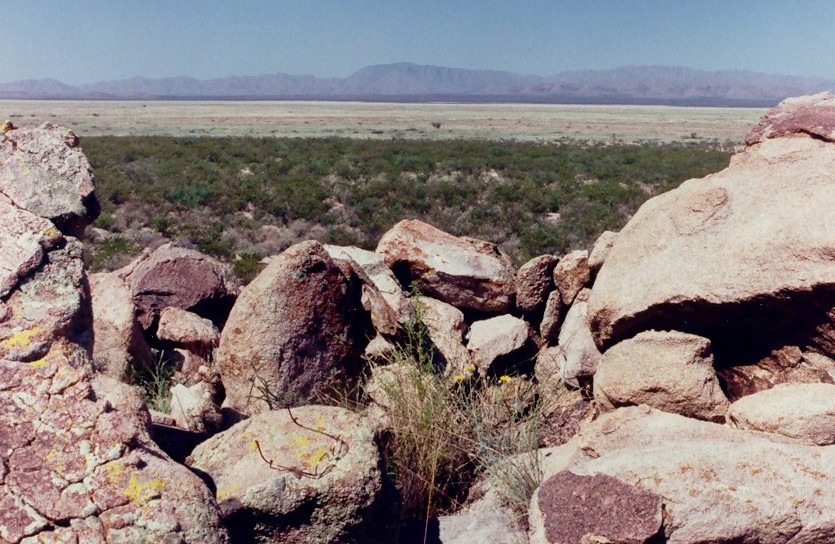
Battle of Tres Castillos
A single rifle cartridge. Archaeologists found it in a shallow cave on one of three rocky hills rising from the Chihuahua Desert, the only ammunition that remained when the last two Apache warriors fell silent on the morning of October 15, 1880. That lone cartridge tells the story of Tres Castillos better than any monument: a people fighting to the bitter end with nothing left to fight with. Here, on this austere desert plain with its ephemeral lake and three low rockpiles called the Three Castles, the Chiricahua Apache war chief Victorio chose to rest his exhausted band. His enemies, he reasoned, would search the mountain strongholds. They would never think to scour the open desert. He was wrong.
Fourteen Months of Fire and Flight
Victorio's War began in August 1879, when the veteran Chiricahua war chief led 80 warriors and their families from the Ojo Caliente reservation in New Mexico rather than submit to forced relocation to the barren San Carlos reservation in Arizona. Within months, his force swelled to nearly 200 warriors as Mescalero Apache joined his cause. For fourteen months, Victorio led a guerrilla campaign across southern New Mexico, western Texas, and northern Chihuahua that tied up several thousand American and Mexican soldiers and tribal scouts. He won most of his battles, slipping from one mountain stronghold to another like smoke through fingers. But Victorio had an Achilles heel: he needed ammunition, and the only way to get it was to trade stolen livestock or raid settlements. When the U.S. Army occupied the Mescalero reservation and cut off his supply lines, the noose began to tighten.
The Hunt Across the Desert
By late summer 1880, Victorio was running out of options. Colonel Benjamin Grierson and his Buffalo Soldiers of the 10th Cavalry had adopted a new strategy. Rather than chase the elusive Apache through mountains, Grierson guarded every spring, river crossing, and mountain pass, blocking Victorio's access to water and ammunition. Pushed back into Mexico, Victorio's force shrank as followers deserted, unable to endure the hardships. In early October, he sent his lieutenant Nana with a small party to raid for ammunition, then led his remaining people to Tres Castillos. Mexican Colonel Joaquin Terrazas was already hunting him with 350 men. On October 8, a Tarahumara scout reported fresh tracks heading toward the three distinctive hills. Terrazas dismissed his unreliable civilian volunteers and marched south with 260 hardened fighters. On October 13, he found the trail that led to Victorio's final camp.
Night Falls on the Three Castles
The Apache spotted the approaching Mexicans while they were still miles away. Thirty warriors rode out to contest their passage, killing a Tarahumara scout before realizing the overwhelming size of Terrazas' force. They retreated to the southernmost of the three rocky hills. By nightfall, the Mexicans had captured the Apache horse herd and surrounded the position. Some Apaches who had escaped the encirclement lit a fire to the south, trying to draw the Mexicans away—but after a brief skirmish, they fled into the darkness. Through the cold desert night, Victorio's people built rock defenses and retreated into caves. The Mexicans pressed their attack relentlessly. By morning, the Apache had exhausted their ammunition. The last two warriors held out in a cave for two hours before silence fell at 10 a.m.
Massacre or Battle
Scholar Dan L. Thrapp called Tres Castillos a massacre rather than a battle, given that the Apaches had almost no ammunition to resist. The toll was devastating: 62 warriors killed, including Victorio himself, along with 16 women and children. Sixty-eight women and children were captured and later sold into slavery in Mexico. Only three Mexican soldiers died. Whether Victorio fell to a Tarahumara sharpshooter named Mauricio Corredor or took his own life by stabbing himself remains disputed among Apache oral histories. The city of Chihuahua celebrated with a parade displaying the captives and the scalps of the fallen, while Apache children were distributed as servants to prominent families.
The End of an Era
Tres Castillos marked the end of large-scale Apache resistance in North America. Never again would Apache fighters assemble in such numbers or be so ably led. Nana and his 17 absent warriors took revenge, ambushing and killing nine Mexican soldiers before retreating to the Sierra Madre Occidental. The following year, he led a legendary raid into the United States, but it was a rearguard action, not a war of liberation. The principal Mexican commanders met violent ends: Mata Ortiz was killed in an ambush by the Apache leader Juh in 1882; Corredor died in 1886 in a confused firefight that also claimed the American scout Emmet Crawford. Only Terrazas died peacefully, in 1901. A monument to his victory was erected in Chihuahua City in 1910, the same year Mexico's own revolution began.
From the Air
Located at 29.967°N, 105.783°W in the Chihuahua Desert of northern Mexico, approximately 100 miles southeast of Ciudad Juarez. The site consists of three low rocky hills rising less than 100 feet above a flat desert plain—visible as distinctive landmarks against the otherwise featureless terrain. Nearest airports include Abraham Gonzalez International (MMCJ) in Chihuahua City, 150 miles south. The terrain is remote high desert with limited road access. Best viewed at 3,000-5,000 feet AGL in clear weather when the three rock formations cast distinctive shadows.