Battle of Triangle Hill
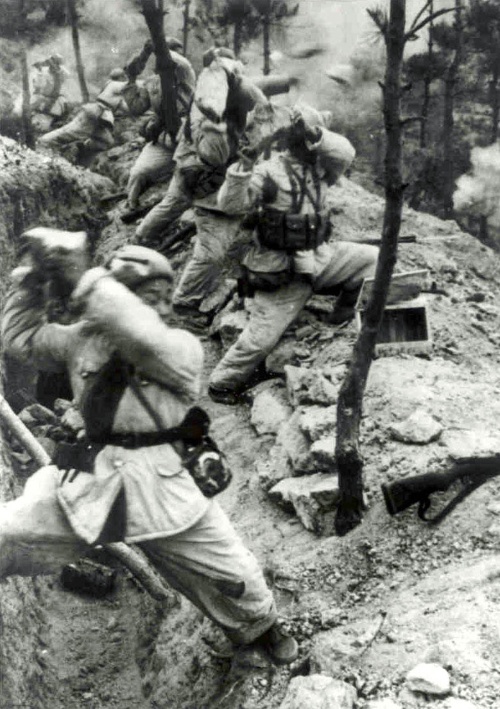
UN planners expected it to last five days and cost 200 casualties. Operation Showdown ground on for 42 days and consumed thousands of soldiers on both sides. The Battle of Triangle Hill, known in China as the Shangganling Campaign, began on October 14, 1952, as a limited operation to seize a forested ridge 2 kilometers north of Gimhwa-eup. It ended on November 25 with Chinese forces back in their original positions, the UN command forced to suspend all offensive operations larger than a battalion, and President Truman privately calling the battle a serious blow to morale.
A V in the Mountains
Triangle Hill earned its name from the V-shape it traced on aerial photographs. Hill 598 sat at the apex, overlooking the Gimhwa valley to the south. Two ridges extended northeast and northwest -- the northwestern one dominated by a peak nicknamed Pike's Peak, the other connecting to a pair of hills soldiers had dubbed Jane Russell. Across the valley stood Sniper Ridge. Together, these positions formed part of the Iron Triangle, the strategic zone that had defined the Korean War's central front since 1951. The Chinese 15th Corps held the hills with veteran troops who had excavated 9,000 meters of tunnels, plus extensive trenches, obstacles, and minefields. A ROK staff officer had defected to the Chinese before the battle carrying a complete copy of the UN attack plan, but the Chinese command did not take the intelligence seriously.
Into the Tunnels
The opening bombardment on October 14 stripped the foliage from Triangle Hill and destroyed most above-ground fortifications. But the defenders were underground. As US and ROK troops approached, they were met with grenades, Bangalore torpedoes, shaped charges, and rocks thrown from tunnel mouths. The 31st Infantry Regiment wore ballistic vests in one of the first mass deployments of modern body armor, but the fighting was at a range where such protection mattered less than the Chinese willingness to absorb punishment and counterattack after dark. Night after night, PVA assault troops charged through their own artillery screens to reach UN positions -- a tactic so desperate that American observers suspected the attackers were drugged, though no evidence supported this. The defending company on Sniper Ridge was reduced to 20 survivors before withdrawing into the tunnels.
The Calculus of Attrition
By late October, PVA acting commander Deng Hua recognized a strategic opportunity: if China could absorb the losses, the battle would exhaust American willingness to attack. On October 25, the 15th Corps was ordered to retake the hills "regardless of the cost." Fresh reinforcements arrived -- the 12th Corps was placed under 15th Corps command, 1,200 new recruits replenished shattered companies, and 67 heavy guns were brought forward. On October 30, the 15th Corps unleashed the largest Chinese artillery barrage of the war: 133 large-caliber guns, 22 rocket launchers, and 30 heavy mortars. Ten infantry companies swarmed the ROK positions after midnight and pushed them off the summit. The seesaw fighting continued for weeks, each side retaking and losing ground in a rhythm of bombardment and assault that consumed men and ammunition at a staggering rate.
The Battle That Ended the Offensives
On November 5, Lieutenant General Reuben Jenkins, commanding US IX Corps, suspended attacks on Triangle Hill. The Chinese had suffered an estimated 11,500 casualties, with many units nearly destroyed, but their ability to sustain such losses had slowly ground down the US Eighth Army. General Mark Clark, UN commander, suspended all offensive operations involving more than one battalion -- a prohibition that held for the rest of the war. No major UN offensive followed Triangle Hill. In China, the outcome was celebrated as a victory. Qin Jiwei, commander of the 15th Corps, became a national hero and eventually rose to Minister of Defense. The 15th Corps itself was selected to become China's first airborne corps in 1961 and remains one of the most elite units in the Chinese military. The battle demonstrated a grim arithmetic: a force willing to accept massive casualties can defeat a technologically superior enemy if that enemy's tolerance for losses is lower.
From the Air
Located at 38.32N, 127.46E in the Iron Triangle area of central Korea, near the current DMZ. The terrain is mountainous with forested ridges and narrow valleys -- the V-shaped ridge of Triangle Hill is characteristic of the area. Overflights near the DMZ are restricted. The Gimhwa valley lies to the south of the former battle positions. Nearest accessible airports include Seoul Air Base (RKSM) and Gimpo International (RKSS) to the southwest. The battlefield area is within or adjacent to the DMZ and inaccessible on the ground.