Battle of Tripoli (1911)
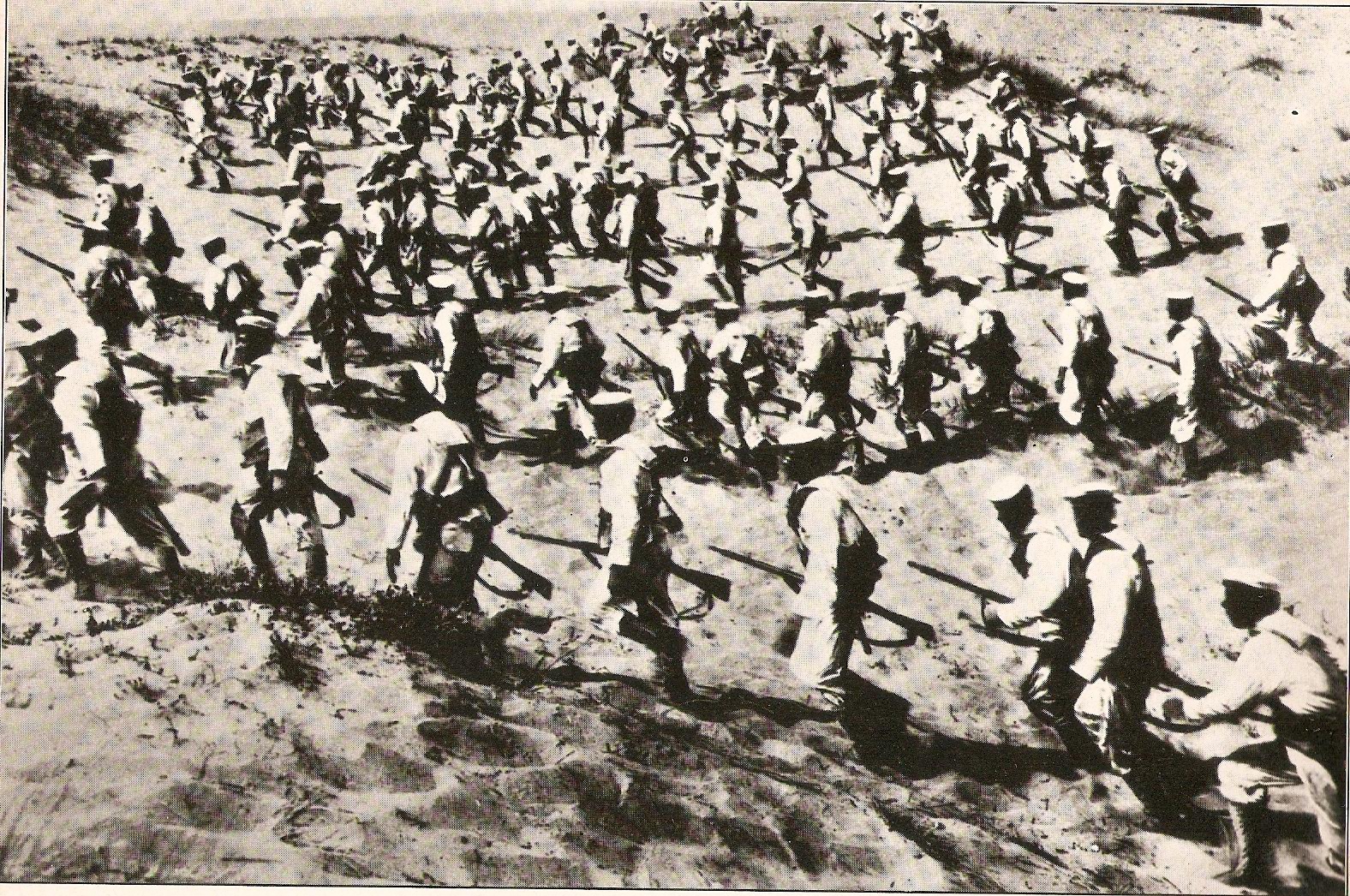
Captain Umberto Cagni had a problem. His sailors held the city of Tripoli, but the Ottoman garrison -- some two thousand soldiers who had withdrawn to positions just ten kilometers away -- outnumbered his landing force considerably. The army transports had not yet sailed from Naples and Palermo. So Cagni improvised: he ordered his troops to march continuously from position to position within the city, creating the illusion of a garrison far larger than the one he actually commanded. The ruse held for a week, long enough for reinforcements to arrive and swell the Italian force to 35,000 men. It was October 1911, and Italy had just begun its colonization of Libya.
An Empire Demands Its Share
The Kingdom of Italy declared war on the Ottoman Empire on 29 September 1911, the opening move in what would become the Italo-Turkish War. Italy's motive was blunt: colonial acquisition. An Italian naval squadron under Admiral Luigi Faravelli was dispatched to the Libyan coast, though Faravelli initially resisted orders to bombard Tripoli's forts, fearing retaliation against the roughly two thousand Europeans living in the city. Only the Italian citizens -- including a contingent of journalists, among them the renowned Luigi Barzini -- were evacuated aboard the warships. The consuls of neutral countries felt safe enough under Ottoman protection to stay.
Guns at Fifteen-Thirty
On 2 October, Faravelli summoned the Ottoman defterdar, Ahmed Bessim Bey, to his flagship and demanded surrender. Bessim Bey refused, stalling for time by claiming he could not reach Istanbul for instructions. Meanwhile, Colonel Neshat Bey quietly withdrew the Ottoman garrison from the city to positions at Aziziya, ten kilometers south. When the Italian squadron opened fire at 15:30 on 3 October, the battleship Benedetto Brin firing first, the forts were only partially manned. From 9,500 meters -- safely beyond the range of the defenders' guns -- the warships pounded the fortifications for nearly two hours. By 17:15, every Ottoman gun had fallen silent. The gunboat Seyyad was scuttled by her own crew during the bombardment. The following day, an Italian patrol found Fort Hamidiye abandoned; the German consul asked them to occupy the city to prevent looting.
A Thin Line Along the Harbor
The landing began at 07:30 on 5 October. Sailors from the battleship Sicilia went ashore first, occupying Fort Sultaniye without opposition. By noon the Italian flag flew over the fort; by late afternoon both regiments of the naval landing force had linked up in Tripoli's marketplace. But Cagni's position was precarious. He was a navy captain holding a city with naval infantry while the army was still loading ships in Italy. The numerically superior Ottoman forces sat just kilometers away. Cagni's marching trick bought critical time. Admiral Raffaele Borea Ricci d'Olmo, appointed provisional governor, meanwhile worked to establish cooperative relations with the city's Arab leadership. The existing Ottoman-appointed mayor, Hassan Karamanli, was confirmed in office and given the additional title of deputy governor.
Reinforcements and What Came After
The fragility of the Italian position became clear on the night of 9-10 October, when Ottoman troops and Libyan irregulars attacked Italian positions at the Bu Meliana wells, the city's primary water source. Gunfire from warships in the harbor repelled the assault. The armoured cruiser Varese and troopships America and Verona, the fastest ships in the inbound convoy, raced ahead to land 4,800 men on 11 October. The rest of the convoy arrived the following day. With 35,000 troops under General Carlo Caneva now in place, Cagni's naval personnel re-embarked. But the Ottoman garrison had not been destroyed -- it had retreated into the desert, beyond the reach of naval guns, and begun recruiting Arab volunteers. Within weeks, Ottoman and Arab forces would attempt to retake Tripoli at Sciara Sciat. They failed, and what followed was three decades of Italian colonial rule.
From the Air
Located at 32.89°N, 13.19°E along the harbor of Tripoli, Libya. The two main Ottoman forts -- Hamidiye to the east and Sultaniye to the west -- flanked the harbor entrance. Tripoli International Airport (HLLT) lies to the south, roughly where the Ottoman forces withdrew to Aziziya. Mitiga International Airport (HLLM) is east of the city center. Recommended viewing altitude: 5,000-8,000 feet to see the harbor and fort positions. The Mediterranean coast runs along the northern edge.