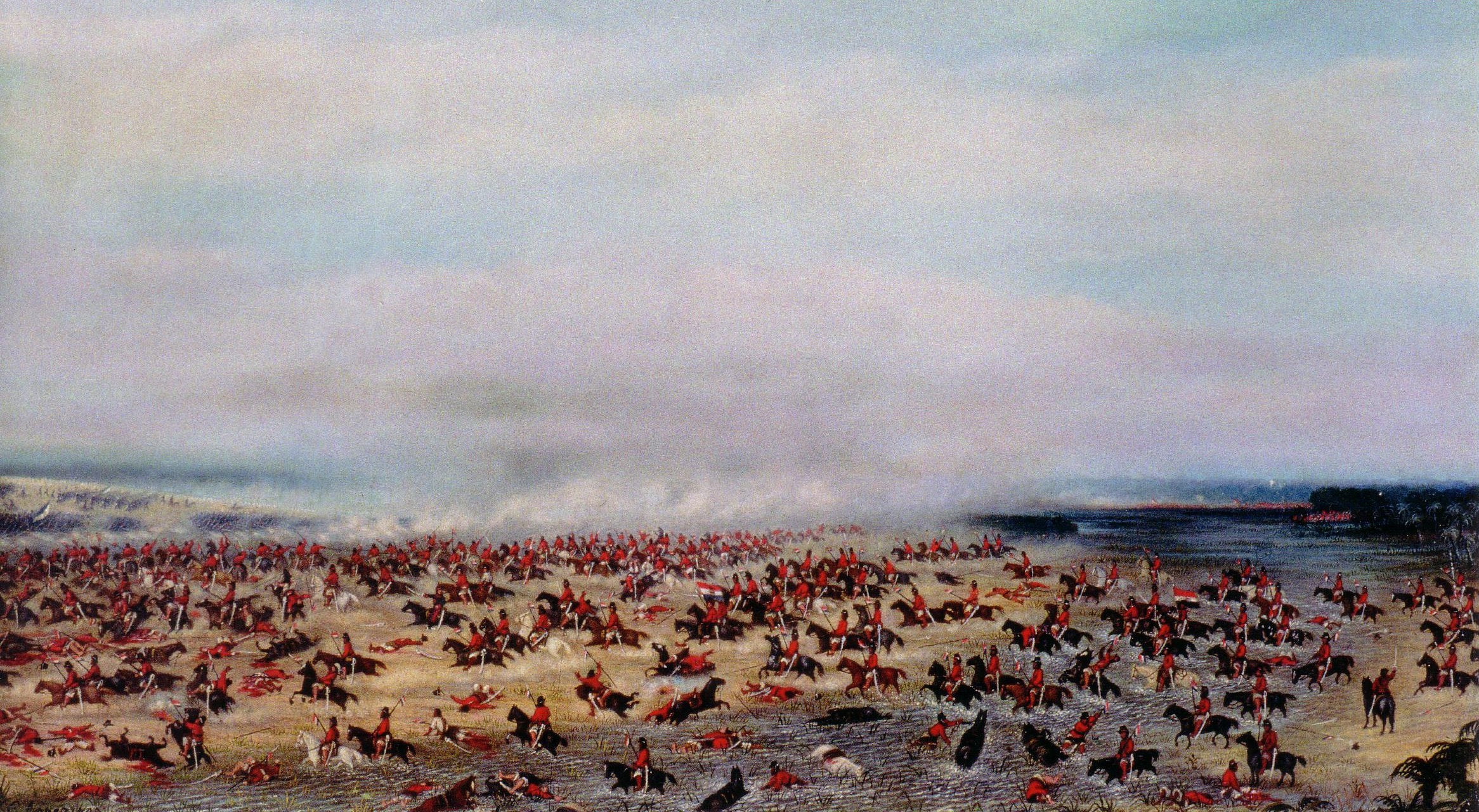
Battle of Tuyuti
A Congreve rocket arced across the sky at 11:55 on the morning of May 24, 1866. It was not aimed at anything. It was a signal. And with that hissing trail of smoke, more than 23,000 Paraguayan soldiers launched themselves at the allied encampment of Tuyuti in the largest battle South America has ever seen.
Three Columns, One Gamble
Marshal-President Francisco Solano Lopez divided his attacking force into three assault columns aimed at different sections of the allied camp. General Vicente Barrios led 8,000 infantry and 1,000 cavalry against the allied left, held by Brazilians under General Osorio. General Isidoro Resquin drove 7,000 cavalry and 3,000 infantry at the allied right flank. Colonel Jose Eduvigis Diaz struck the center with 6,000 infantry and 1,000 cavalry, targeting the Uruguayan vanguard division under General Venancio Flores. Behind them, Colonel Hilario Marco held 7,000 men and 48 cannons in reserve at Estero Rojas. It was an all-or-nothing assault designed to crush the allied armies before they could organize a deeper invasion of Paraguay.
The Breaking Point
The Paraguayan onslaught nearly succeeded. On the allied left, Barrios's infantry pushed the Brazilian defenders back so far that the attackers nearly reached the allied camp itself. Osorio threw in every available unit, finally committing General Joao Manuel Mena Barreto's 2nd Cavalry Division to stabilize the line. On the right, Resquin's cavalry routed the Argentine horsemen under generals Caceres and Hornos. In the center, Diaz's column charged into grapeshot range of the allied artillery but could not cross the killing ground. Attempting to circle the guns, the Paraguayans collided with Antonio Sampaio's 3rd Infantry Division. Sampaio shouted the order that would make him a patron saint of the Brazilian infantry: "Fogo, Batalhao!" -- Open fire, Battalion.
The Toll of a Single Afternoon
The casualty figures remain disputed to this day, which itself speaks to the scale of the carnage. Paraguayan colonel Centurion reported about 5,000 Paraguayan dead and 7,000 wounded. British engineer George Thompson, who served in the Paraguayan army, put the killed at 6,000. Other sources cite as many as 7,000 Paraguayans killed. Allied losses were somewhere between 3,600 and 4,000 killed and wounded, the majority of them Brazilian. Osorio's own report claimed more than 3,000 Paraguayan dead on the field, with Brazilian casualties at 412 killed and 2,003 wounded. Whatever the true numbers, the aftermath was ghastly. The allies buried their own dead but stacked the Paraguayan corpses in piles of 50 to 100, alternating layers of bodies and wood, and burned them. Thompson recorded that the Paraguayan soldiers were so lean from poor rations that their bodies would not burn.
A War Transformed
Tuyuti was the last major Paraguayan offensive of the war. Lopez's flanking maneuver had come terrifyingly close to working, but its failure cost him irreplaceable men and shattered his army's ability to take the initiative. The 10,000 surviving Paraguayans who had not been killed or seriously wounded were, in Thompson's words, "completely scattered and disorganised, and it was some days before they were again collected." The allies, for their part, were too exhausted and short of horses to pursue. They remained in their camp until September, rebuilding their own battered forces. From this point forward, Paraguay would fight a defensive war from prepared positions, and the conflict would grind on for nearly four more devastating years.
Patron Saints of an Army
Three men who fought at Tuyuti became the official patrons of the Brazilian Army's combat arms. Antonio de Sampaio, whose shouted command rallied the center, became the Patron of the Infantry. Manuel Luis Osorio, whose reinforcements saved the crumbling left flank, became the Patron of the Cavalry. Emile Mallet, whose guns tore apart the Paraguayan columns, became the Patron of the Artillery. Today a monument stands at the battlefield site in Paraguay's Neembucu Department, marking the ground where South America's bloodiest single day unfolded on a low ridge surrounded by marshland.
From the Air
Located at 27.20S, 58.55W in the Neembucu Department of southwestern Paraguay, near the Argentine border. The battlefield is on a low ridge surrounded by extensive wetlands and marshes. Nearest airports: Corrientes Airport (SARC) approximately 50 km south across the Parana River in Argentina, and Pilar Airport (SGPI) roughly 40 km west. The terrain is flat and marshy, with the battlefield visible as slightly elevated ground amid the surrounding esteros. Best viewed at 2,000-4,000 ft AGL.