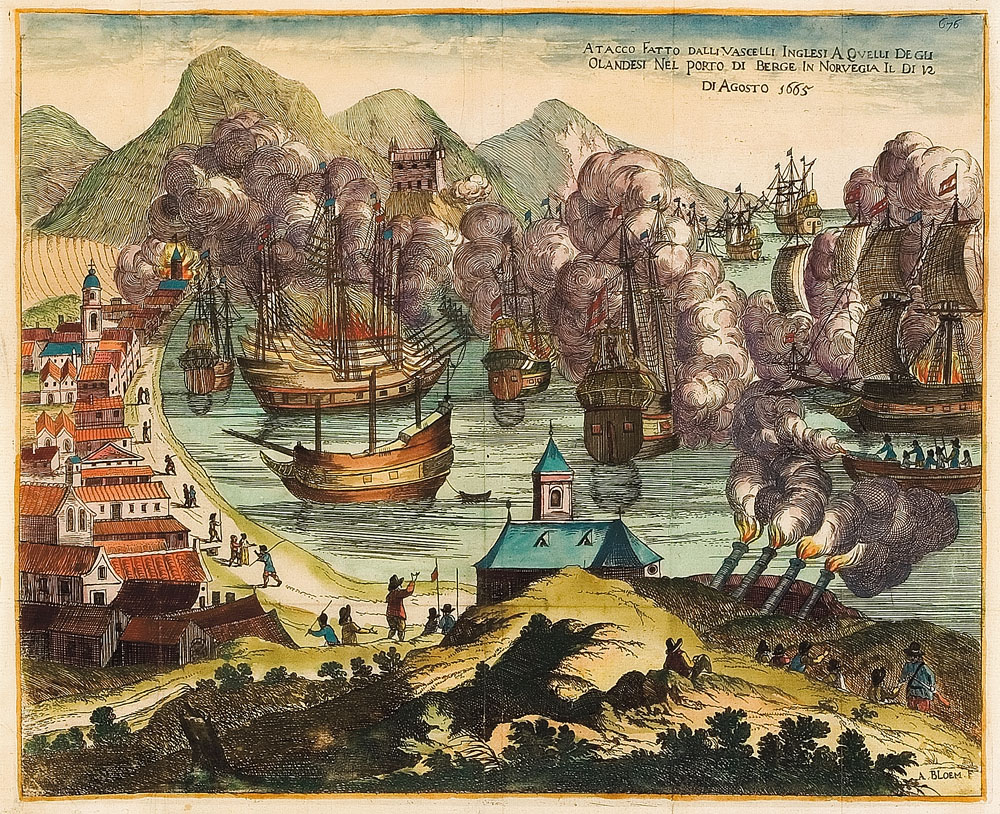
Battle of Vågen
Four million catties of pepper, three thousand raw diamonds, eighteen thousand pearls. In the summer of 1665, a Dutch East India Company fleet carrying the richest cargo ever assembled sat in Bergen's harbor, sheltering from English warships that controlled the Channel after their victory at Lowestoft. The total European market value exceeded eleven million guilders -- more than the entire annual revenue of the Danish-Norwegian crown. Two kings had secretly agreed to split the plunder. But the order authorizing the attack never arrived in time, and what followed was a morning of cannon fire, betrayal, and farce that changed the course of the Second Anglo-Dutch War.
A Fortune Afloat
The ten VOC ships had departed the East Indies on Christmas Day 1664, their holds packed with spices, silk, ebony, indigo, rubies, and porcelain. Commodore Pieter de Bitter commanded the convoy, which sailed north of Scotland to avoid the English Channel. Storms scattered the fleet in late June, and by late July most ships had gathered in neutral Bergen to await rescue by the rebuilt Dutch home fleet. The cargo values read like a merchant's fever dream: the Slot Hooningen alone carried goods worth 386,122 guilders. England's Lord Sandwich, commanding the fleet in the North Sea, learned of the convoy from a merchantman out of Rostock and made the fateful decision to split his forces. He dispatched Rear-Admiral Thomas Teddeman with a flotilla to Bergen, but eight of the original twenty-two warships sailed too far west and could not beat against the wind to rejoin.
The Deal That Arrived Too Late
Behind the scenes, King Charles II of England and King Frederick III of Denmark-Norway had struck a private bargain: the Danes would allow the English to attack the Dutch convoy, and the monarchs would split the treasure equally -- not for their national treasuries, but for their personal coffers. Frederick sent orders to his commander at Bergen, Claus von Ahlefeldt, instructing him to protest the English assault but take no action against it. The orders never reached Bergen in time. Worse, the English message telling Teddeman to wait was intercepted by the Dutch. When Teddeman sent the young courtier Edward Montagu ashore to negotiate cooperation, Ahlefeldt refused. Montagu bluffed about the fleet's size, claiming 2,000 cannon and 6,000 men -- roughly three times the truth. He even offered the Order of the Garter. The Norwegians were unimpressed. As Montagu rowed past the Dutch fleet on his way back, their musicians struck up the Wilhelmus, the Dutch national anthem, and saluted him with white smoke.
Four Hours in the Harbor
At six on the morning of August 2, cannon fire erupted across Vågen. The harbor entrance measured only 400 meters wide, and Teddeman could squeeze just seven warships into the gap. His flagship Revenge had already run aground the previous evening at Cape Nordnes, an ominous start. Southern winds drove the English gun smoke back into their own faces, blinding them; they fired high without realizing it, and most shots fell short of the Dutch line. When a stray English cannonball struck Bergenhus Fortress and killed four Norwegian soldiers, the fortress commander opened fire on the English -- the very allies Frederick had secretly promised would face no resistance. De Bitter had positioned his heaviest armed merchantmen 300 meters from the English line, and their broadsides proved devastating. After three hours, the English blocking ships were routed, their panicked crews cutting anchor ropes to flee. By ten in the morning, the English retreated to Herdla with 112 dead and 309 wounded. Among the fallen was Montagu himself, killed by the same cannonball that slew his companion George Windham as they embraced.
Knee-Deep in Nutmeg
The treasure fleet eventually escaped on August 29, though a hurricane scattered the convoy. Lord Sandwich managed to capture two VOC ships -- the Slot Hooningen and Gulden Phenix -- but the bulk of the cargo reached the Dutch Republic safely. The captured ships still held astonishing wealth. Samuel Pepys visited one and recorded the scene in his diary: pepper scattered through every crack underfoot, cloves and nutmeg piled above the knees in whole rooms, bales of silk and boxes of copper plate stacked in gorgeous confusion. Sandwich helped himself to goods worth around 4,000 pounds and distributed more among his officers. When this came to light, Charles had no choice but to cashier him. The failure to seize the full treasure fleet was a financial catastrophe for England, which needed the plunder to fund the war.
What the Walls Remember
Bergen Cathedral still carries a cannonball from the battle embedded in its tower wall, a small iron sphere lodged in stone for over three and a half centuries. Bergen Maritime Museum displays carved wooden figures from the English vessels -- a lion's head and a unicorn -- salvaged from the wreckage. The battle prompted construction of Fredriksberg Fortress on Nordnes, because, as historian Bjorn Arvid Bagge noted, the engagement showed clearly how vulnerable the city really was. In 2015, the 350th anniversary was marked with an exhibition titled Konger, krydder og krutt -- kings, spices, and gunpowder -- three words that capture the improbable convergence of royal greed, global trade, and naval violence that played out in Bergen's harbor on a smoky August morning.
From the Air
Located at 60.40N, 5.32E in Bergen's main harbor (Vågen). Bergen Airport Flesland (ENBR) is 18km south. From the air, Vågen is the narrow inlet between Bergenhus Fortress to the north and the Nordnes peninsula to the south. The harbor entrance is approximately 400 meters wide -- the bottleneck that shaped the battle. Bergen Cathedral is visible near the waterfront. Best viewed at 2,000-3,000 feet for harbor context. Expect frequent cloud cover and rain in this region.