Battle of Veracruz (1838)
It started with pastries. In 1837, a French cook named Remontel, established in the Mexico City suburb of Tacubaya, had his shop ransacked by drunken Mexican soldiers. His complaint joined a stack of grievances from the 6,000 French citizens living in Mexico -- a decade of killings, expropriations, and forced loans that the Mexican government showed no interest in addressing. France demanded 600,000 pesos in compensation. Mexico refused. What followed was a naval confrontation that military observers had traveled from around the world to watch, and whose results stunned every one of them: a small French frigate squadron, armed with a new type of explosive shell, reduced the fortress of San Juan de Ulua to rubble in a single afternoon. The conflict became known, with a mix of mockery and accuracy, as the Pastry War.
The Fortress That Could Not Fall
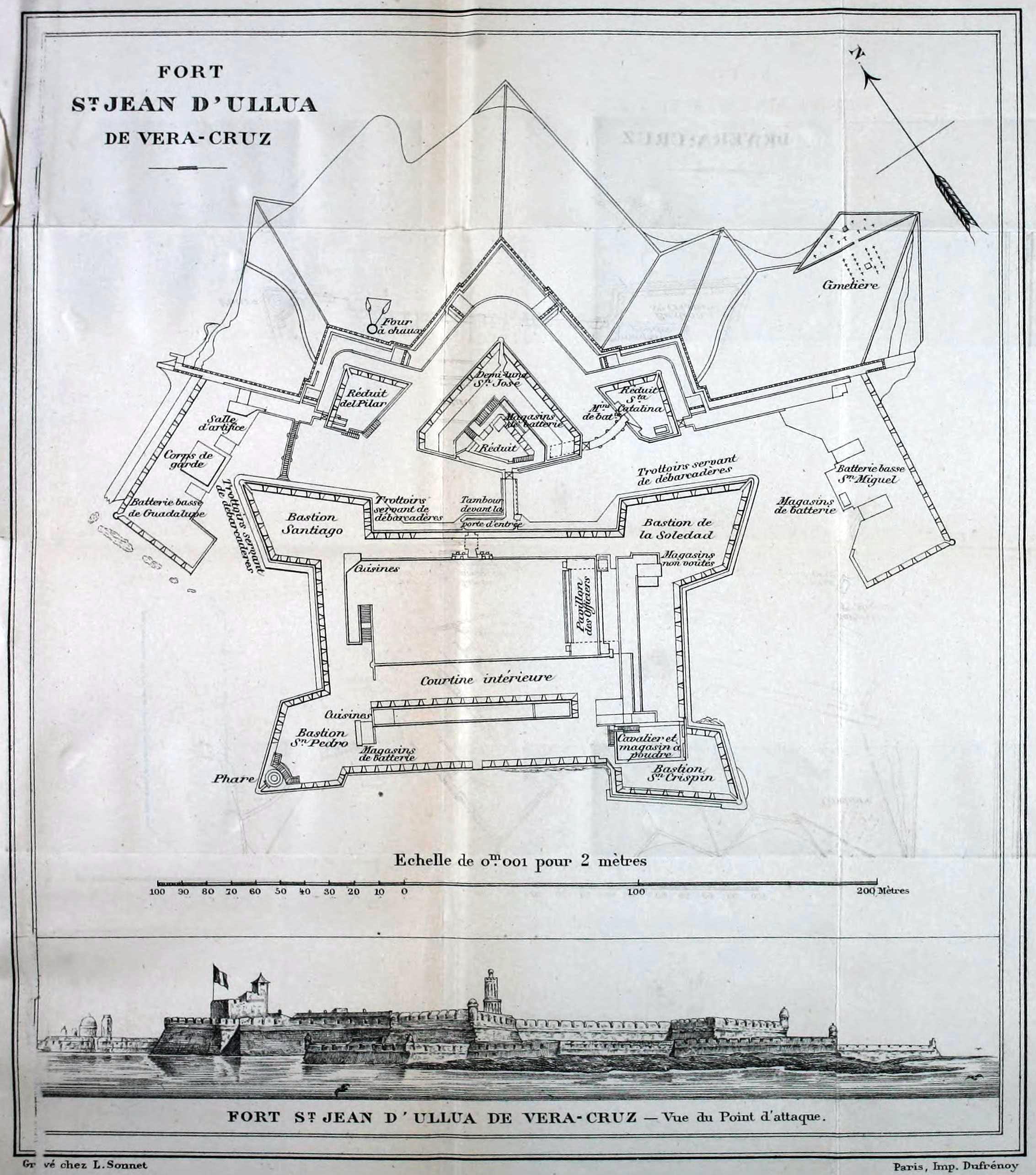
San Juan de Ulua sat on a reef about a kilometer from the city of Veracruz, guarding its harbor with 103 bronze and 83 iron cannons. The fortress had held off attackers for centuries -- it was the last Spanish stronghold to surrender during the Mexican War of Independence. No one expected a squadron of frigates to bring it down. Rear Admiral Charles Baudin arrived with his fleet in late October 1838 after sailing from Toulon. His force included four powerful frigates, two bomb ketches carrying heavy mortars, and two steamers to position the sailing ships. The backbone of his firepower was something new: Paixhans guns, naval cannons designed to fire explosive shells rather than solid shot. Diplomatic negotiations dragged on through November. The Mexicans hoped to exhaust the French, whose crews were already suffering from yellow fever. On November 26, Baudin formed his line of battle. The next afternoon, he sent a final message to the Mexican commander: "I find myself in the necessity to open hostilities."
An Afternoon of Explosions
At 2:30 on November 27, the three frigates opened fire, followed by the bomb ketches. The corvette Creole, commanded by the 20-year-old Prince de Joinville -- third son of King Louis-Philippe -- requested permission to join the fight and took a position in front of the larger ships. When a Mexican cannonball smashed through the prince's cabin and shattered his dinner service, Joinville reportedly doffed his hat and saluted the defenders. The gallantry was short-lived. Two powder depots inside the fort exploded in rapid succession. The signaling tower followed, erupting in a mushroom cloud of smoke and debris that was later depicted in paintings across Europe. A fourth explosion came around 5:10 in the evening. By nightfall, the fortress had lost over 220 men and nearly all its ammunition. The French had suffered four killed and 29 wounded. By dawn on November 28, the fortress and the city had surrendered. Neutral warships from several nations, anchored nearby to observe, carried the news back to their governments: the age of the stone fortress was over.
The Raid and Santa Anna's Leg
Mexico's government responded to the fall of San Juan de Ulua by declaring war, expelling all French citizens, and dispatching an army of 3,200 men under Generals Santa Anna and Mariano Arista to retake Veracruz. Baudin countered with a pre-dawn raid on December 5. Fifteen hundred sailors and soldiers landed on the beaches and split into three columns. Two wings scaled the city walls and sabotaged the cannons without firing a shot. The central column, under Joinville, blew open the harbor gate and reached the Mexican headquarters -- but Santa Anna escaped, though Arista was captured. As the French retreated to their boats, Santa Anna led a counterattack. The French responded with grapeshot from captured cannons and the carronades on their launches. Santa Anna had his horse killed beneath him and took a wound so severe that his left leg was amputated the next day. The wound destroyed his body but resurrected his reputation. Previously discredited by the loss of Texas, Santa Anna cast himself as a wounded hero. His leg was buried with full military honors. He seized power in a coup four months later.
The World Takes Notice
Lord Wellington reportedly told Parliament that the fall of San Juan de Ulua was the only recorded instance of a strong fort overwhelmed entirely by a naval squadron. Admiral David Farragut, observing for the United States, filed a detailed report on the effects of the explosive shells. The frigates had fired 7,771 solid round shots but only 177 Paixhans shells -- yet those shells, along with 302 mortar bombs from the bomb ketches, had done the decisive damage. The steamers, fitted with modest 100-horsepower engines, had proven their worth by towing the frigates into optimal firing positions regardless of wind. The tactical lessons were clear: explosive shells could breach masonry that solid shot could not, and steam power freed warships from dependence on the wind. These innovations would transform naval warfare over the next two decades, culminating in the ironclad battles of the Crimean War. A peace treaty was signed on March 9, 1839. France got its 600,000 pesos. Baudin was promoted to Vice-Admiral. The squadron sailed home to Brest, having lost 24 men to yellow fever -- far more than it lost to Mexican guns.
From the Air
Located at 19.209N, 96.131W, at the harbor of Veracruz on the Gulf of Mexico coast. The fortress of San Juan de Ulua sits on a reef approximately one kilometer offshore from the city center and is clearly visible from altitude as a large stone fortification on a small island. The city of Veracruz extends along the coast behind it. Veracruz International Airport (MMVR) is approximately 10 km south of the city center. Expect tropical maritime conditions with afternoon sea breezes; visibility generally good but afternoon convection and haze possible. The Gulf of Mexico stretches to the east.